SNDK Stock Crashes 11% as CXMT IPO Revives China NAND Competition and Margin Fears
SanDisk stock SNDK plunges 11% as CXMT’s blockbuster IPO fuels fears that Chinese capacity could pressure NAND prices and margins.
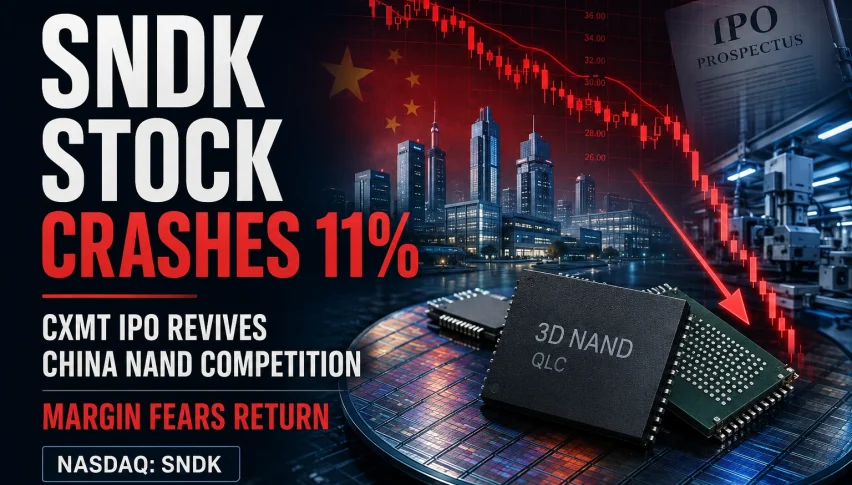
SanDisk shares fell 11.02% to $1,278 before sliding toward $1,212 overnight, as China’s memory-chip expansion raised new concerns about NAND competition, oversupply and the sustainability of elevated profit margins.
SNDK Stock Falls Toward $1,200 as China Memory Expansion Overshadows AI Storage Demand
SanDisk shares suffered another aggressive decline as investors reassessed the long-term threat posed by China’s expanding semiconductor-memory industry.
SNDK fell $158.33, or 11.02%, to close at $1,278.23 after trading as low as approximately $1,222. Shares then declined another 5.16% to around $1,212.31 in overnight trading, placing the stock at its weakest level since early May.
The immediate catalyst was the spectacular Shanghai debut of ChangXin Memory Technologies, or CXMT.
The Chinese DRAM manufacturer surged 466% during its first session after raising approximately $8.6 billion in the largest semiconductor offering in mainland China’s history.
CXMT does not currently compete directly with SanDisk’s core NAND flash business. However, the scale of its listing demonstrated how quickly Chinese chipmakers can access capital, expand production and attract domestic investor support.
That prospect has revived concerns that Chinese capacity could eventually pressure NAND prices and weaken the unusually strong margins enjoyed by global memory producers.
CXMT IPO Sends a Warning Across Memory Stocks
CXMT’s shares closed their first trading session with a market capitalization near $487 billion, briefly making the company the most valuable business listed in mainland China.
The valuation does not necessarily reflect the company’s current technological position or financial scale. Nevertheless, the listing provides CXMT with substantial access to capital as it expands production and develops more advanced memory products.
CXMT specializes in dynamic random-access memory, or DRAM, used in smartphones, computers, servers and other electronic devices.
SanDisk primarily produces NAND flash, which stores data in solid-state drives, smartphones, consumer devices and enterprise systems.
The difference means CXMT is not an immediate direct threat.
However, memory markets are closely connected. Large increases in Chinese DRAM supply can influence investor expectations for pricing, capital discipline and competition across the broader industry.
The concern is that China’s state-supported expansion will not stop with DRAM.
YMTC Represents the More Direct NAND Threat
Yangtze Memory Technologies, or YMTC, presents a more direct competitive risk to SanDisk.
YMTC is China’s leading NAND flash manufacturer and has filed for a domestic initial public offering. A successful listing could provide additional capital for technology development and production expansion.
Commodity NAND has lower barriers to customer switching than highly specialized memory products. Buyers often focus heavily on price, capacity, performance and reliability.
This makes additional low-cost production potentially disruptive.
If YMTC and other Chinese companies increase output aggressively, the NAND market could move from tight supply toward oversupply. That would place pressure on average selling prices and reduce margins for SanDisk, Kioxia, Samsung and other established manufacturers.
China’s progress in domestic semiconductor equipment adds another layer of risk.
Greater access to locally manufactured tools could make it easier for Chinese memory companies to expand despite Western export controls. However, matching the yields, quality and scale of established producers will still require significant time and investment.
SanDisk Selloff May Be an Overreaction
The magnitude of SanDisk’s decline suggests investors may be pricing in a threat that has not yet fully materialized.
CXMT manufactures DRAM rather than NAND. Its public listing does not suddenly give it the technology, customers or production yields required to compete directly with SanDisk.
Even YMTC’s expansion would need to overcome restrictions, technical challenges and the difficulty of producing advanced flash memory profitably at scale.
Meanwhile, NAND demand remains strong.
Artificial intelligence data centers require enormous storage capacity for model training data, inference workloads, checkpoints and rapidly expanding enterprise datasets.
Cloud computing, smartphones and higher-capacity consumer devices provide additional sources of demand.
If AI infrastructure continues expanding faster than memory supply, SanDisk could retain significant pricing power despite Chinese investment.
However, memory stocks are highly sensitive to expectations rather than current conditions. The possibility of future oversupply can pressure valuations long before additional production reaches the market.
BiCS10 Strengthens SanDisk’s Technology Position
SanDisk and long-term manufacturing partner Kioxia recently began sampling their BiCS10 1-terabit triple-level-cell 3D NAND product.
The new architecture uses 332 active memory layers and delivers density above 29 gigabits per square millimeter. It also supports data-transfer speeds of approximately 4,800 megatransfers per second.
These improvements are intended to provide greater capacity, stronger power efficiency and higher performance for data-intensive workloads.
BiCS10 could support future enterprise solid-state drives with capacities reaching hundreds of terabytes, creating an important opportunity in AI and hyperscale storage.
Production is expected at Kioxia’s Fab 2 facility in Kitakami, Japan, while earlier-generation BiCS9 products continue to be manufactured at the Yokkaichi complex.
This roadmap gives SanDisk a technological defense against lower-cost competition.
However, technical leadership must translate into strong yields and competitive manufacturing costs. If the transition is delayed or more expensive than expected, Chinese competitors could gain additional time to narrow the gap.
Memory Cycle Creates a Difficult Investment Test
SanDisk’s stock has benefited from rapidly rising memory prices and expectations for strong AI-related storage demand.
Memory pricing reportedly increased several times over during the past year as constrained supply met growing demand across data centers and consumer devices.
This environment supported unusually strong profitability.
However, high prices encourage manufacturers to add capacity. When too much new supply enters the market, average selling prices can fall quickly and margins can contract.
The potential arrival of additional Chinese production makes this traditional boom-and-bust pattern more dangerous.
SanDisk must balance investment in new technology against the risk of expanding during the peak of the cycle.
The company also depends on a relatively concentrated group of hyperscale customers for high-value enterprise products. Large contracts can improve revenue visibility, but they may also give customers greater negotiating power if market conditions weaken.
August 5 Earnings Become SanDisk’s Next Major Catalyst
SanDisk will report fiscal fourth-quarter and full-year 2026 results on August 5, followed by an investor day on August 13.
The earnings report could determine whether the latest selloff represents an overreaction or the beginning of a deeper revaluation.
Investors will focus on NAND pricing, enterprise SSD demand, backlog, gross margin and the company’s outlook for AI-related storage.
Management’s comments regarding China will also be important.
Any evidence that Chinese competition is affecting pricing or customer behavior could reinforce the bearish narrative. Conversely, strong demand and stable margins could support a sharp rebound from oversold levels.
SanDisk will also need to discuss the BiCS10 ramp, production yields and expected capital expenditure.
The market is likely to reward evidence that premium enterprise products can protect profitability even if commodity NAND becomes more competitive.
SNDK Technical Outlook Turns Deeply Bearish
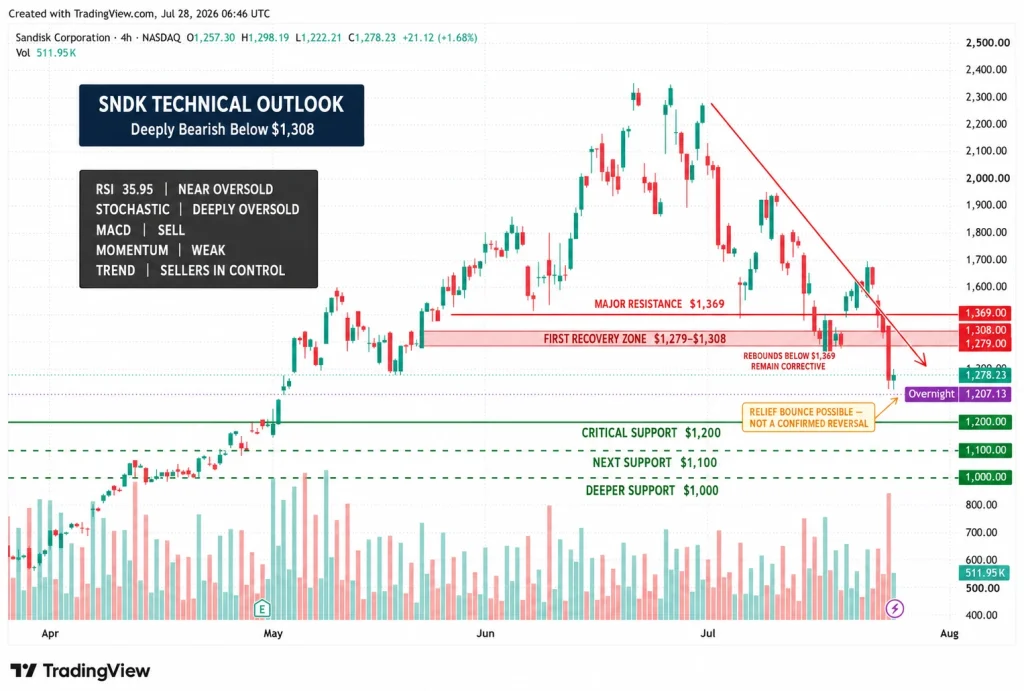
SanDisk’s four-hour chart remains firmly bearish, with the overnight price near $1,212 below every major moving average.
The psychological $1,200 level is the immediate support. A decisive break could expose $1,100 and potentially $1,000. On the upside, SNDK must recover the Hull moving average near $1,279 and the 200-period SMA at $1,308 to stabilize, while $1,369 represents the next major resistance.
RSI at 35.95 and deeply oversold stochastic readings suggest the selloff is stretched and could produce a relief rebound. However, the negative MACD and weak momentum confirm that sellers remain in control.
For now, any rebound below $1,308–$1,369 would remain corrective rather than signal a confirmed trend reversal.
SanDisk Faces a Critical China and Earnings Test
The selloff in SanDisk reflects a legitimate long-term risk, but the immediate trigger is indirect.
CXMT is a DRAM producer, while SanDisk specializes in NAND. The more direct competitive threat comes from YMTC and other Chinese manufacturers that could use domestic capital markets to expand flash-memory capacity.
SanDisk still has important strengths, including advanced BiCS10 technology, exposure to AI data-center storage and a partnership with Kioxia that supports large-scale production.
However, the market is no longer willing to assume that current memory shortages and elevated margins will last indefinitely.
For now, SNDK remains technically bearish below $1,308, while oversold indicators suggest the possibility of a short-term recovery.
The August 5 earnings report will provide the next major test. Strong pricing, stable margins and confidence in enterprise demand could help the stock rebound. Any sign that Chinese expansion is accelerating the arrival of another NAND downturn could push SanDisk below $1,200 and toward deeper support.
- Check out our free forex signals
- Follow the top economic events on FX Leaders economic calendar
- Trade better, discover more Forex Trading Strategies
- Open a FREE Trading Account
- Read our latest reviews on: Avatrade, Exness, HFM and XM

Related Articles


Sidebar rates

Related Posts
 Save
SaveAva