WTI Crude Oil Price Forecast Today: USOIL Holds $81 Support as Iran Talks Ease Supply Fears, July 28
Crude oil futures declined on Tuesday, as U.S. and Iran officials resumed high-level talks. Traders sold some of the geopolitical risk...

Crude oil futures declined on Tuesday, as U.S. and Iran officials resumed high-level talks. Traders sold some of the geopolitical risk premium they had priced into crude during the last few weeks. However, Gulf shipping disruptions and tight physical supplies still support crude.
US-Iran Talks Trigger Sharp Pullback in Oil Prices
West Texas Intermediate (WTI) crude oil fell to $81.16 a barrel on Tuesday, a drop of 1.76%, after losing almost 8% on Monday. President Donald Trump said Washington and Tehran are having “good talks,” raising hopes that the conflict could move towards a diplomatic resolution after weeks of military escalation.
Despite some relief from the threat of an imminent military supply disruption, there is no guarantee that any military action would stop, as Washington has cautioned that its strikes could resume if the talks do not go well, and Iran has signaled that it would retaliate if it was attacked. Geopolitical headlines will be a key focus for oil prices this week.
Shipping Disruptions Continue Despite Diplomatic Progress
The dip in oil prices is due to reduced geopolitical concern, but overall energy shipments haven’t returned to normal levels.
Net crude and refined-product exports via the Strait of Hormuz averaged only 2.9 million bpd during the week ended July 24, according to Barclays. A week earlier, such exports averaged 5.9 million bpd. This suggests that physical exports are still well below the normal rate despite the improved diplomatic mood.
Moreover, security risks are now shifting toward the Red Sea. Iran-backed Houthi rebels have continued to threaten ships near the Bab el-Mandeb Strait and Saudi oil facilities, which has forced some tankers to reroute via Africa, increasing shipping costs and delivery times. Saudi Arabia also recently destroyed drones aimed at its oil facilities, indicating that supply disruptions in the region are still possible.
Loadings at the Caspian Pipeline Consortium’s Black Sea export terminal have resumed after being suspended for a week due to a Ukrainian drone strike, further easing supply concerns. The resumption of Kazakh crude shipments provides refiners with another source of supply, making up for some of the lack of Middle Eastern oil.
OPEC+ Supply Growth Meets Softer Demand Expectations
Worse, the broader supply picture has taken on a bearish tone.
Earlier this month, OPEC+ agreed to increase production targets by another 188,000 bpd from August, lifting the total announced increase since April to nearly 800,000 bpd. It is likely to discuss yet another output increase at its next meeting on 2 August as it seeks to progressively reduce the voluntary curbs first adopted in 2023.
For now, demand expectations have taken a back seat. OPEC recently revised down its 2026 global oil demand growth forecast to 780,000 bpd, the third consecutive cut, while the IEA continues to caution that softer economic conditions and higher energy bills are taking a toll on consumption.
Wednesday’s EIA inventory report will be closely watched after a Reuters survey indicated US crude stocks likely fell last week, but distillate inventories rose. Another stock draw could help stabilise prices around current levels, while a broader build would raise concerns over weakening demand.
WTI Crude Oil Price Forecast: Can Bulls Hold the $81 Support Zone?
WTI crude is attempting to stabilise following a sharp three-day correction from $93.58. Buyers are defending the confluence of the 200-period EMA at $81.29 and horizontal support at $81.03. While momentum has cooled, the overall ascending channel supporting July’s uptrend remains largely intact.
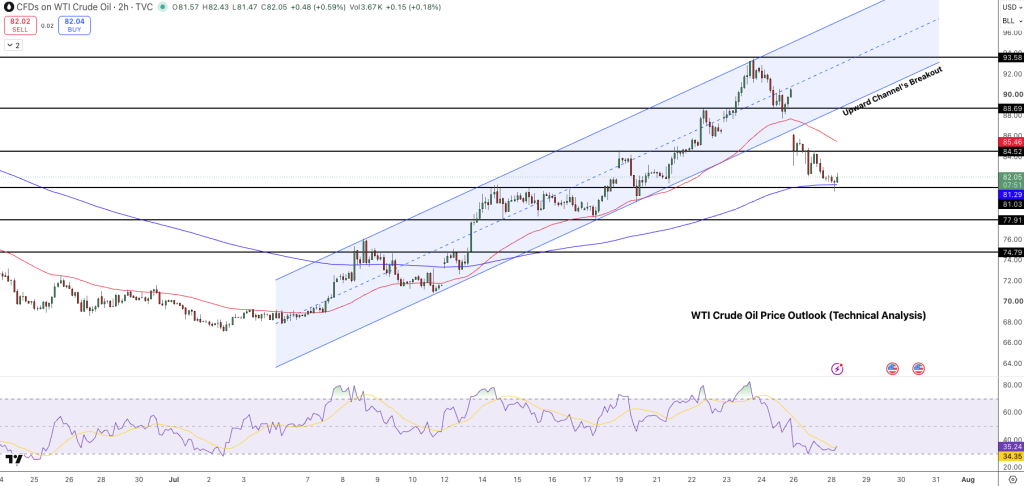
The 50-period EMA at $85.46 acts as overhead resistance, while the RSI near 35 indicates bearish pressure is easing as the market approaches oversold levels. Previous RSI readings in the current advance have drawn in new buying.
If bulls can maintain control above $84.52 and breach the 50 EMA at $85.46, the bullish view would gain further traction and the path to $88.69 would open, with scope for another challenge of the $93.58 high.
Failure to defend the $81.00 level would undercut the current setup and could lead to a further slide toward $77.91 and then $74.79.
Resistance: $84.52, $85.46, $88.69, $93.58
Support: $81.03, $81.29, $77.91, $74.79
Trading Set-up
Bullish: Buy when the market recovers above $85.46. TP1: $88.69 TP2: $93.58 SL: Under $81.00
Bearish: A confirmed close under $81.00 could see further decline to $77.91 and then $74.79.
Frequently Asked Questions (FAQs)
Why is WTI crude oil dropping today?
WTI is trading lower as positive developments in U.S.-Iran talks ease concerns over an imminent disruption in supply. This, in turn, is prompting traders to take profits on some of their long positions that had gained from higher geopolitical tensions over the past few weeks. (reuters.com)
Can oil prices bounce back even if talks persist?
Yes, they can. Traffic through the Strait of Hormuz is still low and there have been several threats against ports and ships in the Red Sea. Any interruption in oil exports from the region would lead to an upward movement in the price of crude. (reuters.com)
What will be the next trigger for WTI crude oil?
The next event to watch out for is the EIA inventory data released on Wednesday, followed by the next OPEC+ meeting on August 2. Oil inventories and any decision to increase output will be instrumental in keeping crude prices above the critical $81 support level. (reuters.com)
- Check out our free forex signals
- Follow the top economic events on FX Leaders economic calendar
- Trade better, discover more Forex Trading Strategies
- Open a FREE Trading Account
- Read our latest reviews on: Avatrade, Exness, HFM and XM

Related Articles



Sidebar rates

Related Posts
 Save
Save