STX Stock Falls Toward $782 as Seagate’s Q4 Earnings Put AI Storage Boom and HAMR Growth to the Test
Seagate stock STX falls toward $782 before earnings as investors test AI storage demand, HDD pricing, margins and the Mozaic HAMR ramp.
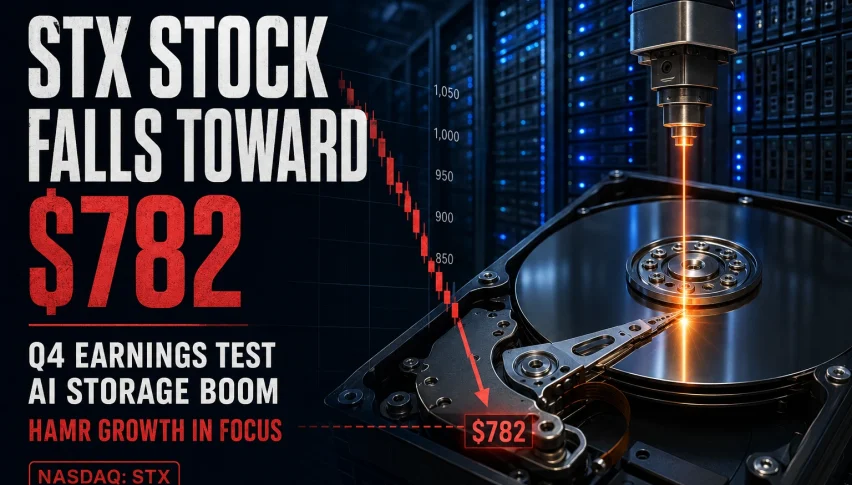
Seagate stock fell toward $782 before its fiscal Q4 report, as strong AI storage demand and rising HDD prices struggled to offset valuation concerns and weakening technical momentum.
Seagate Earnings Could Trigger a 12% Move as Investors Watch Nearline Demand and Fiscal 2027 Pricing
Seagate Technology enters its fiscal fourth-quarter earnings report under significant selling pressure despite continued optimism surrounding artificial intelligence storage demand.
STX fell $34.70, or 4.07%, to $816.99 before sliding another 4.25% to approximately $782.29 in pre-market trading.
The pullback reflects broader weakness across AI-related semiconductor and storage stocks. It also shows that investors are becoming more cautious after Seagate’s exceptional rally earlier in the year.
The stock has roughly tripled during 2026, although it has fallen around 30% from its recent high. That combination leaves Seagate in a difficult position ahead of earnings.
Strong results and guidance may already be expected, while any weakness in pricing, margins or hyperscaler demand could produce an outsized negative reaction.
Options markets are pricing a move of approximately 12% in either direction by the end of the week, potentially pushing STX back above $900 or down toward $700–$720.
Wall Street Expects Another Quarter of Rapid Growth for Seagate
Seagate will report fiscal fourth-quarter and full-year 2026 results after the U.S. market closes on Tuesday, July 28.
Analysts expect adjusted earnings of approximately $5.10 to $5.12 per share, representing growth of nearly 97% from the previous year.
Revenue is forecast near $3.49 billion to $3.5 billion, an increase of more than 40%.
Those estimates are slightly above Seagate’s own guidance of $3.45 billion, plus or minus $100 million, and adjusted earnings of $5 per share, plus or minus $0.20.
The expectations reflect rising nearline hard-drive shipments, improved pricing and a richer product mix.
Seagate exceeded the high end of its guidance during the fiscal third quarter, reporting revenue of $3.11 billion and adjusted earnings of $4.10 per share.
Gross margin reached a record 47% on an adjusted basis, while the company generated approximately $953 million in free cash flow.
Another beat would reinforce the argument that Seagate has entered a stronger and more profitable phase of the hard-drive cycle.
However, investors may require an optimistic fiscal 2027 outlook before extending the rally.
AI Data Growth Drives Nearline HDD Demand
Artificial intelligence is creating enormous volumes of information that must be stored after models are trained and deployed.
While high-performance flash memory handles workloads requiring rapid access, traditional hard-disk drives remain considerably cheaper for storing large amounts of data over extended periods.
This cost advantage makes nearline HDDs essential for hyperscale cloud providers.
The consensus estimate for Seagate’s June-quarter nearline shipments stands near 190 exabytes, compared with approximately 137 exabytes in the corresponding period a year earlier.
That expansion would provide strong evidence that AI-related data growth is translating into demand for mass-capacity storage.
Non-nearline shipments are expected near 25.8 exabytes, slightly below the year-earlier level.
The contrast shows how increasingly dependent Seagate has become on cloud and enterprise customers.
Strong hyperscaler demand can support higher volumes, better factory utilization and improved margins. However, concentration among a small group of powerful customers can also increase pricing pressure if cloud capital expenditure eventually slows.
Tight HDD Supply Supports Higher Prices
Morgan Stanley remains bullish on Seagate and Western Digital, arguing that conditions in the hard-drive market have continued strengthening.
Industry supply has remained disciplined while demand from hyperscalers has accelerated. This balance has allowed manufacturers to raise prices and prioritize higher-capacity, higher-margin products.
Seagate and Western Digital effectively dominate the market for large-capacity enterprise hard drives, creating a more favorable competitive structure than exists in several other memory markets.
Long-term agreements with hyperscale customers provide demand visibility but can delay the benefit of rising market prices because existing contracts may lock in earlier terms.
Updated supply agreements taking effect later in 2026 are expected to include higher average selling prices.
That means the most important part of Tuesday’s report may be management’s outlook for fiscal 2027 rather than the June-quarter results.
Clear evidence that pricing will continue improving could support another increase in earnings estimates. More cautious guidance could disappoint investors who have already priced in a favorable multiyear cycle.
Mozaic 4+ HAMR Platform Becomes a Major Catalyst
Seagate’s heat-assisted magnetic recording technology is central to its long-term strategy.
The company’s Mozaic 4+ platform supports hard drives with capacities of up to 44 terabytes and has entered production with two leading hyperscale cloud customers.
HAMR uses a laser to briefly heat the recording surface, allowing more data to be stored within a smaller physical area.
Higher-capacity drives can reduce the number of machines required to store a given quantity of data. That can lower data-center space, energy and maintenance costs.
Seagate estimates that a one-exabyte Mozaic deployment can reduce the required physical footprint by approximately 100 square feet and annual power use by around 800,000 kilowatt-hours compared with standard 30-terabyte systems.
Mozaic 4+ is expected to represent the majority of Seagate’s HAMR exabyte shipments by the end of calendar 2026.
The company is also developing Mozaic 5, with qualification shipments targeted for late 2027.
This technology could strengthen Seagate’s pricing power by offering hyperscalers lower total ownership costs rather than competing entirely on drive price.
However, the ramp must remain reliable. Production delays, weak yields or slower customer qualifications could undermine the margin opportunity.
Margins and Cash Flow Remain Critical
Seagate’s fiscal third-quarter results demonstrated substantial improvement in profitability.
Adjusted gross margin reached 47%, compared with much lower levels during the previous storage downturn. The company generated $1.1 billion in operating cash flow and $953 million in free cash flow.
Seagate used part of that cash to retire approximately $641 million in debt and returned $191 million to shareholders through dividends and share repurchases.
Continued debt reduction would strengthen the balance sheet after years of cyclical volatility.
However, the company still carries meaningful financial leverage. Its debt-to-equity ratio has been estimated near 3.8, increasing sensitivity to any deterioration in cash generation.
Investors will want to know whether the recent margin performance is sustainable.
Higher prices, strong factory utilization and the Mozaic product mix could provide further support. Rising manufacturing costs, tariffs or weaker demand could reverse some of the gains.
Analysts Raise Targets but STX Valuation Creates Risk
Wedbush analyst Matt Bryson raised his Seagate price target from $825 to $1,000 while maintaining an Outperform rating.
The bullish view is based on expected earnings upside, modest price increases and a better product mix.
Visible Alpha data indicate that five of six analysts covering Seagate recommend buying the stock, with an average target near $992.
However, the valuation already assumes considerable growth.
Seagate’s trailing price-to-earnings ratio has been estimated above 80, substantially higher than its historical norm. Insider selling has also attracted attention, with approximately $126.7 million of shares reportedly sold during the previous three months and no corresponding purchases.
Insider sales do not necessarily signal weakening fundamentals. Executives frequently sell shares for diversification or under scheduled plans.
Nevertheless, the activity adds another source of caution after such a powerful stock-price increase.
STX Technical Outlook Weakens Below $818
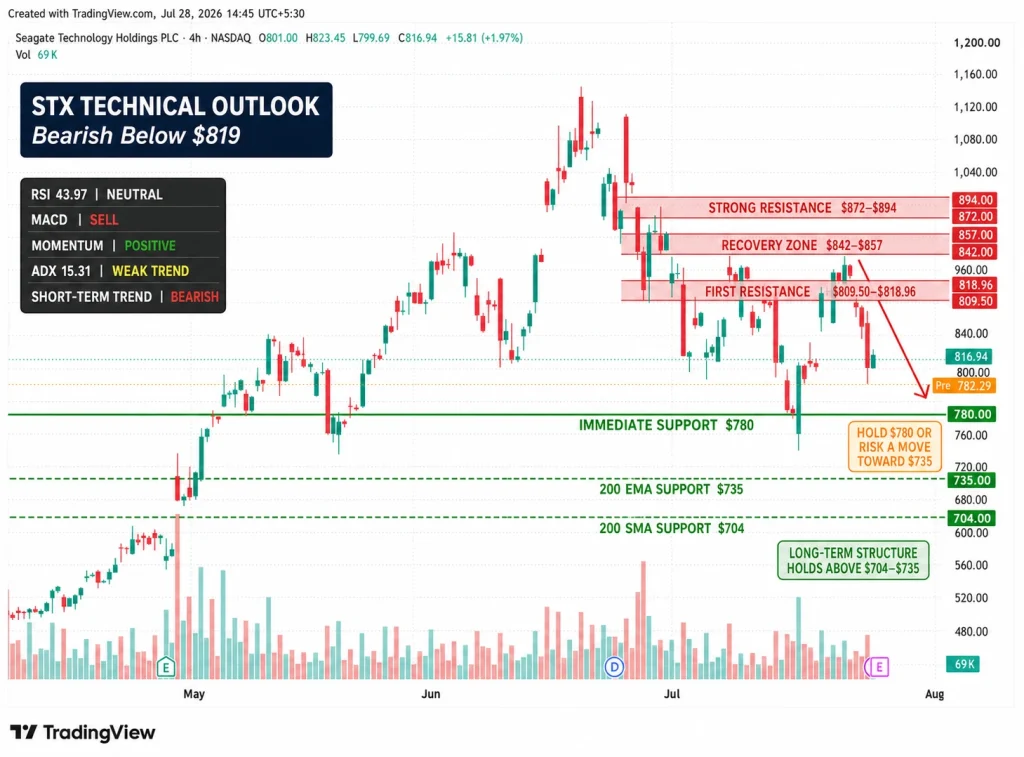
Seagate’s four-hour chart has turned bearish, with the pre-market price near $782 below every short- and medium-term moving average.
The Hull moving average at $809.50 and Ichimoku baseline near $818.96 form the first resistance zone. A recovery above $819 could open the way toward $842–$857, while stronger resistance sits around $872–$894.
On the downside, $780 is the immediate support. A decisive break could expose the 200-period EMA near $735, followed by the 200-period SMA around $704.
RSI at 43.97 remains neutral, while MACD is on a sell signal. Momentum is positive, but the low ADX reading of 15.31 indicates weak trend strength.
For now, the long-term structure remains supported above $704–$735, but the short-term trend will stay bearish unless STX recovers $819 and then $842.
Seagate Faces a High-Expectations Earnings Test Today
Seagate enters earnings with strong industry conditions, improving profitability and a technology platform designed for the rapid growth of AI-generated data.
Nearline shipments are expected to rise sharply, HDD supply remains disciplined and new customer contracts could support higher pricing through fiscal 2027.
However, the stock’s extraordinary rally means strong results may not be sufficient on their own.
Investors will want an earnings beat, durable margins and confident guidance regarding hyperscaler demand and HAMR adoption.
The pre-market decline toward $782 suggests sentiment has become more cautious. Holding that level could support an earnings rebound toward $819 and $842, while disappointing guidance could expose the stronger support region near $735.
Seagate’s AI storage story remains compelling, but Tuesday’s report must prove that its earnings and cash flow can continue growing quickly enough to justify the valuation.
- Check out our free forex signals
- Follow the top economic events on FX Leaders economic calendar
- Trade better, discover more Forex Trading Strategies
- Open a FREE Trading Account
- Read our latest reviews on: Avatrade, Exness, HFM and XM

Related Articles

Sidebar rates

Related Posts
 Save
SaveAva