SKHY Stock Falls Below $130 as SK Hynix’s Record AI Memory Profit Misses Lofty Expectations
SK Hynix ADR SKHY falls below $130 as record AI memory profit misses forecasts despite strong HBM4 demand and new long-term supply deals.
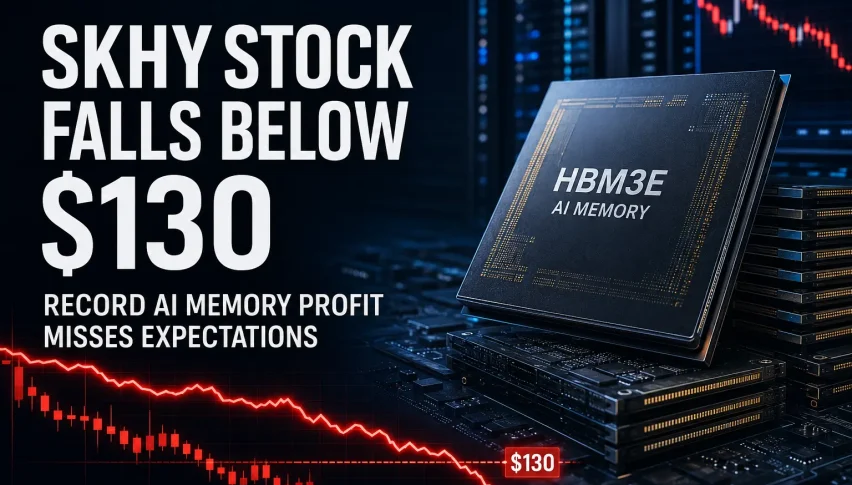
SK Hynix shares fell below $130 as record quarterly profit and surging AI memory demand failed to overcome an earnings miss, slower HBM shipments and rising capital spending.
SKHY Stock Extends Selloff as Record Profit Fails to Meet AI-Fueled Forecasts
SK Hynix shares extended their decline after the Nvidia supplier delivered another record quarter but failed to clear the exceptionally high expectations surrounding the artificial intelligence memory boom.
The Nasdaq-listed SKHY shares fell $12.85, or 8.98%, to $130.17 before declining another 3.30% to approximately $125.93 overnight.
In Seoul, SK Hynix stock fell toward 1.50 million won after suffering a much steeper selloff during the previous session.
The reaction appears severe given the company’s extraordinary year-over-year growth. Revenue more than tripled, operating profit reached another record and management remained confident that demand for high-bandwidth memory will continue expanding.
However, slower-than-expected shipment growth and less aggressive pricing contributed to a miss against elevated analyst forecasts.
Investors are also becoming more cautious about the hundreds of billions of dollars being spent on AI infrastructure and whether hyperscalers can continue funding that expansion at the current pace.
SK Hynix Posts Another Record Quarter
SK Hynix reported second-quarter revenue of 79.32 trillion won, representing growth of approximately 257% from the previous year.
Operating profit increased more than sixfold to 60.54 trillion won, while net profit climbed more than thirteenfold to 93.92 trillion won.
The results also improved sharply from the first quarter. Revenue rose 51% sequentially, while operating profit increased 61%.
For the first time in the company’s history, cumulative first-half revenue exceeded 100 trillion won. First-half operating profit approached the same threshold.
These figures demonstrate the enormous financial impact of the AI infrastructure boom.
SK Hynix has transformed from a cyclical memory producer into one of the most important suppliers within the global AI ecosystem. Its high-bandwidth memory products are used alongside advanced processors to move data rapidly during model training and inference.
However, record results were not enough to satisfy the market.
Revenue fell short of the LSEG SmartEstimate near 84 trillion won, while operating profit missed the 64 trillion won forecast.
Slower HBM Shipments Contribute to Earnings Miss
The earnings miss partly reflected slower growth in shipments of advanced memory products used in AI data centers.
Demand remains strong, but delivering increasingly complex HBM products requires difficult manufacturing processes, customer qualifications and advanced packaging capacity.
SK Hynix also raised prices less aggressively than Samsung Electronics, particularly under long-term customer contracts.
That approach may strengthen customer relationships and provide greater demand visibility. However, it can limit near-term revenue and margin upside during a period of exceptionally tight supply.
The market’s reaction illustrates the danger of elevated expectations.
When a stock has already priced in rapid AI growth, even record earnings can disappoint if shipment volumes, prices or guidance fail to exceed increasingly bullish forecasts.
Investors will now focus on whether SK Hynix can accelerate HBM output during the second half without weakening production yields or spending too aggressively.
HBM4 Strengthens SK Hynix’s AI Leadership
SK Hynix began mass shipments of HBM4 during the second quarter and plans to expand production through the second half of 2026.
The company has emphasized the product’s power efficiency, cost competitiveness and ability to support increasingly demanding AI systems.
HBM4 represents an important technological step because next-generation AI accelerators require greater bandwidth while controlling electricity use and heat.
SK Hynix also shipped samples of its 12-layer HBM4E product to major customers during the first half.
The product offers capacity of 48 gigabytes and speeds of up to 16 gigabits per second per pin. Its advanced packaging technology is designed to reduce thermal resistance while maintaining structural stability.
Early sampling gives customers time to test and qualify HBM4E before mass production.
If SK Hynix successfully converts those samples into large orders, it could protect its leadership as Nvidia and other AI processor developers move toward more powerful systems.
However, Samsung and Micron are investing aggressively in their own HBM roadmaps. SK Hynix must maintain both technological performance and reliable high-volume manufacturing.
Long-Term Agreements Improve Demand Visibility
SK Hynix has completed discussions on approximately 10 long-term agreements with major customers and remains in negotiations with other industry participants.
The agreements include financial protections such as customer deposits, which can support production commitments and reduce the risk of sudden cancellations.
This structure is significant because memory markets have historically been highly cyclical.
Manufacturers often invest heavily during periods of shortage, only to face excess capacity and collapsing prices when demand slows.
Long-term contracts could reduce that volatility by providing greater visibility into customer requirements and allowing SK Hynix to align investment more closely with actual demand.
However, the agreements also introduce a tradeoff.
Fixed or predetermined pricing can prevent the company from capturing the full benefit of a sharp increase in spot and contract prices. This may help explain why Samsung’s more aggressive pricing produced a stronger near-term advantage.
The quality of these agreements—not simply their number—will therefore be important.
AI Spending Concerns Pressure the Entire Sector
The selloff in SK Hynix was not driven entirely by company-specific results.
Semiconductor and memory stocks have come under pressure as investors question the sustainability of enormous AI infrastructure budgets.
Microsoft, Alphabet, Amazon, Meta, Oracle and other hyperscalers are planning hundreds of billions of dollars in data-center spending.
That investment directly supports demand for Nvidia processors, SK Hynix HBM and enterprise solid-state drives.
However, the spending also places pressure on free cash flow and raises questions about returns.
If cloud providers slow construction, delay server deployments or demand more favorable terms, memory suppliers could experience a rapid change in order growth.
SK Hynix argues that the demand is increasingly supported by revenue generated from AI services rather than speculation alone. Management said additional supply requests continue to arrive as major technology companies expand their infrastructure.
The upcoming earnings reports from large U.S. cloud providers should provide an important test of that confidence.
Capital Expenditure Rises as SK Hynix Expands Capacity
SK Hynix plans to increase 2026 capital expenditure to the high-40 trillion won range, compared with 30.17 trillion won in 2025.
The spending will support HBM production, advanced manufacturing equipment and long-term capacity expansion.
Rising investment is understandable given that customer demand continues to exceed available supply. Building capacity now could allow SK Hynix to secure additional market share and deepen its relationships with major AI customers.
However, investors have become increasingly sensitive to capital expenditure across the technology sector.
Expanding too slowly could leave revenue on the table, while expanding too quickly could create excess supply if the AI boom cools.
SK Hynix’s financial position provides some protection. Net cash reached approximately 88 trillion won at the end of June, and the company aims to increase it above 100 trillion won.
With that target approaching, shareholders may begin demanding a larger portion of excess cash through dividends or repurchases.
Management must therefore balance manufacturing investment against shareholder returns.
NAND Growth Adds Another AI Opportunity
Although HBM dominates the investment narrative, SK Hynix is also strengthening its NAND flash portfolio.
The company said 321-layer products now represent the largest portion of NAND production and are expected to reach approximately half of domestic output capacity by year-end.
Higher-layer NAND can improve storage density and manufacturing efficiency, supporting high-capacity enterprise solid-state drives used in AI servers.
SK Hynix has also begun supplying client SSDs using 321-layer QLC technology and plans to broaden applications across enterprise storage and mobile devices.
This provides an additional route to benefit from AI data growth.
However, NAND remains more exposed to commodity pricing and Chinese competition than HBM. Rapid capacity expansion by Chinese manufacturers could create pricing pressure even while premium AI storage demand remains strong.
SK Hynix Technical Outlook Remains Bearish
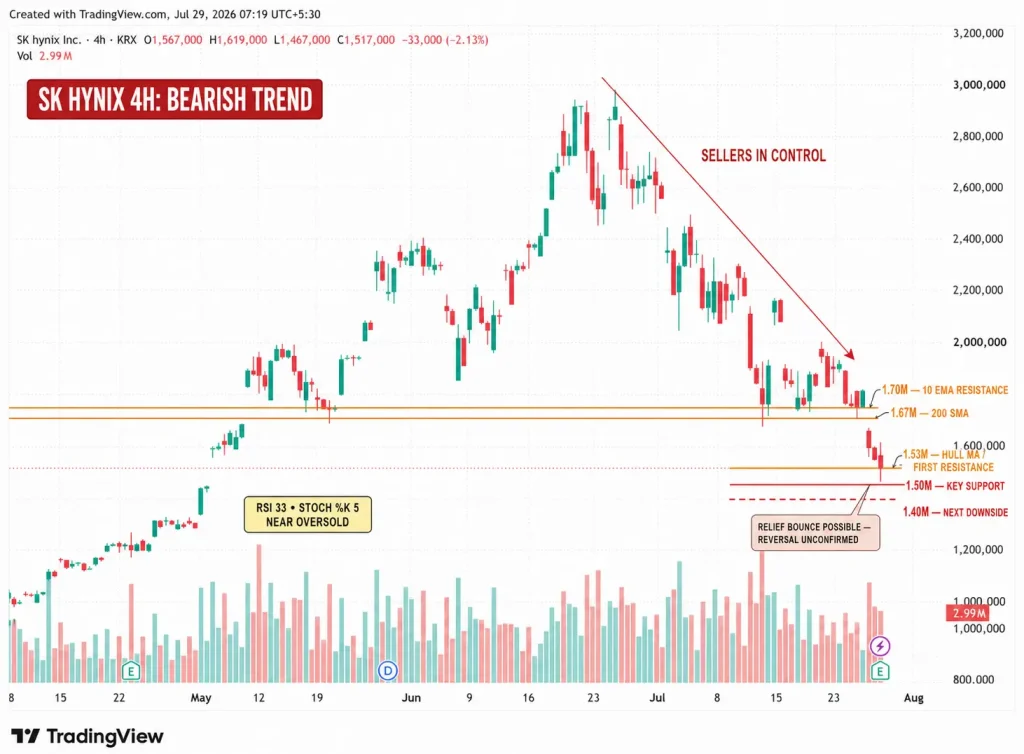
SK Hynix’s four-hour chart remains deeply bearish, with the Korean shares near 1.50 million won and below every major moving average.
The Hull moving average around 1.53 million won is the first resistance. A recovery above that level could target the 200-period SMA near 1.67 million won, followed by the 10-period EMA around 1.70 million won.
On the downside, 1.50 million won is the immediate psychological support. A decisive break could expose approximately 1.40 million won.
RSI at 33 and Stochastic %K at 5 show that the selloff is approaching oversold territory. Williams %R and CCI also produce buy signals, creating the possibility of a relief rebound.
However, negative MACD, momentum and Ultimate Oscillator readings confirm that sellers remain in control. Any recovery below 1.67–1.70 million won would remain corrective rather than signal a confirmed reversal.
SK Hynix Faces an Expectations and Execution Test
SK Hynix remains one of the strongest fundamental beneficiaries of the AI infrastructure boom.
Record operating profit, HBM4 shipments, HBM4E development and long-term customer agreements provide substantial support for the company’s growth outlook.
However, the latest reaction shows that investors are no longer satisfied with record results alone.
SK Hynix must accelerate advanced-memory shipments, maintain its technology lead and demonstrate that higher capital expenditure will generate durable returns.
For now, oversold indicators could support a short-term rebound, but the broader technical trend remains bearish.
The company’s AI memory story is still powerful. The challenge is proving that earnings can continue exceeding the extraordinary expectations already built into the stock.
- Check out our free forex signals
- Follow the top economic events on FX Leaders economic calendar
- Trade better, discover more Forex Trading Strategies
- Open a FREE Trading Account
- Read our latest reviews on: Avatrade, Exness, HFM and XM

Related Articles

Sidebar rates

Related Posts
 Save
Save