ASTS stock tumbles over 10% after earnings miss despite FCC approval, satellite launch progress, and strong broadband growth plans.
Written by:
Arslan Ali Butt•Tuesday, May 12, 2026•4 min read
•Last updated: Tuesday, May 12, 2026
Quick overview
AST SpaceMobile's shares experienced significant volatility after reporting a wider-than-expected quarterly loss and lower revenue, despite management's commitment to its satellite deployment strategy.
The company reported first-quarter revenue of $14.7 million, falling short of analyst expectations, while total operating expenses rose to $164.1 million.
AST SpaceMobile achieved key operational milestones, including FCC approval for direct-to-device broadband service and peak download speeds of 98.9 Mbps from its satellites.
The company continues to expand its partnerships with nearly 60 mobile network operators globally, enhancing its competitive position in the telecom market.
Shares of AST SpaceMobile whipsawed Monday after the company reported a wider-than-expected quarterly loss and weaker revenue, even as management reinforced its aggressive satellite deployment roadmap and highlighted major technological milestones in direct-to-device broadband connectivity.
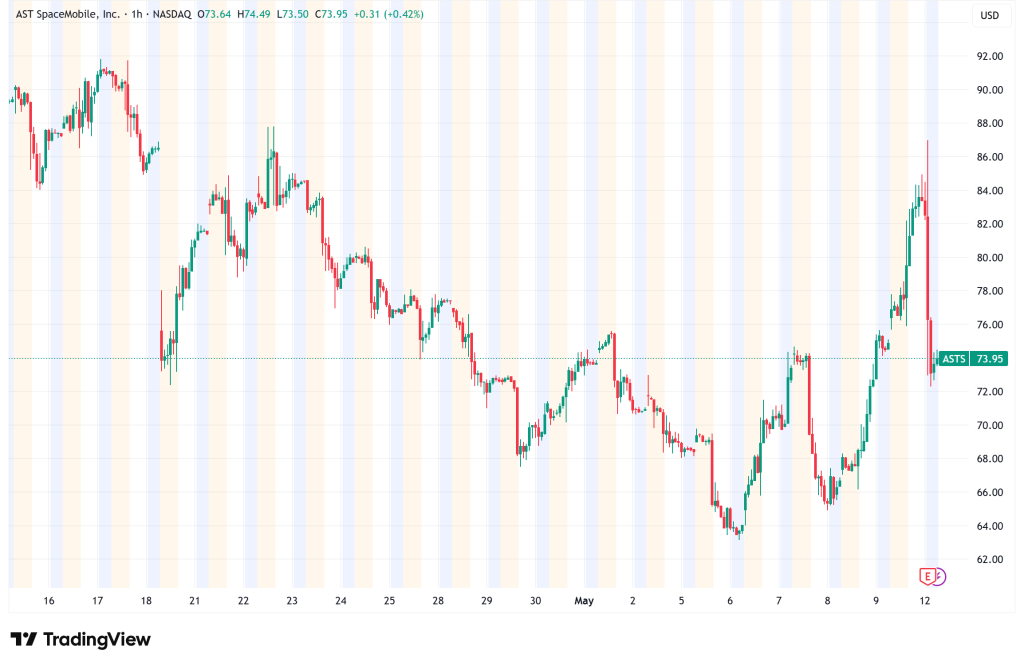
ASTS stock initially surged nearly 10% during regular trading before reversing sharply lower in after-hours trading following the earnings release.
The volatile reaction reflects the increasingly polarized investor debate surrounding AST SpaceMobile: whether the company is evolving into a transformational communications infrastructure platform, or remains a highly speculative capital-intensive satellite venture facing significant execution risks.
Ast SpaceMobile’s Earnings Miss Overshadows Operational Progress
AST SpaceMobile reported first-quarter revenue of $14.7 million, well below analyst expectations near $37 million, while posting a quarterly loss of $0.66 per share versus expectations for a substantially narrower loss.
The disappointing financial results immediately pressured the stock after hours as investors reacted to the company’s still-heavy operating losses and slower-than-expected near-term monetization.
Total operating expenses climbed to $164.1 million during the quarter, driven largely by rising engineering, manufacturing, and administrative costs tied to scaling satellite production.
However, management emphasized that the weaker quarterly revenue primarily reflected timing-related factors involving gateway deployments and government milestone recognition rather than deteriorating demand conditions.
Importantly, the company maintained its full-year 2026 revenue guidance of $150 million to $200 million, which helped stabilize some investor sentiment despite the earnings miss.
Markets increasingly appear willing to tolerate near-term losses because AST remains focused on building what could become the first large-scale direct-to-device satellite cellular broadband network globally.
Satellite Deployment Accelerates Ahead of Key Launches
The company’s broader long-term narrative remains centered around execution of its BlueBird satellite constellation. Management confirmed that BlueBird 8, 9, and 10 remain on track for a mid-June launch aboard a SpaceX Falcon 9 rocket.
More importantly, AST stated that satellites 11 through 33 are already in advanced stages of production and assembly as the company scales its vertically integrated manufacturing model.
The company now targets approximately 45 satellites in orbit during 2026 through agreements with multiple launch providers, including SpaceX and Blue Origin.
That deployment pace has become one of the most closely watched metrics for investors because the commercial viability of AST’s business model depends heavily on rapidly achieving meaningful constellation scale.
Markets are increasingly treating AST not simply as a satellite company, but as a potential next-generation telecom infrastructure provider capable of extending cellular broadband access directly to ordinary smartphones without specialized hardware.
Regulatory and Technology Milestones Strengthen Bullish Case
Despite the weak quarterly financials, AST delivered several operational milestones that reinforced investor optimism around its longer-term technological position.
One of the biggest developments came from the Federal Communications Commission, which granted supplemental coverage authority allowing AST to provide commercial direct-to-device broadband service within the United States using a future network of up to 248 satellites.
That approval significantly strengthened the company’s regulatory positioning.
AST also announced that it achieved peak download speeds of 98.9 Mbps from its in-orbit BlueBird satellite directly to an unmodified smartphone over international waters.
The company expects its newer Block 2 satellites to nearly double those speeds.
These developments are particularly important because they validate the company’s core technological thesis: enabling true broadband-quality connectivity directly from space to standard smartphones.
That differentiates AST from several competing satellite communication systems that remain more limited in capability.
Global Telecom Partnerships Continue Expanding
AST’s growing ecosystem of telecom partnerships also remains one of its strongest strategic advantages.
The company now works with nearly 60 mobile network operators globally, covering more than 3 billion subscribers.
Key partners include:
Verizon Communications
AT&T
FirstNet
Bell Canada
Vodacom
Orange
MTN Group
The company also continues expanding ground network integration efforts across multiple international markets, targeting a combined population reach of roughly 2.9 billion people.
That broad commercial ecosystem is increasingly viewed as one of AST’s most important competitive moats.
Why is Ast SpaceMobile (ASTS) stock so volatile after Q1 earnings?
ASTS Technical Analysis
Technically, ASTS remains highly volatile but continues holding a broader bullish structure. The stock is still trading above major long-term moving averages despite the after-hours pullback.
Key Technical Levels for Ast SpaceMobile (ASTS) Stock
Resistance: $85-$90
Psychological breakout level: $100
Near-term support: $70-$74
Major support: $60-$65
Momentum indicators remain mixed.
RSI had moved toward overbought territory before earnings, suggesting the stock was vulnerable to volatility. MACD still appears constructive longer term, though near-term momentum may weaken if selling pressure continues.
Volume remains elevated, showing strong retail and momentum-driven participation.
The broader trend still favors buyers unless ASTS breaks below key support zones.
One of AST’s biggest strengths remains its balance sheet. The company reported approximately $3.5 billion in cash, cash equivalents, and restricted cash as of March 31, 2026.
That liquidity provides critical flexibility as AST continues funding satellite manufacturing, launches, regulatory expansion, and infrastructure deployment.
Management also emphasized the company’s vertically integrated manufacturing capacity, including more than 500,000 square feet of global production space and a fully operational micron manufacturing facility in Texas capable of supporting more than 10 satellites per month.
The company also holds approximately 3,900 patent and patent-pending claims tied to its technology platform.
Long-Term Outlook Depends on Commercial Execution
AST SpaceMobile continues representing one of the highest-risk, highest-reward opportunities in the emerging space communications market. The company is attempting to build entirely new global communications infrastructure capable of reshaping mobile broadband access.
If successful, the addressable market opportunity could be enormous. However, investors also face substantial risks:
Heavy ongoing cash burn
Large capital requirements
Complex satellite deployment timelines
Regulatory execution challenges
Competitive pressure from existing satellite operators
Uncertain pace of commercial adoption
Wall Street currently expects the company to potentially achieve profitability around 2028 if deployment and commercialization targets remain on schedule.
For now, markets appear increasingly focused less on near-term earnings volatility and more on whether AST can successfully execute its satellite rollout, activate commercial services at scale, and convert its growing telecom ecosystem into sustainable recurring revenue.
The latest earnings reaction shows investors remain willing to tolerate short-term financial weakness, but only as long as operational milestones continue validating the broader long-term direct-to-device broadband thesis.
Lead Markets Analyst – Multi-Asset (FX, Commodities, Crypto)
Arslan Ali Butt serves as the Lead Commodities and Indices Analyst, bringing a wealth of expertise to the field. With an MBA in Behavioral Finance and active progress towards a Ph.D., Arslan possesses a deep understanding of market dynamics.
His professional journey includes a significant role as a senior analyst at a leading brokerage firm, complementing his extensive experience as a market analyst and day trader. Adept in educating others, Arslan has a commendable track record as an instructor and public speaker.
His incisive analyses, particularly within the realms of cryptocurrency and forex markets, are showcased across esteemed financial publications such as ForexCrunch, InsideBitcoins, and EconomyWatch, solidifying his reputation in the financial community.