Samsung Electronics Jumps 8% as Strike Risk Vanishes and AI Memory Boom Fuels Profit Surge

Samsung surges 8% after workers approve a massive chip bonus deal, easing strike fears amid the AI memory boom. What's next for Samsung?

Samsung Electronics Jumps 8% as Strike Risk Vanishes and AI Memory Boom Fuels Profit Surge

Quick overview

  • Samsung Electronics' shares rose by 8% after the company reached a compensation agreement with its semiconductor employees, avoiding a major strike.
  • The deal, which includes bonuses tied to operating profits, reflects the booming demand for AI-related memory chips amid a global infrastructure surge.
  • Despite the resolution of the strike risk, internal labor tensions persist due to significant compensation disparities between chip and non-chip employees.
  • Investor interest in Samsung's stock has surged, with new leverage products attracting over 2 trillion won in inflows, highlighting the growing excitement around AI semiconductor investments.
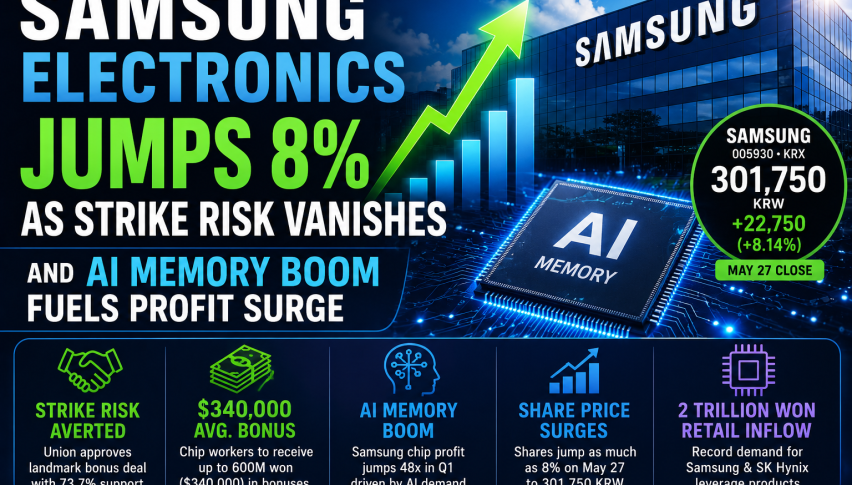
Shares of Samsung Electronics surged as much as 8% this week after the company narrowly avoided a potentially disruptive semiconductor strike, removing a major near-term risk hanging over the global AI chip supply chain.

The world’s largest memory-chip maker secured approval for a landmark compensation agreement that could hand some semiconductor employees bonuses exceeding 500 million won ($340,000), reflecting the enormous profits now flowing through the AI infrastructure boom.

The agreement arrives at a critical moment for Samsung as global demand for high-bandwidth memory (HBM), AI servers, and data-center infrastructure continues accelerating amid explosive adoption of generative AI systems like ChatGPT and Claude.

Samsung Avoids Major Semiconductor Supply Disruption

Samsung’s unionized workers approved the deal with roughly 74% support, ending a five-month labor dispute and averting a planned 18-day strike that could have rattled global memory-chip markets.

The compensation package includes:

  • Bonuses tied to 10.5% of chip division operating profit
  • Cash payouts capped at 50% of annual salary
  • Equity-based compensation vesting over multiple years
  • Profit-sharing thresholds linked to semiconductor earnings through 2035

For memory-division employees, total compensation could reportedly exceed 600 million won this year.

The deal matters because Samsung sits directly at the center of the global AI infrastructure supply chain.

The company supplies memory chips used in:

  • AI data-center servers
  • Smartphones
  • Autonomous systems
  • Electric vehicles
  • Enterprise cloud infrastructure

With AI-driven memory demand already tightening global supply, a prolonged strike could have intensified pricing pressure across the semiconductor industry.

AI Boom Is Reshaping the Korean Chip Industry

The agreement also highlights how rapidly AI is reshaping South Korea’s semiconductor economy.

Samsung’s semiconductor division reportedly posted a 48-fold profit increase in the March quarter as AI-related demand surged across memory markets.

At the same time:

  • SK Hynix has emerged as a major HBM supplier to AI infrastructure companies
  • Micron Technology recently crossed a $1 trillion market capitalization
  • AI server demand continues driving memory pricing higher
  • HBM shortages remain a critical industry bottleneck

Samsung still trails SK Hynix in some advanced AI memory categories, particularly HBM leadership tied to NVIDIA AI accelerators. However, investors increasingly believe Samsung could regain momentum as AI infrastructure spending scales globally.

Internal Tensions Still Remain Even as Strikes Ease

While the strike risk has eased, Samsung’s internal labor tensions may not disappear entirely.

The compensation structure exposed widening divisions between Samsung’s chip and non-chip businesses.

Some non-semiconductor workers reportedly stand to receive bonuses closer to 6 million won, compared with over 600 million won for top memory employees — a nearly 100-fold difference.

That disparity fueled backlash from smaller unions representing employees in:

  • Smartphones
  • Consumer electronics
  • Home appliances
  • Display divisions

Only about 21% of members from one non-chip-focused union reportedly supported the agreement.

The situation reflects a broader trend now emerging across the global AI economy: semiconductor divisions are becoming dramatically more profitable than traditional electronics businesses.

Retail Investors Flood Into Samsung Leverage Products

Investor enthusiasm surrounding Samsung’s AI exposure also exploded this week after South Korea launched new single-stock leverage products tied to Samsung and SK Hynix shares.

Within one day:

  • Samsung leverage products attracted over 612 billion won
  • SK Hynix leverage products drew over 1.4 trillion won
  • Combined inflows exceeded 2 trillion won
  • More than 200,000 investors enrolled in mandatory leverage-product education

Some leverage ETFs tied to SK Hynix surged nearly 20% in a single session.

The frenzy underscores how aggressively retail investors are now positioning around the AI semiconductor narrative.

Still, analysts warned that leveraged products remain highly volatile and are designed primarily for short-term trading rather than long-term investment strategies.

Samsung Electronics Jumps 8% as Strike Risk Vanishes and AI Memory Boom Fuels Profit Surge
Why is Samsung stock rising?

Technical Analysis: Samsung Is Attempting a Major AI-Driven Breakout

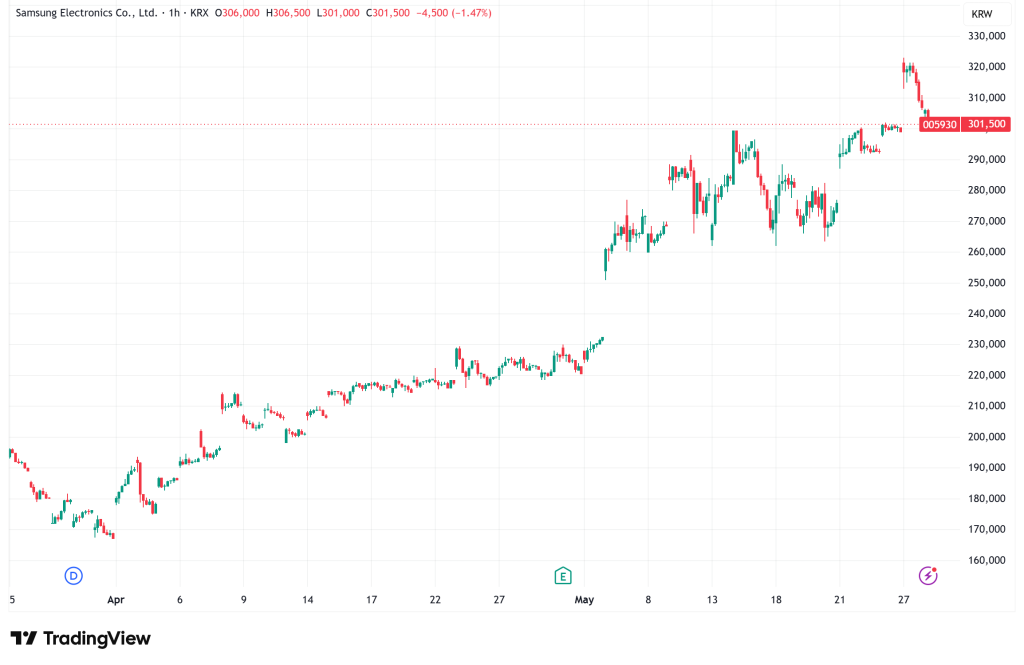
Technically, Samsung’s chart has improved significantly after months of consolidation.

The stock’s recent breakout suggests investors are increasingly repricing Samsung as a core AI infrastructure beneficiary rather than a slower-growth consumer electronics company.

Key Technical Signals

  • Shares surged as much as 8% after the labor agreement
  • Volume expanded sharply during the breakout
  • AI semiconductor momentum continues strengthening
  • Memory-cycle optimism is returning
  • Institutional buying appears to be accelerating

The move also coincides with broader strength across global semiconductor and AI infrastructure stocks.

Moving Averages

Samsung now trades above several key trend indicators:

  • 20-day moving average: bullish
  • 50-day moving average: improving
  • 200-day moving average: long-term recovery underway

A sustained move above recent resistance could confirm a broader long-term reversal pattern.

RSI and MACD

RSI

  • RSI is approaching bullish territory after prolonged consolidation
  • Momentum has improved sharply
  • The stock is not yet deeply overbought

MACD

  • MACD has turned decisively positive
  • Bullish momentum is accelerating
  • Institutional buying signals appear to be strengthening

The setup increasingly resembles the early stages of a semiconductor momentum breakout tied to the AI cycle.

Key Support and Resistance Levels

Level Type Approximate Area
Immediate Resistance ₩315,000–₩320,000
Major Resistance ₩340,000
Near-Term Support ₩290,000–₩295,000
Secondary Support ₩270,000
Major Long-Term Support ₩250,000

A clean breakout above ₩320,000 could strengthen bullish momentum further, especially if AI memory pricing continues rising through 2026.

Long-Term Outlook: Samsung Remains Central to the AI Infrastructure Race

Samsung’s long-term investment case increasingly revolves around one theme: AI memory dominance.

The company remains one of the few global firms with scale across:

  • DRAM
  • NAND flash
  • Advanced packaging
  • AI memory
  • Smartphones
  • Foundry manufacturing

That diversification gives Samsung enormous strategic importance inside the global AI supply chain.

However, several risks remain:

  • HBM competition from SK Hynix
  • Execution challenges in advanced AI chips
  • Geopolitical semiconductor tensions
  • Internal labor divisions
  • Cyclical memory-price volatility

Still, if AI infrastructure spending continues expanding at its current pace, Samsung may remain one of the most strategically important semiconductor companies in the global technology market over the next decade.

ABOUT THE AUTHOR See More
Arslan Butt
Lead Markets Analyst – Multi-Asset (FX, Commodities, Crypto)
Arslan Butt serves as the Lead Commodities and Indices Analyst, bringing a wealth of expertise to the field. With an MBA in Behavioral Finance and active progress towards a Ph.D., Arslan possesses a deep understanding of market dynamics. His professional journey includes a significant role as a senior analyst at a leading brokerage firm, complementing his extensive experience as a market analyst and day trader. Adept in educating others, Arslan has a commendable track record as an instructor and public speaker. His incisive analyses, particularly within the realms of cryptocurrency and forex markets, are showcased across esteemed financial publications such as ForexCrunch, InsideBitcoins, and EconomyWatch, solidifying his reputation in the financial community.

Related Articles
HFM

HFM rest

Pu Prime

XM

Best Forex Brokers