PLTR Stock Approaches $100, Deepening the Correction Amid Contract and Policy Uncertainty
Palantir’s recent decline below key technical levels is intensifying concerns that weakening momentum, overseas contract risks, and stretched valuations may be converging into a more sustained corrective phase.
Quick overview
- Palantir's stock has declined below key technical support levels, raising concerns about weakening momentum and stretched valuations.
- Investor sentiment is negatively impacted by reports of European governments, particularly France, moving away from Palantir's platforms in favor of local alternatives.
- Valuation pressures are mounting as the stock trades at premium multiples, leading investors to question the sustainability of its growth expectations.
- The evolving regulatory landscape surrounding artificial intelligence adds further uncertainty, potentially affecting procurement cycles and contract expansion.
Palantir’s recent decline below key technical levels is intensifying concerns that weakening momentum, overseas contract risks, and stretched valuations may be converging into a more sustained corrective phase.
Technical Breakdown Signals Growing Weakness
Palantir Technologies has come under renewed selling pressure after breaking below another important technical support zone, extending what has already become a notable correction from its earlier peak. After surging during a period of intense enthusiasm around artificial intelligence-linked platforms and government contracting momentum, the stock’s retreat from levels above $160 toward the $110 area marks a clear shift in sentiment.
The latest 2.5% decline reinforces the perception that buyers are losing control of the trend. Multiple prior support levels have failed to hold, and momentum indicators continue to weaken as selling pressure becomes more persistent. What previously looked like orderly profit-taking is increasingly appearing as a broader distribution phase, where early investors gradually exit positions after a powerful rally.
Attention is now turning toward the psychologically important $100 level, which is emerging as the next major reference point should current conditions persist. The speed and structure of the decline suggest that confidence is not yet stabilizing, leaving the stock vulnerable to further downside if sentiment does not improve.
European Contract Losses Pressure Growth Outlook
A key factor behind the recent weakness is growing concern about Palantir’s international expansion narrative, particularly in Europe. Investor sentiment was shaken following reports that France’s domestic intelligence services are moving away from Palantir’s platforms in favor of locally developed alternatives, reflecting a broader push toward technological sovereignty.
This development is significant because government and intelligence contracts have historically formed a core pillar of Palantir’s revenue stability. The shift in France raises the risk that other European governments may adopt similar policies, prioritizing domestic vendors for sensitive data infrastructure and security operations.
Such a trend would directly challenge one of the company’s most important long-term growth assumptions. While not an immediate revenue shock, it introduces uncertainty into future contract pipelines at a time when expectations remain elevated. As a result, investors are increasingly questioning whether international government expansion can deliver the scale that was previously priced into the stock.
Rising Valuation Concerns and Narrowing Margin for Error
Even as operational performance remains solid, valuation pressure continues to dominate investor debate. Despite its recent correction, Palantir still trades at premium multiples compared to most large-cap technology peers, reflecting high expectations for sustained growth in both government and commercial segments.
The issue is not the company’s current revenue trajectory, but the degree to which future success is already embedded in the valuation. With expectations tied closely to continued expansion in artificial intelligence-driven analytics and government adoption, even modest disappointments can have outsized effects on sentiment.
As broader technology markets become more selective, investors are reassessing whether such elevated pricing remains justified. This creates a narrow margin for error, where strong results alone are no longer sufficient to support previous valuation extremes without clear acceleration in growth.
Technical Breakdown Raises the Stakes
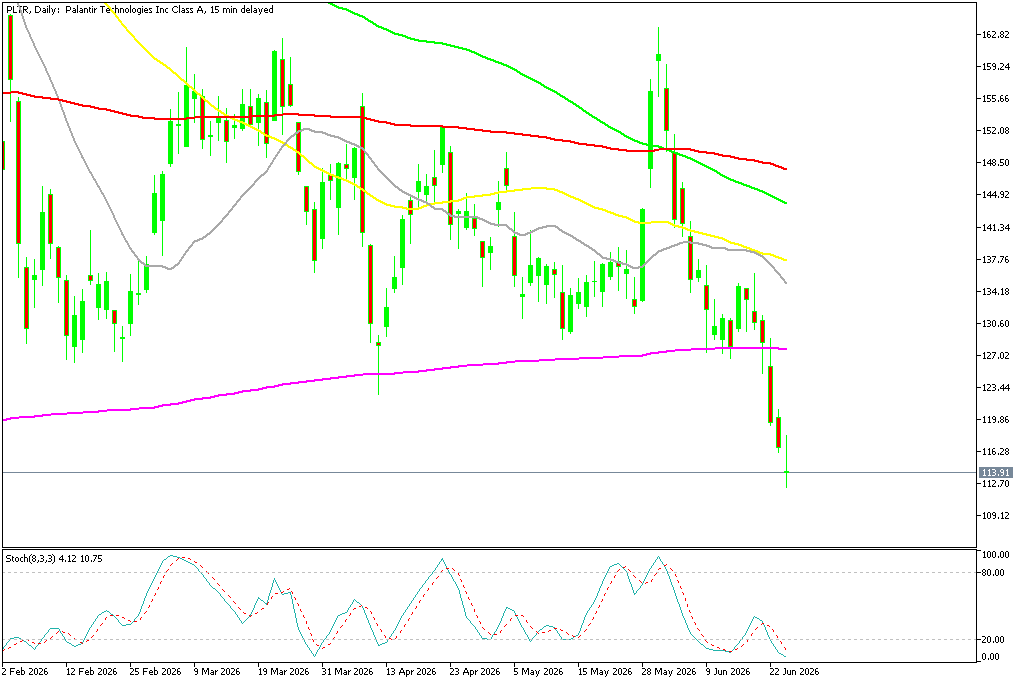
Technically, the picture is getting weaker. Palantir broke below key support levels, including the 100-week simple moving average in green, which had previously acted as a stabilizing floor and is now facing the last technical support.
PLTR Chart Weekly – MAs Turn into Resistance

Former support zones have now turned into resistance, making near-term recoveries more difficult. Early last week’s rebound took PLTR stock closer to the 100 SMA above $130 which was the real test for buyers, but they failed and PLTR fell to the 200 daily SMA (purple) which came under attack on the daily chart. The price has broken below it now, so PLTR will be heading for $100 again.
PLTR Chart Daily – Reversing After the Doji Candlestick
Regulatory Uncertainty and Policy Overhang
Adding another layer of caution is the evolving regulatory backdrop surrounding artificial intelligence and data-driven defense technologies. Recent policy discussions under the Trump administration have emphasized increased oversight, including safety benchmarks, compliance frameworks, and potential testing standards for advanced systems.
While many of these measures remain non-binding, investors are concerned that future regulatory tightening could introduce delays or additional costs for companies operating in sensitive government and defense environments. For Palantir, which is deeply embedded in intelligence and public-sector infrastructure, such changes could meaningfully affect procurement cycles and deployment timelines.
This uncertainty does not represent an immediate threat to operations, but it does contribute to a broader perception of rising friction in the company’s core markets. Over time, this could weigh on the speed and efficiency of contract expansion.
Market Skepticism Builds as Sentiment Turns
Sentiment has also been influenced by renewed criticism from high-profile market participants, including investor Michael Burry, a well-known figure often associated with macro-driven short positions. Burry has suggested that Palantir’s chart structure may be forming a classic head-and-shoulders pattern, historically viewed by technical analysts as a potential reversal signal.
He has also argued that enthusiasm around artificial intelligence narratives may be inflating valuations beyond underlying fundamentals. While such views are not decisive on their own, they add weight to an already cautious market tone.
At the same time, strong operational performance has failed to translate into sustained share price support. Even with revenue reported at approximately $1.63 billion and continued growth across key segments, investors appear increasingly focused on valuation and forward expectations rather than historical execution.
Outlook: Strong Fundamentals Versus Market Repricing
The central tension facing Palantir is the divergence between solid business execution and increasingly fragile market sentiment. On one hand, the company continues to demonstrate growth in both government and commercial operations. On the other, technical deterioration, European contract uncertainty, regulatory questions, and valuation compression are collectively reshaping investor expectations.
Unless sentiment stabilizes or growth meaningfully reaccelerates, the stock remains vulnerable to further volatility. The $100 level is now emerging as a key psychological reference point, and its behavior around that zone may determine whether the current correction deepens or begins to stabilize.
- Check out our free forex signals
- Follow the top economic events on FX Leaders economic calendar
- Trade better, discover more Forex Trading Strategies
- Open a FREE Trading Account
- Read our latest reviews on: Avatrade, Exness, HFM and XM

Related Articles

Sidebar rates

Related Posts
 Save
Save