Google Stock Fails to Revive Uptrend ahead of Earnings as Soaring Capex Costs and Talent Losses Hit Sentiment
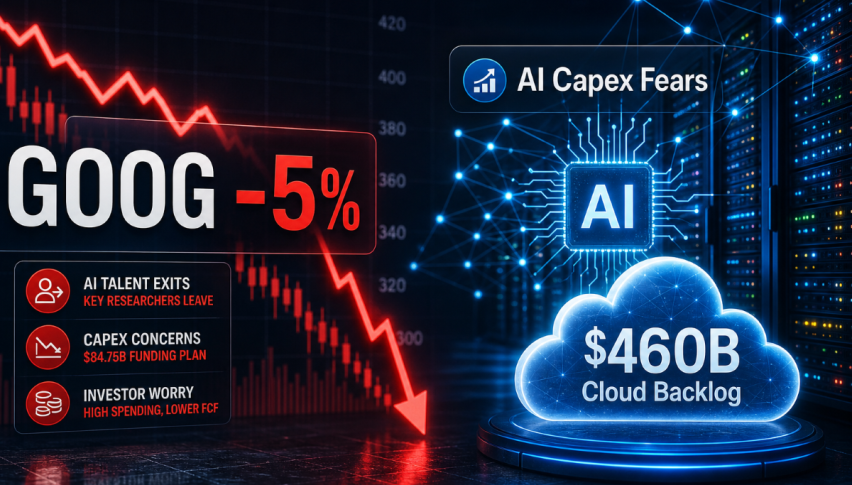
Alphabet stock is facing renewed pressure ahead of earnings as investors demand proof that its massive AI investments can generate sustainable returns amid rising costs, talent departures, and intensifying competition.

Quick overview
- Alphabet stock is under pressure as investors question the sustainability of its massive AI investments amid rising costs and talent departures.
- The upcoming earnings report is critical for Alphabet, with analysts expecting a significant increase in earnings per share and closely monitoring Google Cloud performance.
- Concerns are growing over Alphabet's ability to retain top AI talent, highlighted by the departure of key researchers to competitors.
- Despite strong financial results, investors are increasingly focused on future profitability and the potential risks associated with high capital expenditures in AI.
Alphabet stock is facing renewed pressure ahead of earnings as investors demand proof that its massive AI investments can generate sustainable returns amid rising costs, talent departures, and intensifying competition.
Alphabet Stock Falls Below $360 as Investors Question the Cost of the AI Race
Alphabet shares have struggled to maintain last week’s recovery, when GOOGL stock gained nearly $40, as investors returned to concerns surrounding the company’s aggressive artificial intelligence spending strategy.
The stock reversed lower on Wednesday, falling below the $360 level ahead of its earnings report, with market participants increasingly questioning whether Alphabet can continue funding its massive AI expansion while delivering meaningful returns.
The upcoming earnings call has become a critical test for Google’s AI strategy, with investors looking for evidence that the company’s estimated $190 billion in AI-related capital expenditure is translating into stronger revenue growth.
Earnings Report Becomes Key Test for AI Investment Strategy
Alphabet enters earnings with high expectations from Wall Street. Analysts are forecasting second-quarter earnings per share of approximately $2.86, representing a 23.8% increase from the previous year.
However, the focus will not only be on headline earnings. Investors are expected to closely monitor Google Cloud performance, which has become one of the strongest indicators of Alphabet’s ability to monetize artificial intelligence.
Last quarter, Google Cloud revenue surged 63% year-over-year to reach approximately $20 billion. Maintaining that growth rate will be crucial if Alphabet wants investors to support a move toward the $400 share price level.
A weaker-than-expected cloud performance could raise concerns that enterprise AI demand is slowing, despite Alphabet reporting a massive AI-related backlog estimated at more than $460 billion.
Massive AI Spending Raises Profitability Concerns
Alphabet’s aggressive investment in AI infrastructure has become a major point of debate on Wall Street.
The company has committed roughly $190 billion toward AI-related capital expenditure, including data centers, advanced computing infrastructure, and specialized technology needed to compete with rivals in the artificial intelligence market.
While management argues that these investments are necessary to secure long-term leadership, investors are becoming increasingly concerned about the timeline for returns.
The broader technology sector is facing similar questions as companies continue spending heavily on AI infrastructure while profitability gains remain uncertain.
For Alphabet, the upcoming earnings call represents an opportunity to demonstrate that its spending is supported by tangible revenue growth rather than future expectations alone.
Loss of AI Talent Fuels Competitive Concerns
Investor sentiment was further pressured by the departure of several high-profile artificial intelligence researchers.
One of the most notable exits involved Noam Shazeer, a key contributor to Google’s Gemini AI models, who reportedly left the company to join OpenAI.
Shazeer’s departure attracted significant attention because Alphabet had previously made substantial efforts to retain his expertise. After leaving Google to co-found Character.AI, he returned in 2024 through a $2.7 billion strategic transaction designed to strengthen the company’s AI capabilities.
The loss of another influential researcher has raised questions about Alphabet’s ability to retain elite AI talent despite billions of dollars being invested into the sector.
Concerns increased further after reports that Nobel Prize-winning DeepMind scientist John Jumper also moved to rival AI company Anthropic.
The departures highlight the intensifying competition among technology companies for leading AI researchers and could challenge Alphabet’s position in the rapidly evolving industry.
$80 Billion Fundraising Plan Highlights AI Costs
Adding to investor concerns is Alphabet’s reported $80 billion fundraising initiative, one of the largest capital-raising efforts announced by a major technology company.
The plan includes multiple financing measures designed to increase financial flexibility, but investors have interpreted the move as evidence of the enormous costs associated with competing in AI.
Developing advanced AI models requires massive spending on computing power, energy, data centers, and semiconductor infrastructure.
Rather than boosting confidence, the fundraising announcement has raised concerns that the AI race may require even greater investment than previously expected.
Investors are increasingly questioning whether future AI revenue growth will be large enough to justify the scale of spending currently underway.
Technical Levels in Focus
From a chart perspective, Alphabet slipped below its 50-day moving average (yellow) near $320 in February and the 100 SMA (green) at $300 was broken too, which opened the door for further losses toward $270. That’s where the 200 SMA (red) stood and it provided support, holding the decline and we saw a rebound from there, sending GOOGL above $408 on in May but reversed in June and is heading lower again, slipping below $3670 today after failing to break above the 50 daily SMA.
GOOGL Chart Daily – The 200 SMA Held As Support

Strong Results Overshadowed by Future Risks
Alphabet’s recent financial performance remains impressive. The company reported quarterly revenue approaching $110 billion, with growth exceeding 20% year-over-year. Net income also increased sharply, supported by strong advertising, cloud, and AI-related demand.
However, investors have largely looked beyond current results and focused on future profitability.
The market is increasingly asking whether Alphabet’s AI investments will improve margins or create a long-term increase in operating costs.
Regulatory risks also remain a concern, with ongoing scrutiny surrounding Google’s search dominance, advertising business, and future AI products adding uncertainty.
Alphabet Faces Higher Expectations Ahead
Despite its strong financial position and dominant market presence, Alphabet now faces a higher burden of proof.
Investors expect the company to maintain leadership in AI, accelerate Google Cloud growth, protect its advertising business, and generate attractive returns from unprecedented capital spending.
The recent decline in GOOGL stock reflects growing concerns that the economics of the AI race may not be as favorable as initially expected.
Alphabet remains one of the world’s most powerful technology companies, but the upcoming earnings report will determine whether investors regain confidence in its AI strategy or continue questioning the cost of maintaining its competitive position.
Strong Growth, but Costs Are Rising
Despite robust fundamentals, concerns are building around spending. Alphabet’s core businesses—search, advertising, and cloud—continue to perform strongly, but the cost of maintaining that growth is increasing.
Estimates suggest capital expenditures could reach $175 billion to $185 billion in 2026, driven by infrastructure buildout and AI development.
- Higher capex may pressure margins
- Monetization of AI products remains uncertain
- Returns on investment could take time to materialize
This shift has prompted investors to look beyond revenue growth and focus more closely on profitability.
-
- Total Revenue: $109.9 billion, exceeding analysts’ predictions of $107.2 billion.
- Net Income: $62.58 billion, up 81% from $34.54 billion in Q1 2025.
- Earnings Per Share (EPS): $5.11, significantly beating the estimated $2.62.
- Google Search & Other: Revenue grew 19% to $77.25 billion, driven by high search usage.
- Google Cloud: Revenue jumped 63% to $20.03 billion, with a backlog exceeding $460 billion, highlighting intense demand for AI infrastructure.
- YouTube Advertising: Reported $9.88 billion, missing some analyst expectations.
- Capital Expenditure (CapEx): Raised 2026 guidance to $180B–$190B, signaling aggressive AI investment.
- Dividend: Announced a 5% increase to $0.22 per share quarterly.
- AI Growth: CEO Sundar Pichai noted that AI investments are enhancing all business areas, with AI-driven search experiences pushing query volume to all-time highs.
- Stock Surge: Following the report, Alphabet stock saw a strong positive reaction in after-hours trading, with many analysts highlighting the “earnings crush”.
- Growth Outlook: Total paid subscriptions, including YouTube and Google One, reached 350 million, and Gemini Enterprise saw 40% quarter-over-quarter growth in paid users
- Check out our free forex signals
- Follow the top economic events on FX Leaders economic calendar
- Trade better, discover more Forex Trading Strategies
- Open a FREE Trading Account
- Read our latest reviews on: Avatrade, Exness, HFM and XM

Related Articles

Sidebar rates

Related Posts
 Save
Save