Circle Stock CRCL Jumps 8% on OCC Bank Approval as Bulls Target $70
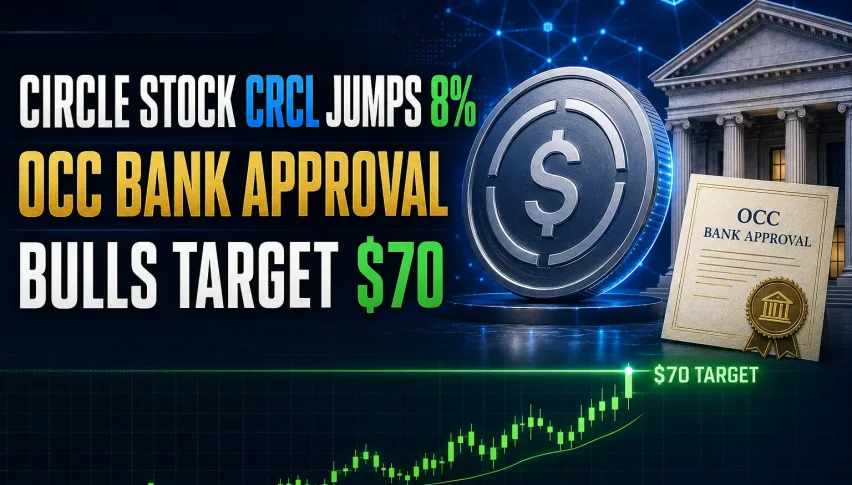
Circle stock CRCL jumps 8% after OCC approval for its national trust bank, putting $70 resistance and USDC margin risks in focus.
Quick overview
- Circle Internet Group's shares rose over 8% following the final approval from the US Office of the Comptroller of the Currency to establish Circle National Trust.
- The approval enhances Circle's regulatory standing and could make USDC more appealing to financial institutions amid increasing competition in the stablecoin market.
- Despite the positive momentum, Circle faces challenges from falling interest rates and rising distribution costs that could impact its revenue growth.
- Investors are closely monitoring Circle's ability to leverage its regulatory advantages to improve margins and sustain profit growth.
Circle Internet Group shares surged more than 8% on Monday as investors returned to the stablecoin issuer following a major regulatory milestone and renewed optimism around digital-asset legislation.
CRCL closed at $65.45 before extending its advance to $66.40 in overnight trading.
The rally follows a sharp decline from the stock’s earlier highs as investors weigh rapid USDC adoption against falling interest rates, increasing distribution costs and stronger competition across the stablecoin market.
Circle Stock Rallies After Final OCC Approval
The latest move followed Circle’s receipt of final approval from the US Office of the Comptroller of the Currency to establish First National Digital Currency Bank, which will operate as Circle National Trust.
The approval moves Circle’s core infrastructure deeper into the regulated US financial system.
Circle National Trust will oversee USDC reserve management on behalf of Circle’s US stablecoin issuer and provide institutional digital-asset custody services. As a national trust bank, it will operate under federal OCC supervision and fiduciary standards. citeturn371681search1turn371681search19
The development follows conditional approval granted in December 2025.
For Circle, the final charter is more than a symbolic regulatory win. Stablecoin adoption depends heavily on confidence that reserves are segregated, liquid and managed under clear oversight.
Bringing reserve management closer to the federal banking perimeter could make USDC more attractive to financial institutions, payment companies and corporate treasury departments that have previously been cautious about digital assets.
It could also help Circle distinguish itself from less regulated stablecoin issuers as governments introduce stricter requirements for dollar-backed tokens.
Why Circle National Trust Matters for USDC Stablecoin
Circle’s business is closely tied to the size and usage of USDC.
The company earns most of its revenue from interest generated by the cash and short-term government securities backing the stablecoin. As USDC circulation rises, Circle generally holds a larger reserve base capable of producing additional income.
USDC in circulation reached $77 billion at the end of the first quarter, up 28% from the previous year. Onchain USDC transaction volume increased 263% to $21.5 trillion during the quarter. citeturn903240search1turn903240search4
Circle reported $694 million in total revenue and reserve income, an increase of 20%.
Adjusted EBITDA rose 24% to $151 million, although net income from continuing operations declined 15% to $55 million as the company increased spending on products, distribution and infrastructure. citeturn903240search4
Those figures show that USDC adoption continues to expand even as Circle faces pressure on the percentage of reserve income it retains.
The trust-bank structure may improve the quality and credibility of Circle’s platform, but it does not remove the economic challenge created by interest rates and partner payments.
Falling Rates Remain a Major Earnings Risk for Circle
Circle’s revenue model gives it significant exposure to US monetary policy.
Reserve income rises when USDC circulation expands or when short-term interest rates increase. It can fall when rates decline, even if the number of USDC tokens in circulation continues growing.
Circle’s first-quarter reserve return rate fell by 66 basis points to 3.5%, partly offsetting the impact of higher average USDC circulation. citeturn903240search4
Further Federal Reserve rate cuts could place additional pressure on reserve income.
That creates an unusual dynamic for CRCL investors.
The stablecoin market may continue expanding while Circle’s revenue growth slows because each dollar of reserves generates less interest.
Circle is attempting to reduce that dependence by growing subscription, transaction and service revenue. Other revenue doubled year over year to $42 million in the first quarter, but it remains small compared with the $653 million generated from reserves. citeturn903240search4
The company therefore remains highly sensitive to both USDC balances and short-term Treasury yields.
Stablecoin Competition Threatens Circle’s Margins
Competition represents the other major risk.
Tether remains the largest dollar stablecoin by circulation, while banks, fintech companies, payment networks and cryptocurrency exchanges are developing their own tokens or supporting new stablecoin platforms.
New competitors may offer issuers, exchanges and payment partners a larger share of the reserve income generated by their tokens.
That could force Circle to improve the economics offered to distributors, reducing the amount of revenue it retains from every dollar of USDC.
Circle’s total distribution, transaction and other costs reached $407 million in the first quarter, up 17% from the previous year. Revenue less distribution costs increased to $287 million, while the company’s RLDC margin reached 41%. citeturn903240search4
The continued rise in distribution expenses shows why USDC circulation alone is not enough to evaluate Circle’s performance.
Investors must also track how much of the reserve income is paid to Coinbase, exchanges, blockchain platforms and other partners that help distribute and use USDC.
A stronger federal regulatory position may improve Circle’s negotiating power, but competition for stablecoin liquidity is likely to remain intense.
Policy Clarity Could Support Institutional Adoption
The rally also reflects a more supportive US policy environment for cryptocurrency infrastructure.
Clearer rules covering stablecoin reserves, custody and market structure could favor companies that already operate within established regulatory frameworks.
Circle has pursued licenses across the US, Europe and other major jurisdictions, positioning compliance as a central part of the USDC value proposition.
The national trust approval reinforces that strategy.
It could make Circle a more credible partner for banks, payment networks and asset managers seeking blockchain-based settlement without relying on lightly regulated offshore infrastructure.
However, regulatory approval does not guarantee faster adoption.
Institutions will still evaluate transaction costs, blockchain risks, interoperability and the financial incentives offered by competing stablecoins.
CRCL Remains Far Below Its Previous Peak
Despite Monday’s rally, Circle stock remains substantially below its earlier post-listing peak.
The decline has reflected concerns about valuation, executive share sales, interest-rate exposure and the possibility that stronger stablecoin competition will compress margins.
Circle President Heath Tarbert has publicly defended the company’s long-term strategy while regulatory filings show that some of his sales were completed under prearranged Rule 10b5-1 trading plans. citeturn371681search5turn371681search27
Executive transactions do not necessarily indicate a weaker business outlook. Shares may be sold for taxes, diversification or personal liquidity.
Nevertheless, insider selling can affect sentiment when a stock is already under pressure and investors are debating whether its valuation adequately reflects earnings risks.
The OCC approval has provided a meaningful positive catalyst, but Circle still needs to demonstrate that regulatory advantages can translate into stronger margins and durable profit growth.
CRCL Technical Analysis: $66.50 and $70 Are the Key Tests
Circle’s 4-hour chart has improved after Monday’s 8.25% rally.
CRCL is trading above its 10 and 20-period moving averages, with the 10 EMA at $63.80, 20 EMA at $64.68, VWMA at $64.47, and Hull MA at $63.67. These levels create an initial support zone around $63.50-$64.70.
The first resistance is the 30 EMA near $66.46. A sustained move above $66.50 could push CRCL toward the stronger $69.94-$71.06 resistance zone, where the 50 SMA and 50 EMA are clustered.
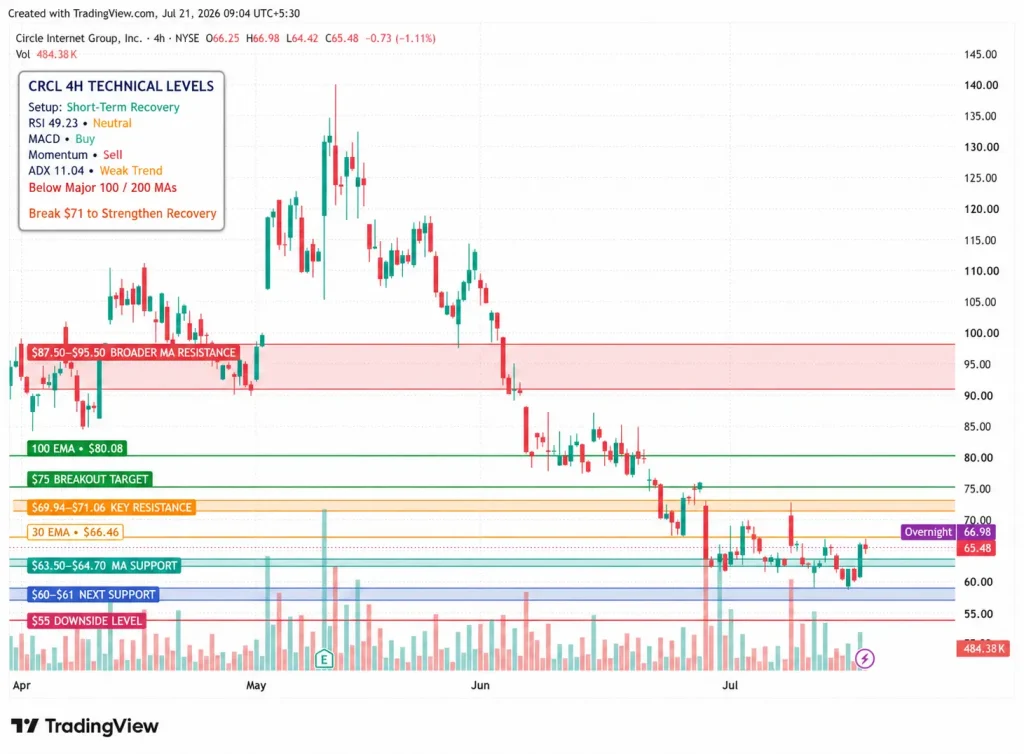
A breakout above $71 could open the way toward $75, followed by the 100 EMA near $80.08.
However, the broader trend remains weak while CRCL trades below the 100 and 200-period averages between roughly $87.50 and $95.50.
Momentum is mixed. RSI is neutral at 49.23 and MACD shows a buy signal, but Momentum remains on sell and ADX at 11.04 points to a weak trend.
If CRCL falls below $63.50, support sits near $60-$61. A break below $60 could expose the mid-$50 region.
What’s Next for Circle (CRCL)?
Circle’s national trust approval strengthens the company’s position as regulated infrastructure for the growing stablecoin economy.
The development could improve institutional confidence in USDC and create new custody opportunities.
However, Circle still faces two central challenges: lower interest rates and rising distribution costs.
Technically, CRCL has regained short-term momentum, but buyers must clear $66.50 and the stronger $70-$71 resistance zone before the rally becomes a broader trend reversal.
For now, the OCC approval has improved sentiment and reduced part of the regulatory uncertainty surrounding Circle. The next test is whether USDC growth can produce stronger earnings while competition for stablecoin partners continues to intensify.
- Check out our free forex signals
- Follow the top economic events on FX Leaders economic calendar
- Trade better, discover more Forex Trading Strategies
- Open a FREE Trading Account
- Read our latest reviews on: Avatrade, Exness, HFM and XM

Related Articles

Sidebar rates

Related Posts
 Save
Save