AMD Stock Nears $500 on MSFT Azure and Analyst Upgrade but Earnings Test Looms
AMD shares have staged a powerful rebound from below $430, climbing more than 13% as stronger Microsoft Azure growth revived confidence in AI infrastructure spending, although questions over valuations, China competition, and the sustainability of the AI investment cycle remain.
AMD shares have staged a powerful rebound from below $430, climbing more than 13% as stronger Microsoft Azure growth revived confidence in AI infrastructure spending, although questions over valuations, China competition, and the sustainability of the AI investment cycle remain.
AMD Stock Rebounds Toward $500 as Microsoft Revives AI Optimism
AMD stock has experienced another dramatic reversal ahead of its upcoming earnings report. After falling below the important $430 level on Wednesday, shares surged more than 13% on Thursday, approaching the $500 mark as stronger-than-expected Microsoft Azure growth eased concerns that the massive AI infrastructure spending cycle could be losing momentum.
The rebound has also lifted the broader semiconductor sector. AMD and Intel both gained around 13%, while the iShares Semiconductor ETF (SOXX) climbed more than 8%.
However, the sharp recovery does not eliminate the underlying concerns. Investors are increasingly questioning whether the enormous spending on AI infrastructure can continue at its current pace and whether semiconductor valuations have already priced in too much future growth.
Microsoft Azure Changes the Market Narrative
The latest rally was triggered by Microsoft’s quarterly results, particularly stronger Azure cloud growth.
The numbers provided fresh evidence that hyperscale customers are still spending heavily on data centers, processors, networking equipment, and other infrastructure required to support expanding cloud and AI workloads.
That was an important development for AMD because the company’s growth strategy increasingly depends on expanding demand for its data center CPUs and Instinct AI accelerators.
The positive Microsoft results therefore helped reverse some of the recent anxiety across semiconductor stocks.
But there is a more cautious interpretation. If investors were already becoming concerned that AI capital expenditure was approaching a peak, Microsoft’s strong Azure growth may simply delay those fears rather than eliminate them.
The market may have received another push higher, but the question remains whether this spending cycle can continue for several more years at the current intensity.
Analysts See Stronger AMD Data Center Growth
Susquehanna analyst Christopher Rolland recently reiterated a Buy rating on AMD and increased his price target to $500 from $450.
His bullish outlook is largely based on improving expectations for AMD’s data center business.
Rolland expects stronger results and guidance to be supported by server CPUs and data center GPUs. He also sees the potential for server CPU demand to outperform expectations as the addressable market expands.
New customer wins could further support the ramp-up of AMD’s MI450 data center GPU platform.
These developments provide an important potential catalyst ahead of earnings. However, the higher expectations also raise the bar for AMD. Strong results may already be partly reflected in the stock price following Thursday’s substantial rebound.
Share Price Rebounds Again Swiftly
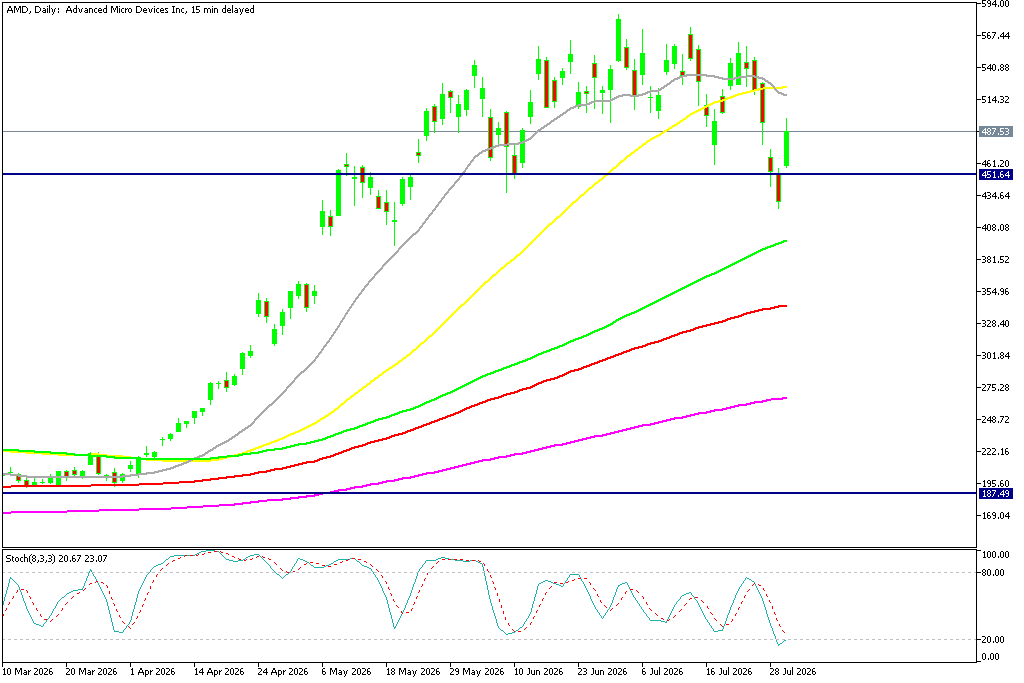
AMD shares fell sharply, sliding roughly 20% in January and pushing the stock below the $200 level. But the 100 SMA (red) acted as support on the daily chart. The price soared higher for three months, with the 20 daily SMA (gray) and reaching a high of $584 in late June before reversing lower and falling below $500 this week, breaking the 50 daily SMA as well, which opened the door for further declines toward $450 support, which was also broken yesterday but today’s we’re seeing a strong jump higher.
AMD Chart Daily – Heading to the 100 SMA
AI Spending Remains the Biggest Question
The AI infrastructure boom has been one of the most important drivers of AMD’s share-price gains over the past several years.
Cloud providers and hyperscalers have committed enormous amounts of capital toward advanced processors, data centers, networking, power systems, cooling infrastructure, and memory.
AMD stands to benefit significantly from this spending cycle.
The concern is that the company’s valuation increasingly assumes that customers will maintain aggressive investment for an extended period.
If hyperscalers eventually slow capital expenditure, postpone projects, or demand stronger returns on their investments, AMD’s growth expectations could be revised lower quickly.
This creates a difficult balance for investors. Strong AI spending is positive for AMD’s revenue prospects, but excessively high spending across the industry could eventually create concerns about returns and overcapacity.
Core Scientific Deal Highlights Opportunity and Risk
AMD’s strategic partnership with Core Scientific illustrates both sides of the AI infrastructure story.
The agreement gives AMD access to more than 500 megawatts of AI-ready data-center capacity beginning in 2027, with the potential to expand toward approximately 2.5 gigawatts.
The partnership is designed to support AMD processors and software across the facilities, while AMD also received warrants to purchase Core Scientific shares under certain conditions.
The scale of the agreement demonstrates the potential size of the AI infrastructure opportunity.
At the same time, it highlights how much capital and physical infrastructure are required to support the next stage of AI growth.
For investors already concerned about the sustainability of the spending boom, increasingly expensive data-center projects could eventually become a source of caution rather than excitement.
China Competition Adds Another Long-Term Risk
AMD also faces an increasingly complicated global semiconductor environment.
China continues to invest heavily in domestic semiconductor manufacturing as it attempts to reduce reliance on foreign technology. Expanding domestic production and government support could gradually strengthen Chinese competitors across several chip categories.
Although AMD is not primarily a memory manufacturer, a stronger Chinese semiconductor ecosystem could influence pricing, supply chains, and competitive dynamics throughout the global industry.
This represents a longer-term risk that investors may increasingly factor into semiconductor valuations, particularly if Chinese companies continue improving their technology and production capabilities.
Technical Picture Improves, but Resistance Remains
From a technical perspective, AMD’s rebound is significant.
The move below $430 had raised concerns about a deeper correction after the stock had previously traded near $574. The sharp recovery toward $500 has therefore helped repair some of the immediate technical damage.
However, the stock now faces resistance around the $500 region and potentially higher levels.
A failure to hold the rebound could revive concerns that the recent decline was more than a temporary correction. Conversely, sustained strength above major resistance could signal that investors are once again willing to pay a premium for AMD’s future AI growth.
AMD Enters Earnings With Expectations Elevated
AMD now approaches its upcoming earnings report with investor expectations once again rising.
The market will be watching data center revenue, Instinct GPU demand, server CPU growth, margins, customer spending, and management’s outlook for the remainder of the year.
Microsoft’s Azure performance has provided an important short-term boost, but it does not remove the broader question surrounding the AI investment cycle.
If AI infrastructure spending continues expanding, AMD could benefit significantly. However, if Thursday’s rally ultimately proves to be another burst of optimism before spending begins to moderate, the stock could remain vulnerable to sharp reversals.
For now, AMD has regained momentum and is approaching $500 again. The rebound is encouraging, but investors may remain cautious until AMD demonstrates that surging AI demand can translate into durable earnings growth rather than simply another phase of increasingly expensive infrastructure spending.
- Check out our free forex signals
- Follow the top economic events on FX Leaders economic calendar
- Trade better, discover more Forex Trading Strategies
- Open a FREE Trading Account
- Read our latest reviews on: Avatrade, Exness, HFM and XM

Related Articles
Sidebar rates

Related Posts
 Save
Save