Silver Price Forecast: XAG/USD Near $54 Despite Supply Deficit
Silver is being hit with a hard dose of reality. The metal’s price has tumbled toward $55 per ounce after a break below a key technical...
Quick overview
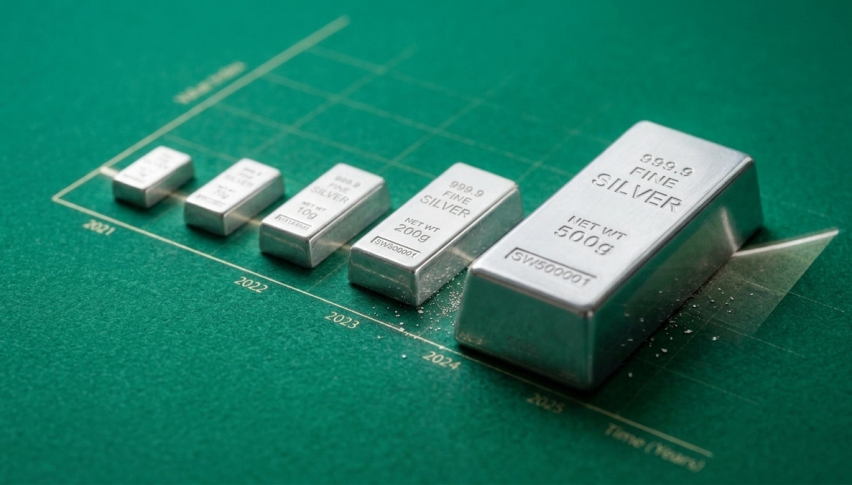
- Silver prices have dropped to around $55 per ounce despite a projected supply deficit in the global market for 2026.
- Higher oil prices are raising inflation concerns, leading investors to anticipate potential interest rate hikes, which negatively impacts silver's appeal.
- Investment demand for silver is expected to rise, but industrial use is declining, creating conflicting trends in the market.
- India's import restrictions have tightened silver supply, but high prices may dampen demand, complicating the market outlook.
Silver is being hit with a hard dose of reality. The metal’s price has tumbled toward $55 per ounce after a break below a key technical support level, despite the global silver market being on track to see its sixth consecutive year of supply deficit in 2026.
That contradiction is now the main story. With physical supplies tight, investment buying of silver bars and coins recovering and shortages in India caused by import restrictions, silver is having a difficult time finding footing. The problem appears to be growing oil prices and the inflationary implications of higher oil prices causing investors to believe that interest rates could rise again. For now, that macro theme is overpowering silver’s long-term supply story.
Oil Prices Higher Hurt Silver More Than Geopolitical Tensions Support It
Normally, silver would benefit from higher military tensions, as investors tend to flock to safer assets during uncertain times. In this case, however, the market is not behaving in the traditional way. War between the US and Iran in its latest round has helped drive prices of Brent crude up to more than $84 per barrel and West Texas Intermediate toward $80, with both benchmarks on track for weekly returns of over 11%. Higher energy prices are spurring worry that costs associated with transporting goods and producing finished goods will lead to higher inflation for consumers.
That puts silver in a tough spot. Initially, higher inflation helps precious metals. It only becomes bearish if investors start believing the Federal Reserve will respond to the higher inflation with tighter monetary policy. Higher policy rates and yields on Treasury notes increase the attractiveness of these other assets relative to assets that don’t produce returns, such as silver.
That explains why the silver price fell 3.6% on July 16 despite escalating geopolitical tensions. Investors aren’t paying too much attention to the war itself; they’re more concerned with the higher energy prices and their potential impact on inflation and interest rates.
Inflation Data Came in Lower, but It Didn’t Change the Narrative
Earlier in the week, silver was about to start a recovery. US consumer inflation slowed to 3.5% in June, down from 4.2% in May, while core prices were unchanged on a monthly basis. Producer prices also fell unexpectedly by 0.3%. Weaker prices helped the dollar give back some of its previous strength. Silver was able to rebound to nearly $58.79 on July 14 as traders started dialing back their expectations for the Fed to immediately hike rates.
However, the optimism did not last. That month’s inflation data included the impact of cheaper energy. Since then, oil prices have been climbing higher. Investors are questioning how long the cooling trend in consumer prices can last through July and August.
There are now two conflicting themes in play:
- On the surface, the latest data suggests that inflation could continue to come under control.
- The oil spike could suggest that it will only worsen.
Until one of the camps prevails, silver will remain highly sensitive to the direction of Treasury yields, the dollar and comments by Fed officials.
Silver’s Supply Deficit Is Real, but It Won’t Necessarily Be a Quick Trigger
Silver’s strongest support remains its fundamentals. According to the Silver Institute, new demand is expected to exceed newly available supply for the sixth straight year in 2026, extending the drawdowns in the aboveground silver market.
One of the reasons why silver has a hard time meeting a spike in demand is because much of it is produced as a by-product of mining for other metals, including copper, zinc, lead and gold. If the price for those other metals doesn’t justify the additional mining, producers cannot produce more silver even if the price for it is climbing.
In time, a string of deficits can lead to tighter supplies and greater risk of the price spiking. However, a supply deficit doesn’t guarantee that prices will immediately rise. There may be a lag as existing inventories cover the shortfall, and in the meantime, the actions by speculators, interest rates and the strength of the dollar could take center stage. That’s the situation today. Silver’s fundamentals are long term bullish, but short-term macro concerns are winning out.
Investment Demand Is Improving as Industrial Use Slows
Silver’s dual identity continues to create conflicting demand trends. The metal is both an investment asset and a critical industrial input. When financial uncertainty rises, demand for physical bars and coins can strengthen. But when economic growth slows, manufacturers may reduce consumption.
Physical investment demand is forecast to increase around 18% in 2026, helped by a recovery in US retail buying and growing interest in precious metals as an inflation and currency hedge. Industrial fabrication, by contrast, is expected to fall approximately 3% to 640 million ounces, its weakest level in four years.
This weaker industrial outlook matters because manufacturing represents a large share of total silver consumption. Electronics, vehicles, electrical equipment and renewable-energy systems all require the metal. Investment demand is helping absorb some of the weakness, but it has not yet been powerful enough to reverse the broader price decline.
Solar Demand Is Silver’s Biggest Long-Term Opportunity—and Risk
Solar manufacturing remains one of the largest industrial uses for silver, consuming roughly 196 million ounces annually, or around 17% of total global demand. Silver paste is used inside photovoltaic cells because it is highly conductive, durable and resistant to corrosion.
The problem is cost. As silver prices increased, the metal began accounting for roughly 30% of solar-cell manufacturing costs. Producers are therefore accelerating efforts to reduce the amount of silver used in each cell.
Manufacturers are testing:
- Thinner conductive lines
- XAG/USD-copper mixtures
- Copper metallisation
- Lower-silver cell designs
A complete transition away from silver is unlikely in the near term because copper is harder to use reliably at scale. Still, even partial substitution could slow future demand growth.
This creates an unusual situation. The solar industry remains one of silver’s biggest demand engines, but the success of solar manufacturing is also encouraging companies to find cheaper alternatives.
India’s Silver Shortage Adds Another Layer of Support
India’s import restrictions are creating visible physical tightness. The country has restricted several categories of silver imports while raising import duties, sharply reducing overseas supply. Domestic premiums climbed to six-month highs as investors, jewellery manufacturers, electronics companies and solar producers competed for available metal.
India is one of the world’s largest silver consumers, so prolonged shortages could eventually influence global prices if local buyers return aggressively to international markets. However, high prices and import costs can also weaken demand. Consumers may delay purchases, reduce order sizes or substitute cheaper materials. The Indian market is therefore supportive, but not automatically bullish.
Silver Investment Demand Is Picking Up as Industrial Use Weakens
Silver continues to occupy two conflicting roles. It’s used to back the price of bullion and coinage but it’s also a commodity that’s essential in industrial manufacturing. A worsening financial situation might boost demand for physical bullion, whereas the economy slowing down might have the opposite effect for industrial use.
Investment demand from bars and coins is thought to grow about 18% in 2026 as US retail purchases improve and precious metals continue to appeal to those looking for an inflation- and currency-based hedge. Industrial demand from fabrication activities is expected to decline about 3% to 640 million ounces to hit its lowest level in four years.
The decline in industrial demand is important because a huge portion of demand for the metal comes from fabrication activities. Silver is used to make electrical equipment, electronics, vehicles and power-generating solar panels to name a few. Investment demand from physical bullion is helping to offset some of the weakness in industrial demand for the metal but it’s not been strong enough to lift the wider price decline for now.
Solar Demand Remains The Biggest Long-Term Opportunity and Risks for Silver
Solar-panel manufacturing remains one of the largest industrial demand areas for silver, using around 196 million ounces annually or 17% of total silver demand. Photovoltaic cells make use of silver paste because it is conductive, durable and can stand up to corrosion. However, that cost remains problematic.
The metal accounted for roughly 30% of manufacturing cost for the cells at higher silver prices. The silver demand from solar panel manufacturing has started to slow as manufacturers are working to reduce the amount of silver used for each panel cell. Manufacturers are looking to test out:
- Thinner silver conductive lines
- Silver-copper alloy mixtures
- Copper-based metallisation
- Less silver in panels and cell designs
A wholesale replacement of silver by copper is unlikely for the medium-term because copper is more difficult to use on a reliable basis. However, partial replacement can still slow future growth in the demand for silver. This creates a unique paradox where solar manufacturing is one of the big sources of demand for silver, while the success of solar manufacturers is pushing them to look for other, cheaper materials.
Silver Shortage in India is Providing A Lift
Import restrictions for silver in India have led to a very tight physical market. Silver imports have been curbed across different classes of the metal, and the import duties for all categories have been raised. This has reduced the supply of foreign-sourced silver. Silver premiums in India have hit 6-month highs as investors, jewelers, electronics companies, and solar-panel manufacturers compete for available supply.
India is one of the biggest consumers of silver so shortages for a sustained period might feed into world prices if buyers from the subcontinent start looking to source from overseas markets again. But high spot prices can have an adverse effect on demand. Buyers can start pushing back against purchases, reduce their order size and look for other sources. As such, while the shortage in India might support the market, that does not necessarily mean it will turn higher.
Silver Price Forecast: $54.48 Becomes The Level Bulls Cannot Let It Fail From
Silver is currently trading just below $55.30 after breaking down below the lower boundary of a long-term symmetrical triangle chart formation and taking out the key horizontal support level at $56.85.
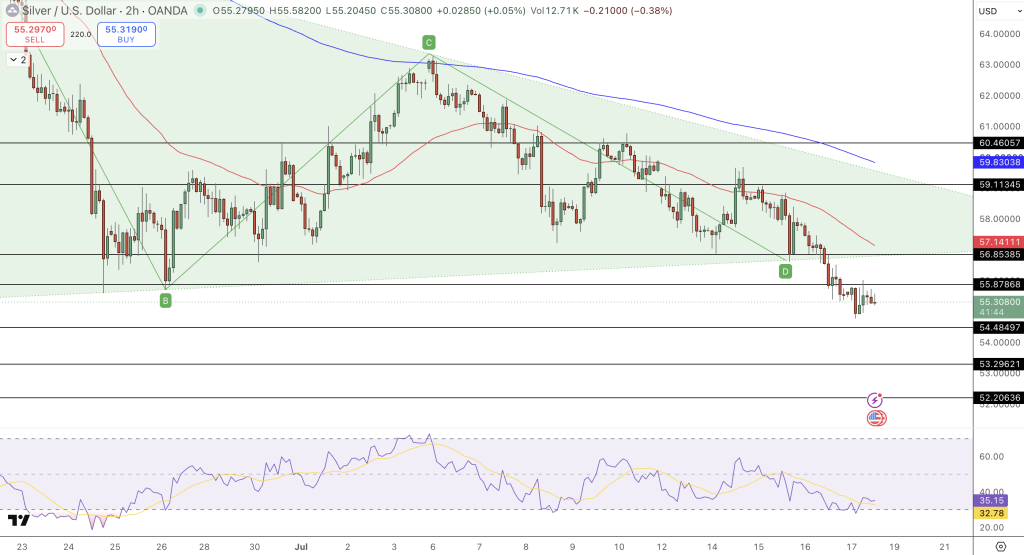
The breakdown has put the short-term technical analysis for silver in sellers’ hands. Silver remains below the 50-period simple moving average (EMA) at $57.14, and the 200-period EMA at $59.83, signaling that both medium-term and short-term momentum is currently bearish.
The immediate downside support is seen at $54.48. A firm candle close below $54.48 might increase the likelihood of silver moving to the next downside support level at $53.30.
Looking at the upside, the breakdown level of $56.85 might act as resistance. Bulls will need to push silver back above the $56.85 support level, now a ceiling, and the 50-period EMA at $57.14 for the technical outlook to improve.
The relative strength index (RSI) has declined to around 35, implying that silver is getting close to oversold conditions and that there’s a possibility of a bounce. Oversold conditions don’t always lead to a reversal, but it’s something to be aware of if silver keeps sliding in the short-term. As long as the metal remains beneath $56.85, there’s a strong chance that rallies will bring the next wave of selling.
Silver Outlook: Strong Supply Story, Difficult Macro Backdrop
Silver’s long-term case remains credible. The market is still in deficit, physical investment demand is improving, and import restrictions are tightening supply in India. These might be factors to support silver if monetary policy turns softer.
The macroeconomic outlook for the coming months is far from supportive. Oil prices are rising, which means there’s increasing expectations for inflation and rate hikes from the Federal Reserve. Treasury yields remain firm while the Fed is yet to rule out the possibility of additional tightening. Industrial demand has also slowed down and is now likely to face pressure from manufacturers who are using less silver in solar panels.
A sustained rise in silver price might have to wait for the oil price to decline, for yields to soften, the dollar to fall and a renewed flow of investors’ funds. For now, the supply deficit might be more of a long-term theme than an immediate catalyst for price increases.
- Check out our free forex signals
- Follow the top economic events on FX Leaders economic calendar
- Trade better, discover more Forex Trading Strategies
- Open a FREE Trading Account
- Read our latest reviews on: Avatrade, Exness, HFM and XM

Related Articles

Sidebar rates

Related Posts
 Save
Save