SPCX Stock Falls Toward $110 as Earnings, AI Spending and Lock-Up Expiry Threaten IPO Support
SpaceX stock SPCX falls toward $110 as Aug. 4 earnings, rising AI spending and an Aug. 6 lock-up release threaten further volatility.
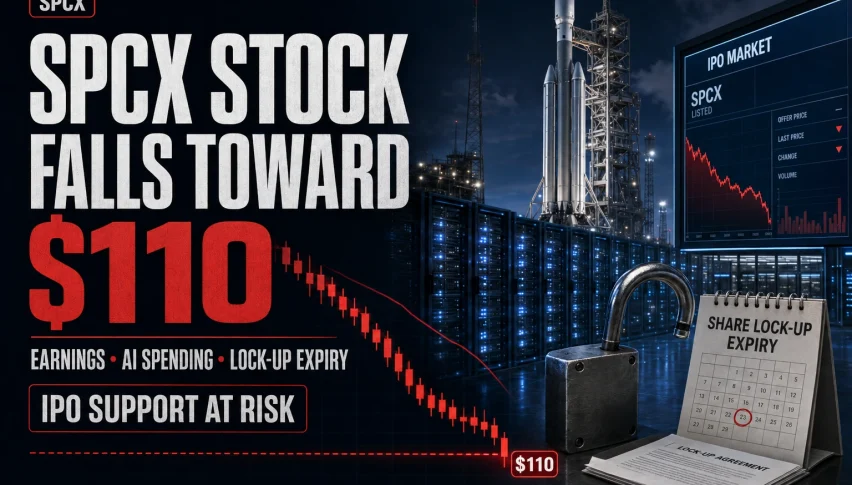
SpaceX stock slipped toward $110 after losing half its value from the post-IPO peak, as investors prepared for its first earnings report and the release of up to 911.5 million locked-up shares.
SpaceX Stock Slides Below Its $135 IPO Price as Earnings and Insider Selling Risks Approach
SpaceX stock extended its post-IPO decline as investors prepared for the company’s first quarterly earnings report as a public business and a potentially significant increase in available shares.
SPCX fell $1.57, or 1.36%, to $113.50 on Monday before slipping another 2.26% to approximately $110.89 in overnight trading.
The decline marked SpaceX’s 13th negative session in the previous 16 trading days and brought the stock close to its record low of $108.66.
SpaceX completed its initial public offering at $135 in June, raising approximately $85.7 billion through the sale of nearly 639 million shares. Strong early demand subsequently lifted the stock to $225.64.
However, the rally quickly reversed.
SpaceX has now erased more than $1.2 trillion in market capitalization from its peak, as investors reassess its valuation, rising artificial intelligence spending and the amount of stock that could enter the market following earnings.
August 4 Earnings Become a Critical Test for SPCX
SpaceX will report second-quarter results after the market closes on Tuesday, August 4, followed by a management webcast.
The report will provide investors with their first detailed post-IPO update on Starlink, launch activity, Starship development and SpaceX’s expanding artificial intelligence operations.
SpaceX generated approximately $4.7 billion in first-quarter revenue, representing growth of around 15% from a year earlier.
That performance shows that the company’s commercial operations are expanding, but the growth rate appears modest relative to a valuation still estimated near $1.5 trillion.
Investors will therefore look beyond revenue.
The market will focus on operating margins, free cash flow, satellite deployment costs and the amount of capital required to develop Starship and orbital AI infrastructure simultaneously.
Strong results could reassure investors that the selloff has gone too far. However, another increase in spending or weaker-than-expected profitability could push the stock below $100.
AI Capital Spending Creates the Biggest Earnings Risk for SpaceX
SpaceX’s artificial intelligence investments have become one of the most controversial parts of its valuation.
The company reportedly spent approximately $7.7 billion on AI-related capital expenditure during the first quarter. That represents an annualized pace above $30 billion, compared with roughly $12.7 billion during 2025.
SpaceX is developing orbital computing infrastructure intended to process artificial intelligence workloads using its satellite, launch and communications capabilities.
The strategy could eventually create an enormous new business. SpaceX has several potential advantages, including reusable launch vehicles, vertical integration and control over a rapidly expanding satellite network.
However, the economics remain uncertain.
Building AI infrastructure requires advanced processors, communications equipment, power systems and repeated satellite launches. Investors do not yet have enough information to determine when these investments could generate meaningful revenue or attractive returns.
Markets have recently punished several technology companies for raising AI capital expenditure even when their underlying revenue remained strong.
SpaceX faces the same risk. A sharp spending increase could overshadow progress across Starlink and launch services.
Lock-Up Expiry Could Release 911.5 Million Shares
The first major post-IPO lock-up release represents another immediate threat.
SpaceX’s IPO terms allow eligible shareholders to sell up to 20% of their locked stock on the second full trading day following the company’s first earnings report.
With results scheduled for August 4, the initial release could occur on August 6 and make as many as 911.5 million shares eligible for sale.
Not all shareholders will necessarily sell.
Employees, early investors and other insiders may choose to retain their positions, particularly after the stock’s steep decline.
However, even the possibility of additional supply can pressure a recently listed company.
SpaceX has already fallen below its $135 IPO price. Some early shareholders may still hold shares at substantially lower costs and could use the first available opportunity to realize gains or diversify their holdings.
The lock-up does not change SpaceX’s fundamental value, but it could increase volatility and temporarily weaken the balance between buyers and sellers.
Starship Flight 13 Provides Operational Support
The stock’s decline has continued despite encouraging operational progress.
SpaceX completed the 13th Starship flight test on July 24, with the mission achieving most of its important objectives.
Starship remains central to the company’s long-term plans. A fully reusable heavy-lift system could reduce launch costs, support lunar and Mars missions, deploy larger Starlink satellites and enable orbital AI infrastructure.
SpaceX already dominates the global commercial launch market through the Falcon 9 program. Its reusable boosters provide a cost and launch-frequency advantage that competitors have struggled to match.
However, Starship still requires additional testing before routine commercial operations become possible.
The program consumes substantial capital, and delays could affect several other parts of SpaceX’s strategy. Investors will therefore want a clearer update on future test flights, development costs and the timeline for full reuse.
Starlink Remains SpaceX’s Strongest Commercial Business
Starlink provides the clearest support for the company’s valuation.
SpaceX’s low-Earth-orbit satellite constellation delivers broadband connectivity to consumers, businesses, governments and mobile customers across global markets.
The network benefits from SpaceX’s ability to launch its own satellites at lower cost and on a faster schedule than competitors.
Starlink’s potential expansion into direct-to-device services could create another major opportunity by extending satellite connectivity to ordinary mobile phones.
However, competition is increasing.
Amazon’s Leo network and other satellite operators are expanding their constellations, while governments may support regional alternatives to reduce dependence on a single provider.
SpaceX must also continue replacing and upgrading satellites, making Starlink a capital-intensive business even as subscription revenue expands.
The earnings report should give investors a better indication of whether Starlink’s growth and cash generation can offset spending on Starship and AI.
SpaceX-Tesla Merger Speculation Adds Uncertainty
Speculation about a possible combination between Tesla and SpaceX has created another source of volatility.
Elon Musk recently declined to dismiss the possibility, citing increasing operational overlap and saying any transaction would need to follow the appropriate process.
Tesla and SpaceX already cooperate in areas including batteries, manufacturing technology and the proposed Terafab semiconductor project.
A merger could combine rockets, satellites, energy storage, robotics, autonomous vehicles and artificial intelligence within a single corporate structure.
However, substantial obstacles remain.
The companies have different shareholder bases, governance structures and regulatory exposures. Tesla’s large business in China could face additional scrutiny because of SpaceX’s relationships with the U.S. government and national-security agencies.
There is also no confirmed transaction.
Investors should therefore treat merger speculation as a potential long-term scenario rather than the central reason to own either stock.
SPCX Valuation Remains Difficult Despite the 50% Decline
SpaceX’s correction has made the stock considerably cheaper than it was near $225.
However, a market capitalization around $1.5 trillion remains demanding for a company with quarterly revenue near $4.7 billion and inconsistent profitability.
Morgan Stanley has argued that a decline to $100 could imply that the market is assigning little or no value to SpaceX’s AI business.
The brokerage reportedly maintains a $300 price target, while approximately 80% of analysts covering the company have Buy-equivalent recommendations.
The average target near $232 suggests substantial potential upside.
Nevertheless, analyst valuations depend heavily on assumptions about businesses that remain early in development.
Starlink, Starship, orbital AI computing and future Mars-related infrastructure may ultimately generate significant value. But the timing, capital requirements and profitability of those opportunities remain uncertain.
SPCX Technical Outlook Remains Bearish Below $117
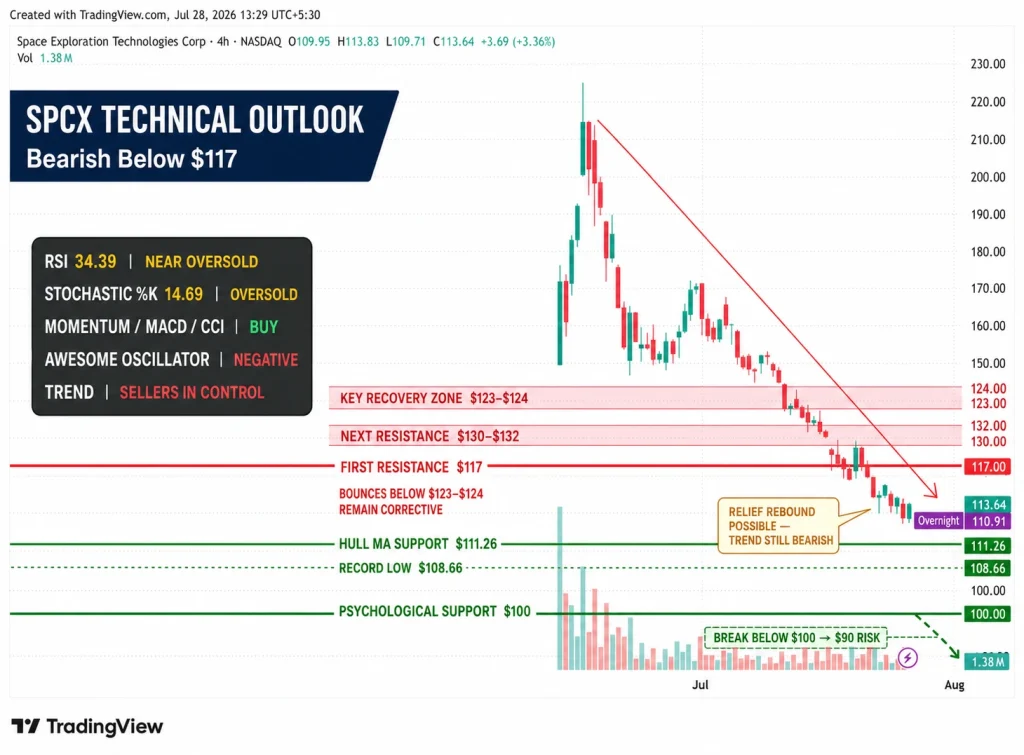
SpaceX’s four-hour chart remains firmly bearish, with the overnight price near $110.89 below every major short- and medium-term moving average.
The Hull moving average at $111.26 offers immediate support, followed by the record low near $108.66 and the psychological $100 level. A break below $100 could extend the decline toward $90.
On the upside, SPCX must first recover the 10-period averages near $117. Above that, the $123–$124 region represents the next resistance zone, followed by $130–$132.
RSI at 34.39 and Stochastic %K at 14.69 indicate that the stock is approaching oversold territory. Momentum, MACD and CCI currently show buy signals, creating the possibility of a relief rebound.
However, the strongly negative Awesome Oscillator and price action below all major averages confirm that sellers remain in control.
For now, any bounce below $123–$124 would remain corrective rather than signal a confirmed reversal.
SpaceX Faces Its Most Important Post-IPO Test on August 4
SpaceX remains one of the world’s most strategically important technology companies.
It dominates commercial launches, operates a leading satellite-connectivity platform and is developing a reusable rocket capable of transforming access to orbit.
However, the stock’s post-IPO collapse shows that investors are no longer willing to value those ambitions without greater financial clarity.
The August 4 report must demonstrate that Starlink and launch revenue can support expanding investments in Starship and AI. Two days later, the first lock-up release could place additional pressure on the shares.
For now, oversold indicators may support a rebound from $108–$111. A recovery above $117 would provide the first sign of stabilization, while a move through $124 would improve the short-term structure.
Failure to hold the record-low region could expose $100, where the market would face a critical decision over whether SpaceX’s long-term opportunities finally justify the remaining valuation.
- Check out our free forex signals
- Follow the top economic events on FX Leaders economic calendar
- Trade better, discover more Forex Trading Strategies
- Open a FREE Trading Account
- Read our latest reviews on: Avatrade, Exness, HFM and XM

Related Articles

Sidebar rates

Related Posts
 Save
Save