Microsoft’s AI Business Is Booming, but Can MSFT Stock Finally Break Above $395?
Microsoft’s AI revenue run rate reaches $37 billion as Azure grows 40% and contracted backlog hits $627 billion. Ahead of earnings...

Microsoft’s AI revenue run rate reaches $37 billion as Azure grows 40% and contracted backlog hits $627 billion. Ahead of earnings, MSFT stock must clear $394.63 to target the $408 to $422 region. As Microsoft (NASDAQ:MSFT) prepares for its upcoming fiscal fourth-quarter earnings report, the stock has regained some technical momentum and has seen its AI business expand.
MSFT has bounced off its trendline, regained the 50-period exponential moving average and is currently confronting key resistance near $394.63. The company will report earnings for the quarter and fiscal year ended June 30 on or around July 29. The report will reveal if Azure and AI growth can sustain Microsoft’s increasing capital expenditures and drive the stock higher toward $407.93 and $421.73.
Microsoft revenue increases 18% as cloud demand grows
Microsoft’s last reported quarter ended on March 31, 2026. Revenue grew 18% year over year to $82.9 billion, with operating income climbing 20% to $38.4 billion. GAAP net income increased 23% to $31.8 billion, resulting in diluted earnings of $4.27 per share. The results indicate Microsoft continues to generate healthy profit margins while continuing to spend heavily on data centers, AI accelerators, and cloud infrastructure.
Microsoft Cloud, which includes Azure, Microsoft 365 Commercial cloud, Dynamics 365, and certain parts of LinkedIn, increased 29% to $54.5 billion. Cloud products represented roughly two-thirds of total revenue for the quarter, pointing to the importance of Microsoft’s cloud revenue.
Through the first nine months of fiscal 2026, Microsoft earned $241.8 billion in revenue, an 18% increase from the same period last year.
Azure growth jumps to 40%
Intelligent Cloud was Microsoft’s largest growth segment. Revenue climbed 30% to $34.7 billion, mainly due to 40% growth in Azure and other cloud services. This growth demonstrates that Azure demand persists across traditional cloud workloads, AI developers and customers running generative AI solutions. Microsoft also leverages the breadth of its offerings across computing, databases, security, developer tools and AI models as a platform.
Management has commented on multiple occasions that demand outpaces supply. That provides a positive outlook but also hampers Microsoft’s ability to accelerate revenue recognition. To sustain future growth, Microsoft must continue to build out new data centers and increase the utilization rate of its existing assets.
Looking ahead to the fiscal fourth quarter, Microsoft expects Azure growth of 39% to 40% in constant currency. Stronger-than-expected results could further confirm that AI demand is healthy. Conversely, a lower-than-expected outcome could spark concerns about the return on Microsoft’s data center investments.
The Microsoft AI Business Hits a $37 Billion Run Rate
During the March quarter, Microsoft’s AI business reached an annual run rate of $37 billion, growing 123% compared with a year earlier. The figure includes revenue from Azure AI services, Copilot products and other enterprise products related to AI.
The number shows Microsoft is starting to turn its AI bets into real revenue instead of waiting for AI to become relevant in the future.
Microsoft has a head start on monetizing AI since it can sell AI within existing products used by companies. Copilot is available for purchase within Microsoft 365, GitHub, Dynamics, security services and Azure, which means Microsoft does not have to acquire a whole new set of customers.
In addition, Microsoft’s partnership with OpenAI positions Azure to play a significant role as a provider of computing resources and access to advanced models. But Microsoft must keep showing that Copilot adoption brings enough revenue to cover the cost of building AI infrastructure.
A $627 Billion Backlog Improves Revenue Visibility
Microsoft had $627 billion of commercial remaining performance obligation at March 31, up 99% compared with one year ago. Remaining performance obligation is revenue contracted with customers that has not yet been recognized.
The large amount of remaining performance obligation gives Microsoft visibility into revenue in the coming months and years. It also illustrates that companies and big AI clients are making multi-year commitments to Microsoft’s cloud infrastructure.
Revenue won’t be recognized immediately from the backlogged work. Still, a backlog of more than $600 billion gives Microsoft some breathing room if the economy softens in the near term or companies become more conservative when it comes to cloud spending.
Productivity and Business Processes revenue rose 17% to $35 billion. Microsoft 365 Commercial cloud revenue grew 19%, Dynamics 365 grew 22% and LinkedIn revenue was up 12%.
More Personal Computing remains the lowest-performing segment of Microsoft’s business. Revenue fell 2% to $13.2 billion as Windows OEM and Devices declined and Xbox content and services revenue dropped. The weak performance in the segment is less concerning than in the past because most of Microsoft’s revenue growth now comes from cloud and productivity products.
$190 Billion in Spending Boosts Microsoft’s Bets on AI
Microsoft raised its full-year 2026 capital expenditure estimate to around $190 billion. The spending includes additional data centers, plus higher prices for memory, networking hardware and AI accelerators.
If Microsoft spends this much money, it could give the company an edge over competitors by allowing it to handle demand that others cannot. But Microsoft will also face higher depreciation charges, putting more pressure on management to deliver strong results.
At the end of March, Microsoft held about $78 billion in cash, cash equivalents and short-term investments. The company had more than $694 billion in total assets, and its strong operating cash flow meant Microsoft could continue paying dividends and repurchasing stock.
Microsoft (MSFT) Earnings Could Be Key Factor in Next Breakout
The company gave fiscal fourth-quarter revenue guidance of $86.7 billion to $87.8 billion. Analysts expect Azure revenue growth, the growth rate of AI-related revenues, Copilot uptake, operating margins, and updated capital spending forecasts from management to drive the stock price. Forward guidance may be more important than headline revenue and earnings.
Any indication that Azure demand continues to outpace supply could sustain the bullish outlook, while reports of delays in new data centers or a slowdown in AI revenue generation could weigh on the stock.
Microsoft Stock Technical Analysis: What’s the Next Level?
Microsoft (MSFT) has created a higher low after bouncing off its uptrending support line and the pivot point at $376.90. A bullish candle has lifted the stock back above the 50-period exponential moving average at $389.60, and the 200-period exponential moving average at $394.63.
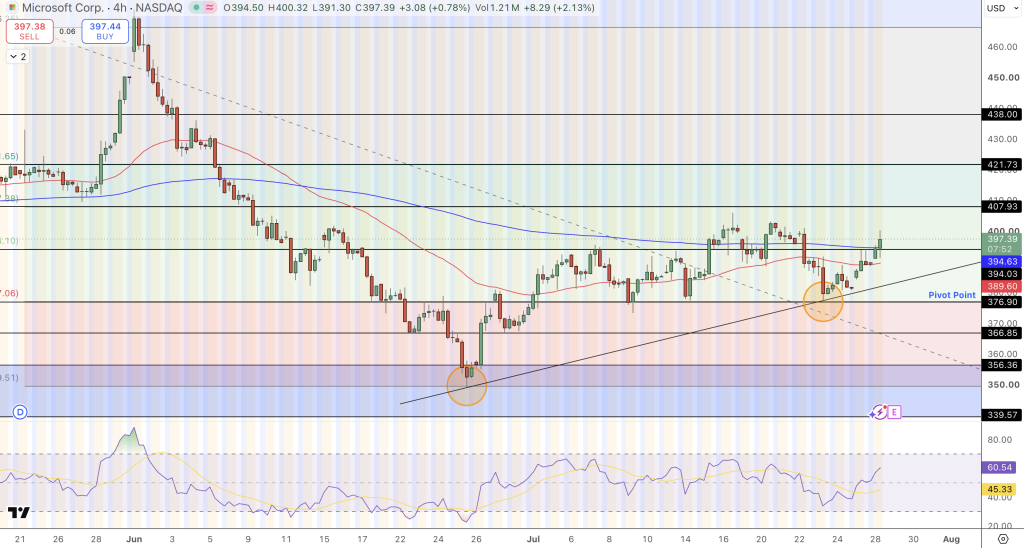
The RSI is now above 60, indicating strengthening bull strength but not yet extended. This suggests there is still room for gains if buyers break through $394.63. If the next leg takes MSFT above $394.63, the next target is $407.93, followed by $421.73. A failure to stay above the 50-day EMA at $389.60 would likely stall the bullish recovery and send the stock back to the $376.90 pivot. Support lies below at $366.85 and $356.36.
Microsoft Stock Price Outlook
Microsoft enters earnings with strong Azure growth, a run rate for AI revenue of $37 billion and $627 billion of contracted business. These fundamentals are supportive of a longer-term rally, although the size of the company’s $190 billion spending program is high.
Technically, $394.63 is the immediate test. A break above that level could pave the way for a move to $407.93 and $421.73, while a pullback below the 50-period EMA may see MSFT revisit its uptrend support line.
- Check out our free forex signals
- Follow the top economic events on FX Leaders economic calendar
- Trade better, discover more Forex Trading Strategies
- Open a FREE Trading Account
- Read our latest reviews on: Avatrade, Exness, HFM and XM

Related Articles
Sidebar rates

