MU Stock Hits 52-Week High as AI Memory Supercycle Accelerates and Analysts Target $1,000
Micron surges over 6% to a new ATH as HBM demand explodes, hyperscalers confirm a memory crunch, and Wall Street's most bullish price target
Quick overview
- Micron Technology's stock surged over 8% on May 4, reaching a new 52-week high of $589 before closing at $576.45.
- The increase was driven by strong earnings reports from peers and bullish price targets from analysts, indicating underestimated profit potential for Micron.
- High Bandwidth Memory (HBM) products are sold out for several quarters, highlighting systemic supply limitations amid rising demand from major tech companies.
- Micron's recent earnings beat expectations significantly, projecting substantial revenue and profit growth driven by AI-related memory demand.
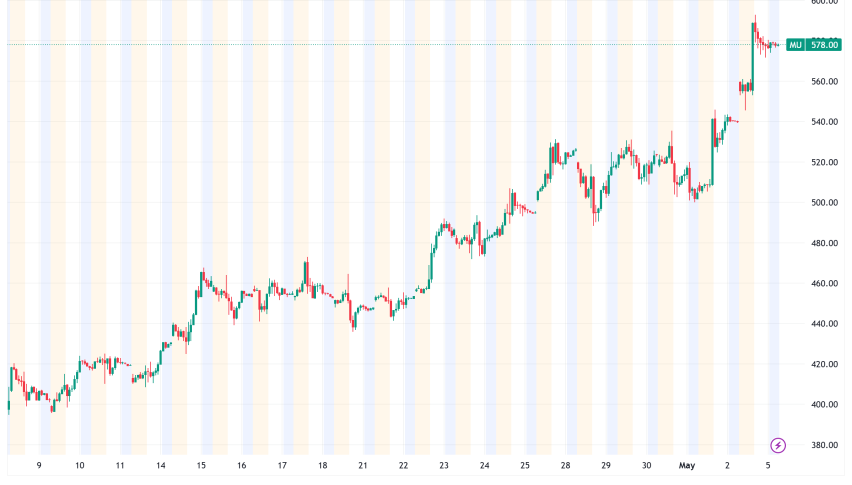
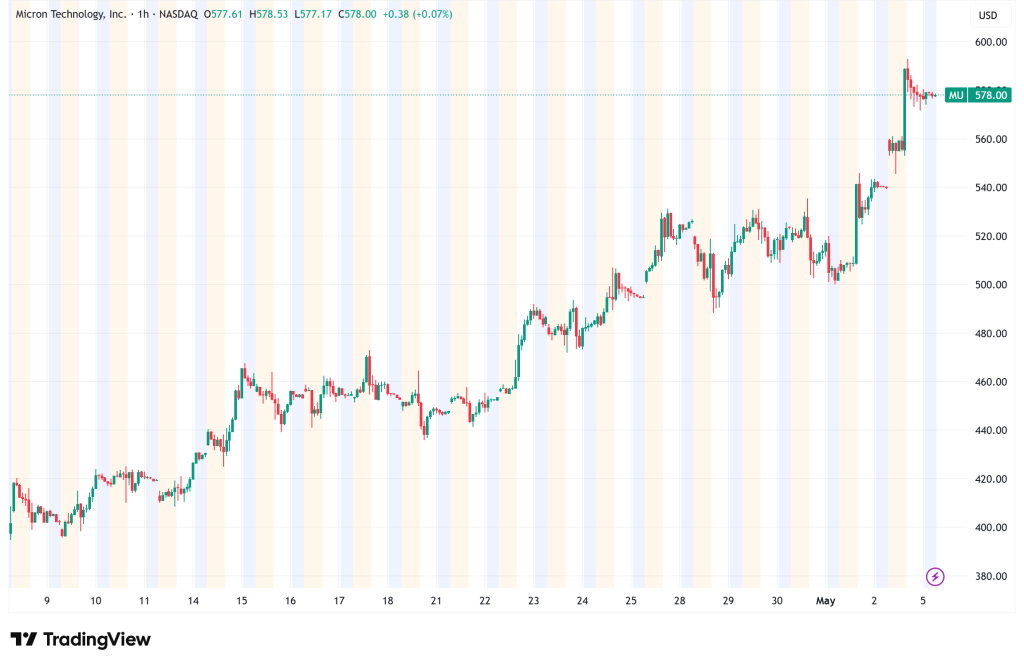
May 4 was one of Micron Technology’s (NASDAQ: MU) best days in months, with the stock rising more than 8% intraday to reach a new 52-week high of $589 before closing at $576.45, a gain of 6.31% for the day that put the S&P 500’s near flat close to shame. Shares closed at $583.34, up 4.1%, in after-hours activity.
Micron Stock New 52-Week High on Converging Catalysts
The session was born out of a confluence of events. Peer semiconductor manufacturer Sandisk had already shattered its Q3 earnings report the week before, boosting enthusiasm across the memory industry. Bernstein followed with a $1,750 price goal while Fox Advisors bumped up its Sandisk price objective to $1,500 over the weekend. Neither firm directly promoted Micron, but the read-across was apparent – if NAND and DRAM price is skyrocketing to that degree, then Micron’s profits trajectory is being considerably under-estimated.
Then DA Davidson went a step further with a $1,000 price target right on Micron, the highest on Wall Street, along with a Buy rating. Thesis: AI infrastructure spending has permanently changed the memory cycle, producing a demand-supply dynamic that will keep prices elevated for far longer than previous semiconductor cycles traditionally permitted.
Hyperscalers Confirm the Memory Crunch
What’s interesting about the current environment is that Micron’s pricing power is not just being forecasted by analysts – it’s being validated in real time by the company’s own customers. Memory costs are a major budget driver for 2026, three of the world’s biggest technology spenders said on recent earnings calls.
The rise in Meta’s 2026 capital expenditures was due to higher component pricing, its chief financial officer said. Microsoft cited the higher component costs as having a $25 billion impact. Amazon’s chief executive said memory costs had “sky-rocketed” with supply not meeting demand. Apple’s Tim Cook separately warned of a prolonged memory crisis.
These are not analyst estimates, they are operational disclosures from the firms writing the biggest cheques on AI infrastructure. For Micron, it implies pricing power isn’t theoretical, it’s locked in via confirmed demand from clients who have openly said they can’t acquire enough supply.
HBM: Sold Out and Structurally Scarce
High Bandwidth Memory is the most essential product in Micron’s portfolio right now — it’s the unique chip design that goes into AI accelerators and allows the huge data flow that large language models need. Micron said its HBM products are sold out “for several quarters to come.”
The supply limitation is systemic and not transient. There are just three global HBM suppliers – Micron, SK Hynix and Samsung; Samsung recently said the memory chip bottleneck is severe and SK Hynix has been aggressively pre-positioning inventory. Even the expedited manufacturing schedules these three vendors are operating are not keeping pace with demand growth, as Nvidia’s Blackwell and next-gen AI accelerators require ever-more HBM capacity per chip.
And it’s not only the stock that is bouncing around. Goldman Sachs points out that Micron alone makes up 51% of all S&P 500 EPS revisions since the start of the Middle East crisis, a staggering fact that shows how outsized Micron’s position has become in the current earnings cycle.
Micron’s Earnings Print That Started It All
Micron’s recent surge is due to its Q2 FY2026 earnings announcement, which achieved one of the biggest estimate beats in company history. Adjusted EPS came in at $12.20, well above the consensus estimate of $9.21, or 33%. Revenue of $23.9 billion exceeded the projection of $20.0 billion by approximately 20%.
Looking ahead, the projection for Q3 FY2026 is even more impressive: Revenue of $33.5 billion, Gross Margin of 81% and EPS of $19.15. The company is on target to increase revenues 200% and profitability 600% year-over-year in this fiscal year. These are not incremental gains – they are a dramatic change in Micron’s financial profile driven almost exclusively by AI related memory demand.
Micron (MU) Stock Valuation: Cheaper Than It Looks
Despite the rally, Micron trades at about 25 times trailing profits, a sizable discount to peer Sandisk which is trading at about 40 times earnings after its own rapid run. That value disparity implications for investors contemplating exposure to the AI memory theme.
Memory stocks are cyclical by nature, and rising prices do eventually bring supply reactions. That risk is still real. The hyperscaler comments above provides important support for the structural argument from DA Davidson that AI has generated a positive feedback loop between compute deployment and memory demand that prolong the upcycle. Gravity may not be above the cycle, but the ceiling looks higher than past versions.
What’s Next for Micron Traders?
Micron’s rally to a new 52-week high is a true alignment of fundamental catalysts: blowout profits, sold-out HBM supplies, hyperscaler confirmation of a memory crunch, and Wall Street price forecasts hitting four digits for the first time. This stock isn’t a speculative AI trade anymore — it’s being positioned as key AI infrastructure.
The breakout has traders eyeing the $557-$560 level as near-term support with momentum signs pointing to further higher if the larger semiconductor industry holds up. A reasonable place to go in would be to get back in on a retreat to that zone on profit-taking. On the upside the next target to watch is the $600 psychological level with the $1,000 analyst target providing a long term directional anchor for position size decisions.
- Check out our free forex signals
- Follow the top economic events on FX Leaders economic calendar
- Trade better, discover more Forex Trading Strategies
- Open a FREE Trading Account
- Read our latest reviews on: Avatrade, Exness, HFM and XM

Related Articles
Sidebar rates

Related Posts
 Save
Save
