UPS Stock Crashes 10% as Amazon Opens Logistics Network to All Comers
Amazon's launch of Supply Chain Services sends UPS and FedEx into freefall, threatening the incumbents' most profitable business lines.
Quick overview
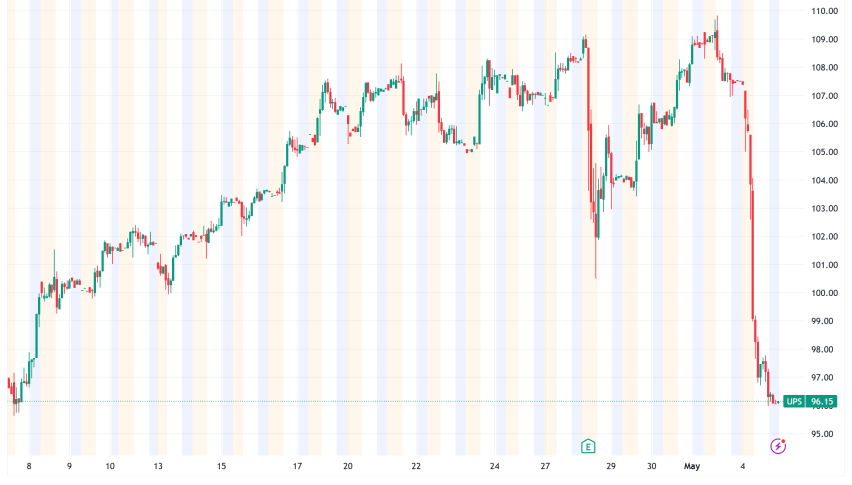
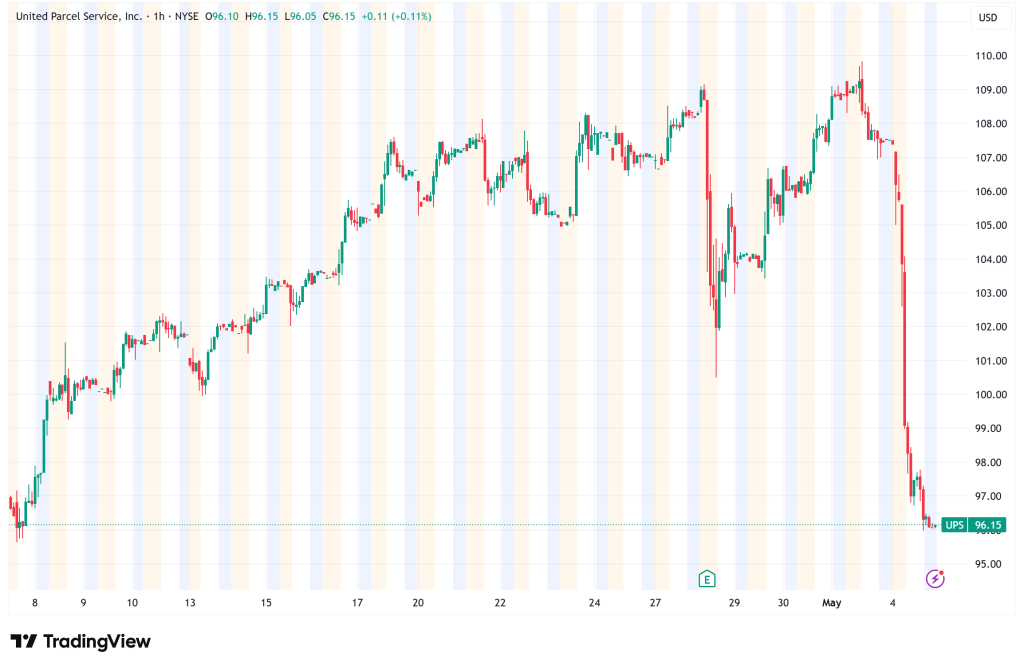
- UPS shares fell 10.47% to $96.31, marking its largest single-day decline in years due to Amazon's launch of Amazon Supply Chain Services.
- Amazon's new platform allows businesses to utilize its extensive logistics network, posing a significant threat to UPS's high-margin B2B shipping segment.
- Major companies like Procter & Gamble and 3M are already using Amazon's logistics services, indicating strong enterprise traction for the platform.
- UPS faces a challenging environment with declining global trade volumes and increased competition, leading to concerns about its future earnings stability.
Monday was a tough one for UPS shareholders. Shares of the package giant plunged 10.47% to $96.31, its biggest single-session decline in years, after Amazon opened up its massive logistical infrastructure to outside businesses with a new platform named Amazon Supply Chain Services.
The service lets enterprises in retail, healthcare, manufacturing and automobiles to leverage the same freight, warehousing, fulfillment and last-mile delivery network that Amazon established for its own e-commerce empire. That system has more than 100 cargo aircraft, 80,000 trailers, 24,000 intermodal containers and a distribution infrastructure for ocean, air, ground and rail. Clients can also take advantage of Amazon’s AI-driven inventory forecasting and multi-channel fulfillment solutions.
Shares of FedEx tumbled a comparable 9% on the day, with contract logistics businesses GXO Logistics and DHL also under pressure, with GXO down nearly 13%.
Amazon’s Direct Attack on UPS’s Most Profitable Segment
Where Amazon is headed is what makes this threat particularly serious for UPS. The new platform is aimed firmly at business to business shipping – the high-margin market UPS and FedEx have been moving toward as they actively draw back from lower-margin retail packet volumes.
B2B shipments are popular because they are denser, more predictable and cheaper to serve than consumer deliveries. UPS has been reshaping its entire business around this market. Now Amazon is entering the space with scale and pricing power and an existing relationship with many of the same enterprise clients.”
The similarities to Amazon Web Services are impossible to overlook. AWS began as internal infrastructure, launched to external customers in 2006, and became the world’s largest cloud platform. Amazon is playing a similar long plan here – turning a shipping cost center into a revenue-generating infrastructure product.
Early Clients Signal Real Enterprise Traction
This isn’t some speculative foray for Amazon. Procter & Gamble is leveraging the network to transfer raw materials and finished goods, 3M is sending items worldwide on Amazon’s freight network, and American Eagle Outfitters is using Amazon’s package delivery for direct-to-consumer fulfillment. The platform already includes blue-chip clients — Lands’ End also participates on the platform and utilizes Amazon’s single inventory pool across several sales channels.
These are not marginal experiments. These are major sophisticated logistics purchasers selecting Amazon for significant pieces of their supply chains over incumbents. The warning from UPS is unmistakable: The competitive threat is not just coming, it’s here.
What It Means for UPS Stock
For UPS, the timing is just compounding a challenging backdrop. The company has been grappling with weaker global trade volumes, cost restructuring and margin pressure, and is also seeking to reorient itself away from low-value parcel movements. Amazon’s arrival doesn’t just bring a new competitor, it threatens the very part of the business that UPS was banking on to steady its earnings course.
Baird analysts said they “would not be surprised to see near-term weakness across less-than-truckload, air-freight and forwarding complexes” as the sector digests the competitive implications. Evercore ISI was more blunt, describing it as a “direct competitive blow” with little sugar coating.
The big question is how UPS responds today. Yet the company still has significant pluses – 117 years of operating experience, substantial enterprise ties, a worldwide network that Amazon can’t copy overnight and a healthcare logistics division that remains a true difference. But standing motionless is not an option.
UPS Stock Technical Analysis: Significant Damage
From a technical perspective the 10% decline has caused major chart damage. UPS has now sliced through multiple support layers, and is trading at levels not seen in several years, in one session. Momentum is firmly negative and any near-term attempt at recovery is expected to meet tough resistance in the $100-$105 zone.
Traders should keep an eye out for UPS to settle in the $93-$96 level. But if they can’t hold here, selling might pick up speed toward the $85-$88 area. Unless the rebound is on high conviction volume and management has a credible strategic response, it’s difficult to stick.”
Conclusion: What’s Next for UPS Investors?
Amazon’s foray into third party logistics is a real structural change, not a headline risk that blows over in a week. “UPS is facing its toughest competitive threat in a generation and the market’s 10% verdict is a perfect reflection of that. UPS’s scale and corporate ties provide a buffer, but now its biggest protection — the transition to B2B and healthcare logistics — is being aggressively questioned.
Traders don’t see much upside to the long side unless there is either technical stabilization or a clear strategic response from UPS management. Keep an eye on the $96 level.
- Check out our free forex signals
- Follow the top economic events on FX Leaders economic calendar
- Trade better, discover more Forex Trading Strategies
- Open a FREE Trading Account
- Read our latest reviews on: Avatrade, Exness, HFM and XM

Related Articles


Sidebar rates

Related Posts
 Save
Save