IONQ Stock Surges 9.5% as Quantum Computing Revenue Explodes 755%, But Mounting Losses Keep the Debate Alive
IonQ crushed revenue estimates by 30% with 755% growth, but a $97M EBITDA loss keeps IONQ stock a high-conviction, high-risk trade.
Quick overview
- IonQ reported a record revenue of $64.7 million for Q1, marking a 755% year-over-year growth, significantly surpassing analyst expectations.
- Despite strong sales, the company faced a substantial adjusted EBITDA loss of $96.8 million, raising concerns about its profitability.
- IonQ's commercial sales were driven by a diverse customer base, with 60% of revenue coming from commercial clients and a growing international presence.
- The company secured important government contracts, enhancing its revenue visibility and validating its technology in competitive environments.
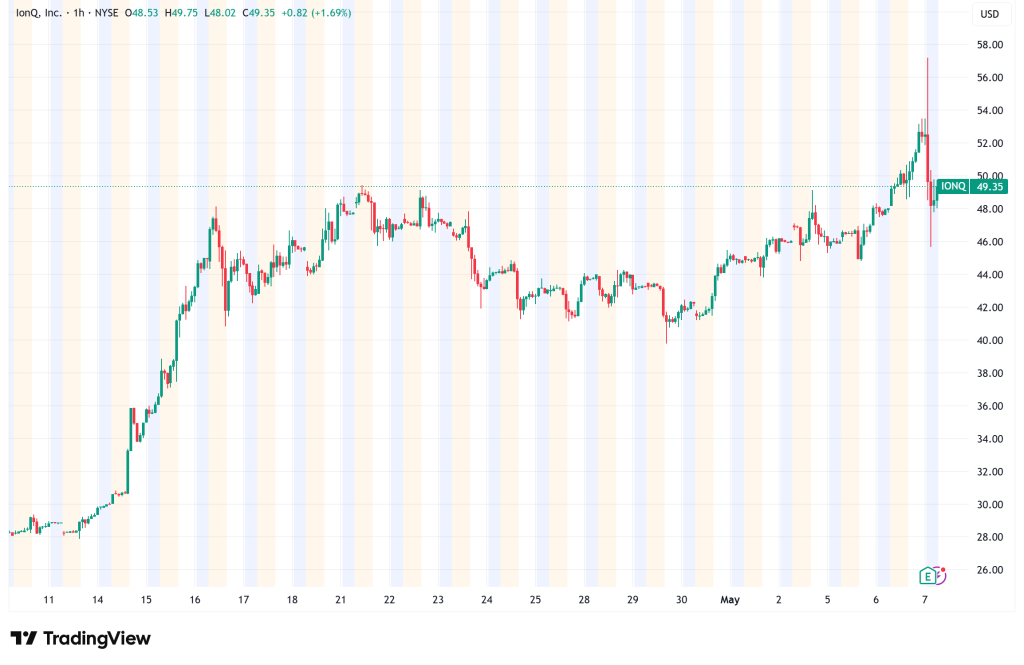
On May 7, IonQ (NYSE: IONQ) announced its largest quarter in business history — and the market’s reaction spoke it all about how contentious the quantum computing field remains. Shares initially plummeted 8.5% in after-hours trading on the earnings miss at the adjusted level, but reversing strongly to end up 9.52% the next session, as investors processed the entire picture.
IonQ Reports Annual Growth of $64.7M, a 755% YoY Growth
The revenue numbers were really, really good. The 755% annual growth to $64.7 million was 30% over the analyst forecast, a beat that’s nearly unheard of at any size. CEO Niccolo de Masi said it was “the biggest quarter in our company’s history — so far” and that momentum is continuing growing, not slowing. Full-year guidance upgraded to $265 million at the midpoint vs a prior estimate of $236 million, signaling ongoing outperformance through the remainder of 2026 13.
The problem was the corrected financials told a different story. Adjusted EBITDA loss was a huge failure at $96.8 million, a 170% year-over-year decrease. Adjusted EPS of -$0.34 missed the estimate of -$0.25 by 37.5%. The GAAP EPS of $2.19, which was first striking, was mostly driven by a change in fair value of warrant liabilities, a non-operational accounting issue, and not by any underlying improvement in profitability. Free cash flow was -$159.4 million, down sharply from -$35.3 million a year ago, highlighting the cost of rapid expansion.
Commercial Customers Drive 65% of Sales
Beyond the accounting chaos, IonQ’s commercial progress in Q1 is hard to overlook. Around 60% of sales came from commercial customers, 35% from international customers and 35% from multi-product customers – the last number showing that purchasers aren’t simply buying computing access but engaging with IonQ’s wider platform covering networking, sensing and security.
The company has now sold quantum solutions in over 30 countries, compared to a handful a year ago. We have $470 million of remaining performance obligations, up 554% year-over-year, which is kind of like a locked-in future revenue stream and really de-risks our growth prospects in the short term. It is the trajectory of the backlog, more than any one quarter’s revenue number, that the long-term investment thesis is based on.
The product milestones are equally important. IonQ’s first 256-qubit, chip-based, sixth-generation system was sold to the University of Cambridge, supported by a secure quantum network and a broad IP-generation relationship across many application domains. This is the start of a move from fifth-generation Tempo systems – which remain in high demand – to a new generation of hardware that will put IonQ at the forefront of fault-tolerant quantum computing.
During the quarter the business got its first ion trap chip sample returns from the fab and transitioned from component level testing to integrated system level testing of the whole 256-qubit machine. IonQ also shared what it says is the world’s first formal architectural blueprint for fault-tolerant quantum computing, a technical transparency move intended to build trust with commercial and government buyers making long-term quantum bets.
Defense and Government Contracts Add Durability
The official perspective is that IonQ was selected for DARPA’s HARQ program due to the company’s leadership in modular quantum computing and scalable networking architectures based on quantum interconnects. The company also was awarded a $39 million contract to develop next-generation tactical space communications under the Space Development Agency’s HALO program, and was also awarded a position on the Missile Defense Agency’s SHIELD IDIQ contract.
“These contracts achieve two objectives: providing near-term revenue visibility and validating IonQ’s technology in the most demanding performance environments available. Winning government defense contracts is famously tough and often signals real technological differentiation, rather than marketing hype.
IonQ’s Profitability Problem
The bull thesis on IonQ requires you to believe in years of mounting losses before the economics of scale turn positive. The full-year adjusted EBITDA loss projection of -$310MM to -$330MM is a considerable cash burn, especially against the $3.1 billion cash cushion. Analysts expect the adjusted loss per share to widen from -$0.34 in Q1 to -$0.99 for the full year.
The company is investing heavily in manufacturing capacity growth, deployment resources and the SkyWater chip fabrication relationship – all required investments but which put profitability farther into the future. The -420% operating margin in Q1 is an improvement from -1,000% a year earlier but it shows how much the business is away from positive returns on its revenue base.
What’s Next After IONQ Q1 Earnings?
IonQ’s Q1 statistics affirm it as the most commercially advanced pure-play quantum computing business in the world—a distinction it won through true product milestones, government contracts and a growing international client base, not through narrative alone. The 755% revenue growth and $470 million backlog are not abstractions.
The stock’s volatility around earnings — an 8.5% decrease followed by a 9.52% recovery — speaks to the dichotomous nature of investing in a nascent technology that is simultaneously providing exceptional top-line growth and large losses. For traders, The $48-$50 area is the near-term support from the after-hours decline and the $55-$58 area is the next resistance level to watch on ongoing momentum. For the longer-term investor, the main signs to watch are backlog growth and the ramp of the commercial 256-qubit system that will demonstrate if IonQ’s revenue surge is durable or front-loaded.
- Check out our free forex signals
- Follow the top economic events on FX Leaders economic calendar
- Trade better, discover more Forex Trading Strategies
- Open a FREE Trading Account
- Read our latest reviews on: Avatrade, Exness, HFM and XM

Related Articles
Sidebar rates

Related Posts
 Save
Save
