UBER Jumps 8.5% as Gross Bookings Hit $53.7B, Robotaxi Bets Signal a New Growth Phase
Uber broke a six-quarter post-earnings losing streak with $53.7B in bookings, 33% EBITDA growth, and guidance that topped consensus.
Quick overview
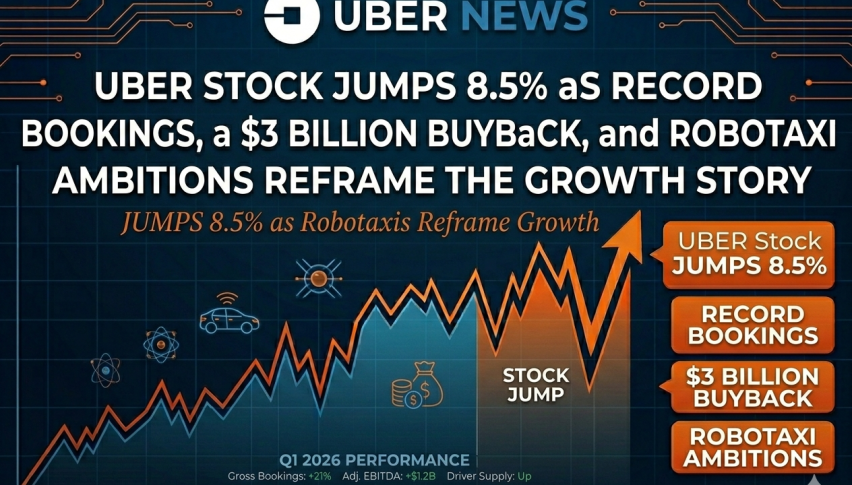
- Uber's Q1 earnings report showed significant growth, with gross bookings rising 25% year-on-year to $53.7 billion.
- The delivery segment excelled, generating $5.07 billion in revenue, while the mobility segment faced challenges but still posted a 25% increase in gross bookings.
- Uber is investing heavily in autonomous vehicles, committing $1.25 billion to Rivian for robotaxis and launching a new business unit for AV partnerships.
- The company's membership program, Uber One, is driving recurring revenue and enhancing customer loyalty, contributing to a positive outlook for the stock.
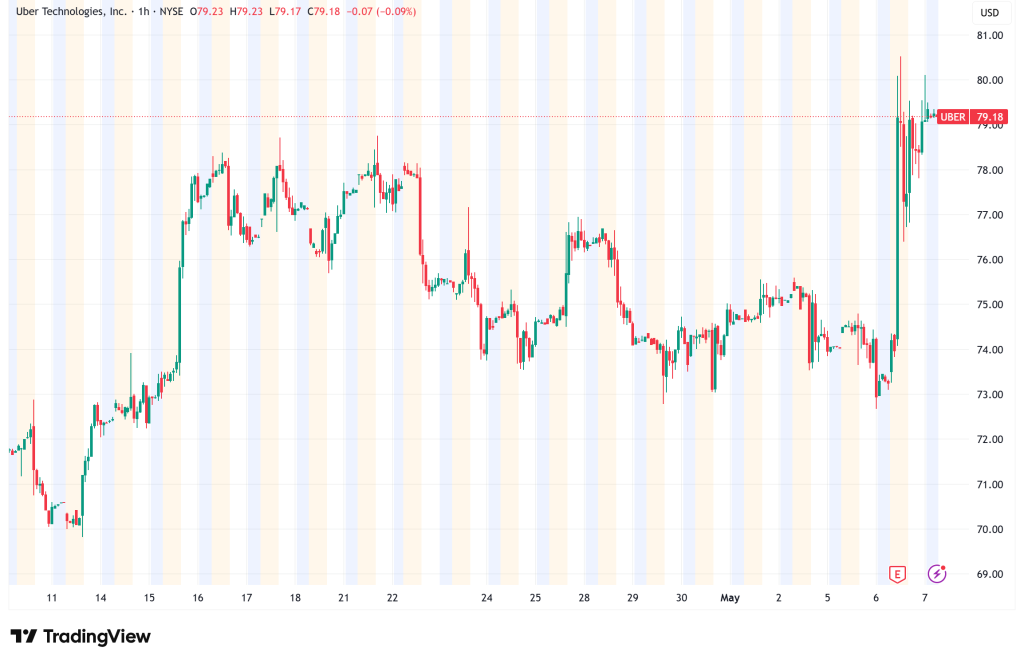
Uber Technologies (NYSE:UBER) has been an annoying profits bet. The stock had declined after results in each of the past six quarters irrespective of the underlying performance. Wednesday’s results sharply broke that trend, with shares soaring more than 8% after a Q1 report that delivered on the measures investors care most about: bookings, profitability and future guidance.
Uber’s Q1 Earnings Rewards Shareholders
Gross bookings of $53.7 billion, up 25% year-on-year, above the consensus and the company’s own projection range of $52.9 billion. Adjusted EBITDA of $2.48 billion was higher than the projection of $2.44 billion and up 33% from a year earlier. Non-GAAP EPS of $0.72 above the $0.71 expectation. GAAP operating income reached a record $1.9 billion. CEO Dara Khosrowshahi said it was “an exceptional start to 2026” despite what he called “a complex macro backdrop marked by weather disruptions, geopolitical tensions and gas price volatility.”
GAAP net income was $263 million, down drastically from $1.78 billion a year earlier, mainly due to a $1.5 billion charge on the revaluation of equity stakes in Didi and Grab. The underlying operational performance was clean and getting better.
Delivery Leads, Mobility Steadies, Freight Returns
Uber’s delivery business was the star of the quarter. Revenue rose 34% to $5.07 billion, topping the $4.89 billion forecast, with robust results in Australia, Japan and the UK, in particular. Delivery gross bookings increased 28% to $25.99 billion. Khosrowshahi said that consumer spending remained resilient and doesn’t appear to be slowing, a positive data point given broader concerns about discretionary spending in a high energy price environment.
The mobility segment missed the revenue forecast at $6.8 billion vs estimates of $7.11 billion but nonetheless posted 25% gross bookings increase to $26.39 billion. The miss was partly due to macro headwinds – since combat operations began in Iran in February, US gas prices are up almost 50%, putting pressure on driver economics and creating friction in some regions.
In a rare bright spot, Uber Freight returned to growth for the first time in nearly two years, with bookings up 6%, a hint the logistics business may be stabilizing after a long depression. For the quarter, Uber delivered 3.6 billion journeys on its platform, up 20% year-over-year, while monthly active consumers on the platform increased 17% to 199 million.
Uber’s Autonomous Vehicle Bet Is Getting Bigger
The most strategically important developments of the quarter were not in the rearview mirror, but on the road ahead. Uber said it will spend $1.25 billion in Rivian for 10,000 R2 robotaxis, with an option to buy a further 40,000 by 2030. Initial launches will start in San Francisco and Miami in 2028, and will be in 25 locations by 2031.
The company also announced Uber Autonomous Solutions, a new business unit to help AV partners create and deploy fleets on Uber’s demand-matching network around the world. Waymo, WeRide, Waabi, Wayve and Nuro existing AV collaborations continue to expand Khosrowshahi targets Waymo availability in 15 cities by year-end 2026 Uber also increased its stake in Lucid Motors to $500 million, and now owns more than 11% of Lucid. Its vehicles will serve as the hardware base for Nuro’s Level 4 autonomous software.
“Another trillion-dollar total addressable market,” Khosrowshahi called the AV opportunity. Pointedly, Khosrowshahi said it won’t be winner-takes-all, establishing Uber as the platform layer that wins regardless of whether hardware and software companies eventually win out.
Premium and AI Push Adds Another Growth Lever to UBER Stock
Uber’s membership program, Uber One, which currently has 50 million members, is becoming a powerful flywheel. Members contribute 50% of gross bookings across Mobility and Delivery, creating a recurring revenue foundation that smooths out cycle volatility.
The business also created Uber Elite, a premium tier aimed at CEOs and regular travelers, and started providing in-app hotel booking through an Expedia deal that gave users access to more than 700,000 properties. Uber One customers get 10% back in credits on hotel bookings, adding stickiness to the platform beyond transportation. AI-powered voice booking using ChatGPT was added also, and Khosrowshahi said that AI algorithms now forecast three-quarters of rides on the platform before they’re requested. More than 95% of Uber’s developers are using AI coding tools on a monthly basis, and today over 10% of code is created independently.
Should You Buy Uber Stock in 2026?
Uber’s Q1 numbers are a real inflection in the market’s image of the firm — from a growth story that consistently disappointed to one that is showing operating leverage, capital returns and a credible long-term autonomous car strategy all at the same time. A P/E of around 15-16x versus a tech sector average above 70x and a consensus analyst price target of $106.71 (more than 40% upside) is hard to argue with.
The break over $78 sets up a new support range in the near-term and the $82-$85 range is the next resistance to watch for traders. The risk is still the autonomous vehicle spending ramp — $1.25 billion into Rivian alone is a substantial commitment — and any macro deterioration that impacts consumer mobility spending. But with earnings expanding at double the rate of revenue, and management executing a disciplined capital return program in concert with ambitious growth initiatives, the directional bias has turned considerably to the upside.
- Check out our free forex signals
- Follow the top economic events on FX Leaders economic calendar
- Trade better, discover more Forex Trading Strategies
- Open a FREE Trading Account
- Read our latest reviews on: Avatrade, Exness, HFM and XM

Related Articles
Sidebar rates

Related Posts
 Save
Save