Alphabet Raises $80 Billion for AI as Berkshire Invests $10 Billion: Building the World’s Largest Compute Engine?
GOOGL stock: Alphabet plans an $80B stock sale to fund AI infrastructure, with Berkshire Hathaway investing $10B in a major endorsement.
Written by:
Arslan Ali Butt•Tuesday, June 2, 2026•3 min read
•Last updated: Tuesday, June 2, 2026
Quick overview
Alphabet is raising $80 billion through equity offerings to expand its artificial intelligence infrastructure, including a $10 billion investment from Berkshire Hathaway.
The company views AI not just as a product opportunity but as a critical infrastructure race, driven by surging demand from enterprise and consumer customers.
Despite initial negative reactions from investors due to dilution concerns, the long-term strategy positions Alphabet as a key player in the AI era.
Berkshire Hathaway's investment signals strong confidence in Alphabet's ability to generate returns from its significant AI spending.
Alphabet is making one of the boldest capital allocation decisions in corporate history.
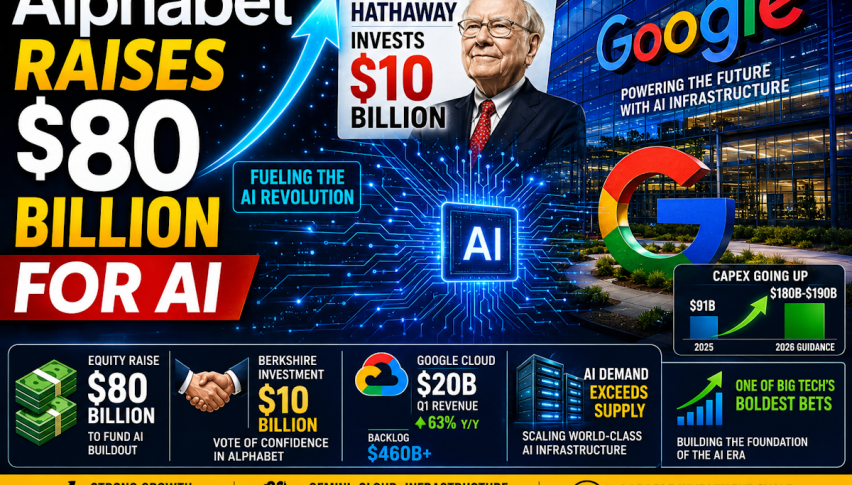
The Google parent announced plans to raise $80 billion through equity offerings, including a $10 billion investment from Berkshire Hathaway, to accelerate its artificial intelligence infrastructure expansion.
The move comes as demand for Google’s AI services, cloud computing platform, and Gemini models continues to exceed available capacity.
While investors initially reacted negatively to the dilution, sending shares lower, the announcement highlights a much bigger story: Alphabet is positioning itself to become one of the dominant infrastructure providers of the AI era.
Alphabet Is Betting Bigger on AI Than Ever Before
The fundraising announcement confirms what investors have increasingly suspected.
Google no longer views AI as a product opportunity alone.
It views AI as an infrastructure race.
The company said demand from enterprise and consumer customers is exceeding available supply, forcing management to aggressively expand compute capacity.
Key figures illustrate the scale:
New equity raise: $80 billion
Berkshire Hathaway investment: $10 billion
2026 capex guidance: $180 billion-$190 billion
2025 capex: approximately $91 billion
Recent debt raised: over $85 billion
Total debt balance: over $100 billion
Combined with Microsoft, Amazon, and Meta, hyperscalers are expected to spend more than $700 billion on AI infrastructure this year alone.
Some Wall Street forecasts now expect industry AI capex to exceed $1 trillion annually by 2027.
Berkshire Hathaway’s Investment Changes Google’s AI Narrative
Perhaps the most important aspect of the announcement was Berkshire Hathaway’s participation.
The investment giant will purchase:
$5 billion of Class A shares
$5 billion of Class C shares
Berkshire had already built one of its largest technology positions in Alphabet.
The new investment significantly expands that commitment.
The move carries symbolic importance because Berkshire is known for prioritizing durable competitive advantages, strong cash generation, and long-term returns on capital.
Many investors view the transaction as a vote of confidence in Alphabet’s ability to generate attractive returns from its massive AI spending.
More importantly, it signals growing confidence from Berkshire CEO Greg Abel, who has increasingly shaped Berkshire’s investment decisions.
AI Demand Is Accelerating Across Google’s Ecosystem
Alphabet’s aggressive spending is supported by powerful operating trends.
Google Cloud Is Booming
Google Cloud generated:
$20 billion in Q1 2026 revenue
63% year-over-year growth
Contract backlog exceeding $460 billion
Cloud remains one of Google’s most important AI monetization channels.
Enterprise customers increasingly rely on Gemini models, custom AI chips, and Google’s cloud infrastructure to build AI applications.
Gemini Is Delivering Results
Investor sentiment toward Google has improved significantly as Gemini adoption accelerates.
The market increasingly believes Google can successfully defend its search franchise while creating entirely new AI revenue streams.
That belief has helped Alphabet outperform most mega-cap peers over the past year.
Why Investors Initially Sold the GOOGL Stock
Despite the strategic rationale, the market’s first reaction was negative.
Alphabet shares fell after investors focused on dilution.
The math explains why:
$80 billion issuance against a roughly $4.5 trillion market value
Estimated dilution of approximately 1.8%
For many investors, dilution concerns temporarily overshadowed the long-term growth opportunity.
However, equity financing offers several advantages:
Permanent capital
Reduced reliance on debt markets
Greater balance sheet flexibility
Capacity to fund multi-year infrastructure investments
Management appears willing to accept modest dilution in exchange for maintaining its competitive position in AI.
Alphabet’s Biggest Risk: AI Economics
The central debate surrounding Google is no longer whether AI demand exists.
The question is whether AI spending will generate adequate returns.
Alphabet is effectively making a massive wager that:
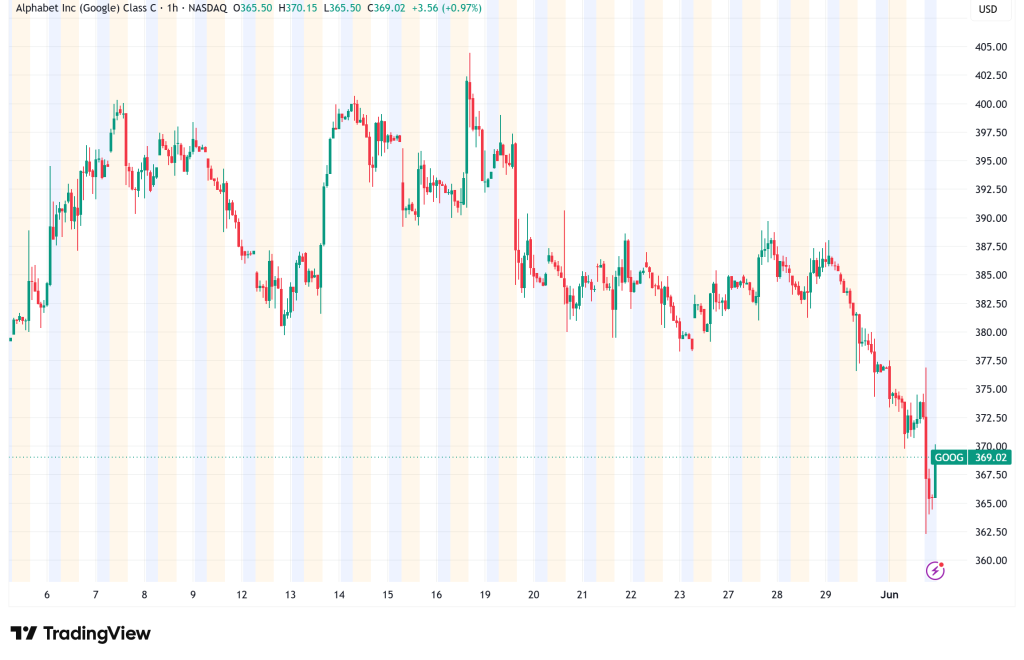
From a technical perspective, Alphabet remains one of the strongest large-cap technology stocks.
The stock has more than doubled over the past year and continues to trade within a well-established long-term uptrend.
RSI has cooled from overbought levels and MACD remains positive, suggesting momentum is moderating but has not turned bearish, supporting a consolidation phase rather than a trend reversal.
Support and Resistance Levels
Level Type
Approximate Area
Immediate Resistance
$380
Major Resistance
$400
Psychological Resistance
$450
Near-Term Support
$360-$365
Secondary Support
$340
Major Trend Support
$300-$320
Holding above the $360 area would preserve the current bullish structure, while a move back above $380 could signal renewed momentum.
Long-Term Outlook: Alphabet Is Becoming an AI Utility
The most important takeaway from Alphabet’s announcement may not be the stock sale itself.
It is what the company intends to do with the money.
Google is increasingly evolving from a search and advertising company into a foundational AI infrastructure provider.
Its advantages remain formidable:
Global cloud platform
Proprietary AI models
Massive enterprise customer base
Custom TPU chips
Search distribution dominance
Deep financial resources
The company’s willingness to raise $80 billion despite already generating enormous cash flow highlights management’s belief that the AI opportunity is larger than anything technology companies have faced since the internet revolution.
Investors may worry about dilution today.
But if AI becomes the next trillion-dollar computing platform, Alphabet’s infrastructure investments could ultimately determine whether Google remains a technology leader for the next decade.
Lead Markets Analyst – Multi-Asset (FX, Commodities, Crypto)
Arslan Ali Butt serves as the Lead Commodities and Indices Analyst, bringing a wealth of expertise to the field. With an MBA in Behavioral Finance and active progress towards a Ph.D., Arslan possesses a deep understanding of market dynamics.
His professional journey includes a significant role as a senior analyst at a leading brokerage firm, complementing his extensive experience as a market analyst and day trader. Adept in educating others, Arslan has a commendable track record as an instructor and public speaker.
His incisive analyses, particularly within the realms of cryptocurrency and forex markets, are showcased across esteemed financial publications such as ForexCrunch, InsideBitcoins, and EconomyWatch, solidifying his reputation in the financial community.




 Save
Save
