Dell Stock Dips Below $400 as Cheaper Competition Hits Hardware Sector
Dell shares reversed sharply lower this week as concerns over cheaper Chinese competition, margin pressure, and slowing enthusiasm for AI hardware overshadowed strong infrastructure demand and earlier support from President Trump's public endorsement.
Quick overview
- Dell shares fell over 10% this week, dropping below the $400 mark due to concerns about competition from cheaper Chinese manufacturers and margin pressures.
- Despite strong demand for AI infrastructure products, investors are increasingly focused on profitability and the impact of rising component costs on margins.
- Dell's recent product expansions and strong earnings results highlight its potential in the AI market, but investor confidence is wavering amid competitive pressures.
- Institutional investors remain optimistic about Dell's long-term strategy, yet the recent stock decline indicates a cautious market environment prioritizing sustainable earnings growth.
Dell shares reversed sharply lower this week as concerns over cheaper Chinese competition, margin pressure, and slowing enthusiasm for AI hardware overshadowed strong infrastructure demand and earlier support from President Trump’s public endorsement.
Dell Rally Loses Momentum as Shares Slip Below $400
Dell Technologies shares came under heavy selling pressure on Wednesday, falling more than 10% and dropping back below the important $400 level after failing to establish fresh record highs.
The reversal erased much of the momentum generated earlier this month when President Trump publicly praised the company and encouraged Americans to “go out and buy a Dell computer” during a White House event promoting the launch of Trump Accounts.
President Trump also highlighted Dell CEO Michael Dell’s participation in the initiative, helping fuel a strong rally in the stock at the time.
However, the latest decline suggests investors are becoming increasingly focused on industry fundamentals rather than political endorsements or short-term sentiment catalysts.
Hardware Sector Faces Pressure From Chinese Competition
The immediate trigger behind the selloff appears to be growing concerns surrounding lower-cost competition from Chinese hardware manufacturers.
As Chinese companies continue improving their technological capabilities and expanding production capacity, investors are increasingly questioning whether Western hardware companies will be able to maintain premium pricing over the long term.
The concern extends beyond Dell and has affected much of the broader hardware sector, with investors rotating away from companies perceived to be vulnerable to intensifying price competition.
For Dell, which benefited significantly from the first wave of AI infrastructure spending, the prospect of lower-cost alternatives entering the market has raised fresh questions about future margins.
Infrastructure Growth Remains Strong
Despite the recent weakness, Dell continues to benefit from exceptionally strong demand for AI infrastructure products.
The company’s server business remains one of the largest beneficiaries of enterprise spending on artificial intelligence, cloud computing, and hyperscale data center expansion.
Recent earnings results highlighted a rapidly growing backlog of AI server orders as businesses continue investing heavily in computing capacity.
These trends have helped offset weaker conditions in traditional personal computer markets and remain central to Dell’s long-term investment case.
However, investors are increasingly asking when strong revenue growth will translate into consistently higher profitability.
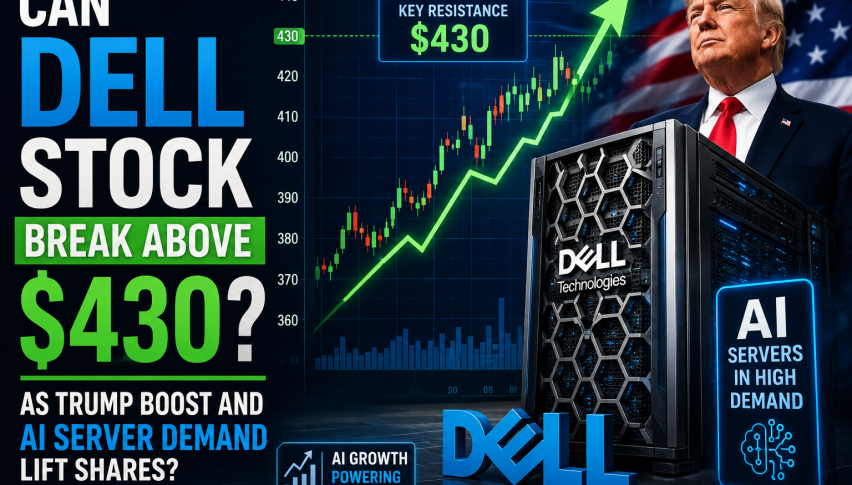
Dell Stock Chart Daily – Will DELL Price Resume the Uptrend?

Dell’s recent stock action reflects a turnaround in February from a retreat in the previous months. After reaching a high near $180 in May 2024, the stock slumped significantly, bottoming out around $67 by early April 2025, coinciding with broader market volatility.
However, technical indicators pointed to a rebound which unfolded in Q2 of 2026. The price soared to 470 in early June but has been consolidating in a range since then. On Wednesday we saw a pullback, but the 20-day Simple Moving Average (gray) has been acting as support around the $400 zone, preventing deeper declines.
Margin Concerns Begin to Dominate the Narrative
One of the biggest challenges facing Dell is the rising cost of critical components.
Advanced semiconductors, high-bandwidth memory products, and specialized AI hardware continue to command premium prices throughout the supply chain.
While demand remains robust, higher component costs are creating pressure on hardware margins across the industry.
At the same time, competition among server manufacturers is intensifying.
As more companies enter the AI infrastructure market, investors worry that aggressive pricing strategies could gradually reduce the premium margins that companies like Dell enjoyed during the early stages of the AI buildout cycle.
Product Expansion Supports Long-Term Strategy
Dell continues investing aggressively to strengthen its competitive position.
The company recently expanded its enterprise and consumer offerings with several new products aimed at AI-enabled computing environments.
Among the latest launches is the AI-focused Pro Max 16 Copilot+ PC featuring processors from AMD and graphics technology from NVIDIA.
Dell has also introduced additional cybersecurity and resilience solutions designed to support increasingly complex AI workloads.
In the consumer segment, the company launched its latest XPS 13 laptop with aggressive pricing aimed directly at competitors including Apple.
While these initiatives strengthen Dell’s long-term product portfolio, investors remain focused on whether increased competition could eventually pressure profitability.
Institutional Confidence Remains Intact
Despite the recent volatility, institutional investors continue to show confidence in Dell’s long-term strategy.
Several large asset managers have recently increased their exposure to the company, attracted by its growing role in AI infrastructure and enterprise computing.
Professional investors continue to view Dell as one of the major beneficiaries of long-term data center expansion and artificial intelligence adoption.
However, the recent reversal highlights a changing market environment.
Investors are becoming less willing to reward growth stories without clear visibility into margins, returns on capital, and sustainable earnings growth.
For Dell, the long-term outlook tied to AI infrastructure remains favorable.
Yet the sharp rejection below record highs and the move back under $400 suggest the market is entering a more cautious phase, where competition, profitability, and execution may matter more than headline growth figures alone.
DELL Earnings Results
Dell Technologies (DELL) reported stellar Q4 fiscal 2026 results on February 26, 2026, beating estimates with $3.89 adjusted EPS and $33.38B in revenue, driven by a 342% surge in AI-optimized server sales. The company, which is benefiting from high AI demand, issued a strong outlook, projecting fiscal 2027 revenue between $138B and $142B, prompting a surge in share prices.
Key 2025 Earnings Highlights (Q4 & Full Year)
- Q4 Revenue: $33.38 billion, up 39.5% year-over-year.
- Q4 Adjusted EPS: $3.89, surpassing estimates of $3.53.
- Server Performance: Record AI-optimized server revenue of $9.0 billion in Q4, representing a 342% increase from the prior year.
- Full-Year Revenue: $60.8 billion, a 40% year-over-year increase.
- Full-Year Operating Income: $7.1 billion, up 27% year-over-year.
Dell Fiscal 2027 Outlook
- Revenue Growth: Projected to be between $138 billion and $142 billion.
- AI Outlook: Revenue for AI-optimized servers is expected to continue strong momentum, driven by high demand for AI hardware.
Operational Highlights
- Infrastructure solutions, including servers and networking, experienced high demand, with total server and networking revenue hitting $14.8 billion in Q4, reports Barron’s.
- Dell’s AI server backlog continues to grow, and the company is navigating rising memory costs by strengthening its supply partnerships
- Check out our free forex signals
- Follow the top economic events on FX Leaders economic calendar
- Trade better, discover more Forex Trading Strategies
- Open a FREE Trading Account
- Read our latest reviews on: Avatrade, Exness, HFM and XM

Related Articles
Sidebar rates

Related Posts
 Save
SaveAva
