Micron MU Stock Dips Below $900 Support as China Threatens the DRAM Pricing Power
As investors became more worried about the outlook for the memory business due to growing competition from China, better memory supply circumstances, and worries about semiconductor expenditure, Micron Technology's stock fell to a significant technical support level.
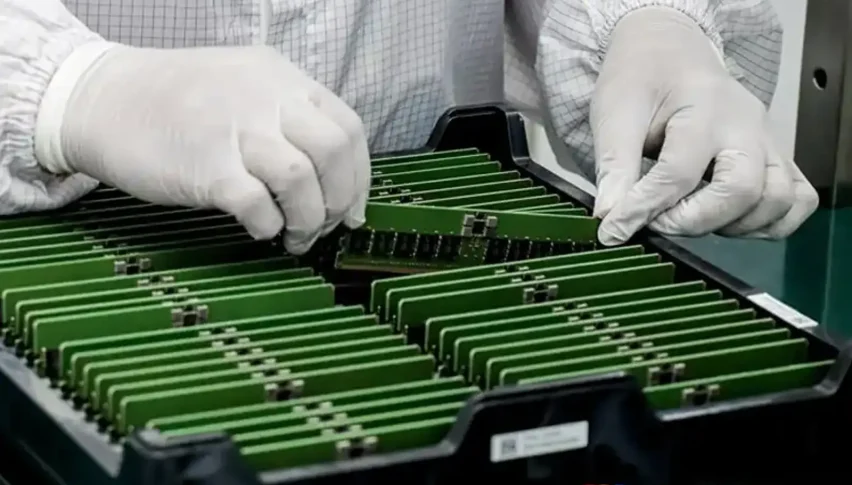
Quick overview
- Micron Technology shares have fallen below the critical $900 support level due to rising competition from Chinese manufacturers and concerns over semiconductor spending.
- The company is facing increased pressure from improving memory supply conditions and potential oversupply fears as production yields rise.
- Despite strong demand for AI-related memory products, investors are cautious about the sustainability of current pricing power and margins in the memory market.
- Micron continues to invest heavily in future growth, planning over $250 billion in U.S. semiconductor manufacturing through 2035 to meet increasing demand.
As investors became more worried about the outlook for the memory business due to growing competition from China, better memory supply circumstances, and worries about semiconductor expenditure, Micron Technology’s stock fell to a significant technical support level.
Micron Stock Falls Below $900 as Sellers Target June Lows
Micron shares came under renewed pressure this week, breaking below the critical $900 support zone and opening the door for a potential move toward the June lows in the $850 region.
The breakdown marks an important shift in sentiment after buyers repeatedly defended the $900 level during previous pullbacks.
While demand for advanced memory products linked to artificial intelligence remains robust, investors are becoming increasingly concerned that the industry’s exceptionally favorable conditions may not last indefinitely.
The latest decline suggests the market is beginning to focus more heavily on risks surrounding pricing power, supply growth, and the long-term sustainability of semiconductor spending.
Chinese Memory Competition Emerges as a Major Concern
The immediate catalyst for the latest selloff came from growing concerns over rising competition from Chinese memory manufacturers.
According to a recent Barron’s report, Chinese producer ChangXin Memory Technologies, or CXMT, is rapidly expanding its position within the global DRAM market.
The company has already become the world’s fourth-largest DRAM producer and continues to increase production capacity at an aggressive pace.
Investors were particularly focused on reports that Apple is testing CXMT memory chips for devices sold within China, a development that could represent an important milestone for the Chinese semiconductor industry.
Adding to the momentum, electric vehicle manufacturer Nio recently disclosed a $23.3 million investment in the memory producer.
While these developments do not represent an immediate threat to Micron’s earnings, they raise important long-term questions about pricing power in traditional memory markets.
Commodity Memory Faces Growing Pricing Pressure
Micron has benefited enormously from favorable pricing conditions over the past two years, particularly in high-bandwidth memory products used in AI accelerators and advanced data centers.
However, commodity DRAM and NAND markets remain highly sensitive to changes in supply and competition.
The emergence of lower-cost Chinese alternatives raises concerns that pricing pressure could eventually return to segments of the market that historically experienced severe cyclicality.
Importantly, Micron’s leadership in HBM4 and advanced AI memory products remains largely intact.
The issue for investors is not the near-term outlook but rather whether future competition could gradually reduce margins in traditional memory products that continue to contribute significantly to overall revenues.
For a stock that had been priced for near-perfect execution, even modest risks can have an outsized impact on sentiment.
Improving Production Yields Raise Oversupply Fears
Another major concern involves improving manufacturing efficiency across the memory industry.
Recent reports suggest that production yields for advanced memory products are improving faster than analysts had previously expected.
Under normal circumstances, stronger yields would be welcomed by investors.
However, memory markets have historically followed highly cyclical patterns where periods of shortages and record profitability eventually give way to oversupply and declining prices.
If production catches up with demand faster than anticipated, the supply shortages that supported premium pricing may begin to disappear.
That possibility has revived memories of previous memory downturns that severely damaged industry profitability.
Technical Strength Meets Near-Term Valuation Questions
From a technical perspective, Micron’s fall below $311 in March and the quick rebound off the 100 daily SMA (green) was symbolically important. Buyers came back as broader stock market sentiment improved. As a result, we have seen a strong rebound and buyers have pushed MU stock above the $1,000 level in early June, reaching $1,210 which was broken yesterday. We saw a pullback under $1,000 and MU stock slipped to $864, although the 20 SMA (gray) held as support again on the daily chart and we saw a rebound from there early last week. But now the 50 SMA (yellow) has been broken at $900, which held opens the door for further losses toward to $8,50.
MU Chart Daily – Micron Has Slipped Below the 50 SMA

Consumer Electronics Recovery Remains Uneven
Adding another layer of uncertainty is the slower-than-expected recovery in consumer electronics markets.
Demand from cloud providers, hyperscalers, and AI infrastructure companies remains exceptionally strong.
However, smartphone and personal computer sales have yet to recover at the pace many semiconductor companies originally anticipated.
A prolonged slowdown in consumer demand could result in rising inventories of conventional DRAM and NAND products.
Should inventory levels begin increasing, manufacturers may be forced to lower prices to stimulate demand, placing further pressure on industry margins.
For investors familiar with previous semiconductor cycles, this remains a significant risk.
Micron Continues Betting on Long-Term Growth
Despite growing market concerns, Micron continues to aggressively invest in future expansion.
The company recently announced plans to invest more than $250 billion in US semiconductor manufacturing through 2035.
The investment programme includes major production facilities in New York, Idaho, and Virginia and aims to increase domestic DRAM production to roughly 40% of total output.
Micron has also committed approximately $3 billion toward strengthening the domestic semiconductor supply chain.
In addition, the company announced a $500 million partnership with GlobalWafers designed to expand silicon wafer production capabilities in Texas while securing long-term access to critical materials.
Management argues that these investments are essential to meet growing demand from artificial intelligence infrastructure, cloud computing providers, and hyperscale data centers.
Industry Spending Boom Creates New Questions
Micron’s spending plans are part of a much broader trend sweeping across the semiconductor industry.
Virtually every major chip manufacturer is expanding production capacity at an unprecedented pace in an effort to capture future AI demand.
The concern among investors is not current demand conditions but whether future growth can justify the enormous amount of capital being deployed today.
If AI infrastructure spending slows over the coming years, the semiconductor industry could eventually find itself dealing with excess capacity and weaker pricing conditions.
That possibility has encouraged many institutional investors to become more selective despite the industry’s strong current fundamentals.
Investors Debate Whether the Peak Has Arrived
Perhaps the biggest question surrounding Micron is whether the current memory cycle represents a structural transformation or simply another temporary peak.
The company has delivered some of the strongest financial results in its history thanks to extraordinary demand for advanced memory products.
Yet the market remains cautious.
Micron continues to trade at relatively modest earnings multiples despite rapid revenue growth and record profitability.
Rather than viewing that valuation as an opportunity, many investors interpret it as a signal that markets expect earnings growth to normalize over time.
The break below $900 reinforces that caution.
From a technical perspective, the focus now shifts toward the June lows near $850, which could become the next important battleground between buyers and sellers.
While Micron’s long-term opportunities in AI memory remain significant, investors appear increasingly unwilling to assume that today’s exceptional margins and pricing power will continue indefinitely.
Until confidence improves regarding supply discipline, competitive dynamics, and the sustainability of semiconductor spending, Micron shares may continue facing periods of elevated volatility despite maintaining a strong position within the global memory market.
Micron Q3 2026 Earnings Report
Micron posted Q3 revenue of $41.46B against a $35.69B estimate and guided Q4 to $50B, blowing past a $43.24B consensus on surging AI memory demand.
Summary:
- Micron reported Q3 fiscal 2026 revenue of $41.46 billion against a consensus estimate of $35.69 billion, per company results
- Adjusted EPS came in at $25.11 versus an estimate of $20.49, according to the results
- Q3 adjusted gross margin reached 84.9%, ahead of the 81.9% estimate, per company figures
- Micron guided Q4 revenue to a range of $49 billion to $51 billion, well above the $43.24 billion Wall Street had expected, per company guidance
- Q4 adjusted EPS is forecast at $31.00 against an estimate of $25.50, according to guidance
- Q4 gross margin is guided to approximately 86%, above the 83.6% estimate, per company guidance
- The company cited customers’ rapidly growing demand as the driver behind the results and outlook
- Check out our free forex signals
- Follow the top economic events on FX Leaders economic calendar
- Trade better, discover more Forex Trading Strategies
- Open a FREE Trading Account
- Read our latest reviews on: Avatrade, Exness, HFM and XM

Related Articles



Sidebar rates

Related Posts
 Save
SaveAva
