WTI Crude Oil (USOIL) Ends the Week Above $82; Can Middle East Risks Push Crude Toward $90?

WTI crude surged 16% this week as the US-Iran conflict reignited supply fears. Here's what traders should watch this week, including Hormuz.

Crude Oil (USOIL)

Quick overview

  • WTI crude oil surged approximately 16% last week, closing near $82.49 per barrel, driven by heightened geopolitical risks following the collapse of the US-Iran ceasefire.
  • The International Energy Agency warned that prolonged disruptions in shipping through the Strait of Hormuz could threaten global energy security, as 20% of global oil shipments pass through this critical route.
  • US inventory data showed a decline in commercial crude inventories and increased refinery utilization, reinforcing the bullish sentiment in the market despite rising OPEC+ production.
  • Looking ahead, oil prices may be influenced by US-Iran military developments, tanker traffic, and economic activity, with key resistance levels set between $81.80 and $83.50.
WTI crude oil (USOIL) heads into the new trading week after one of its strongest performances of 2026. The benchmark settled Friday near $82.49 per barrel, climbing around 16% over the week, while Brent crude finished above $88, marking its highest level in more than a month.

The rally wasn’t driven by stronger economic demand or tighter seasonal supplies. Instead, it reflected a sharp return of geopolitical risk after the ceasefire between the United States and Iran collapsed, sending traders scrambling to price in potential disruptions across the Middle East.

With markets reopening Monday, attention will remain fixed on the Strait of Hormuz, US military activity and whether the recent surge has already priced in the worst-case scenario.

Middle East Conflict Completely Changed the Market

Just two weeks ago, WTI traded near $68.55 as investors expected recovering Middle Eastern production and additional OPEC+ supply to keep prices under control. That outlook changed dramatically during the past week.

The United States expanded military operations against Iran, while Iran responded with missile and drone attacks targeting regional infrastructure. At the same time, tanker traffic through the Strait of Hormuz slowed considerably as security risks increased.

Because roughly 20% of global oil shipments pass through the Strait, even partial disruptions immediately pushed risk premiums higher.

The International Energy Agency warned that prolonged shipping disruptions could threaten global energy security, while Gulf producers continued rerouting exports to alternative terminals where possible.

US Inventories Added to the Bullish Story

Geopolitical tensions were reinforced by supportive US inventory data.

The Energy Information Administration reported that commercial crude inventories declined by 1.7 million barrels, while refinery utilisation climbed to 96.2%, highlighting strong demand from refiners during the peak summer driving season.

Cushing inventories also remained below 20 million barrels, leaving the WTI benchmark particularly sensitive to additional supply disruptions.

The only weaker element of the report was a 4.6 million-barrel increase in distillate inventories, although diesel markets remain relatively tight because of reduced Russian refinery output and ongoing shipping disruptions.

OPEC+ Is Producing More… But Can It Reach Buyers?

OPEC+ continues restoring production, approving another 188,000 barrels per day increase for August.

Normally, additional supply would pressure oil prices.

The problem is that higher production matters only if producers can actually export those barrels.

Shipping through the Strait of Hormuz remains the market’s biggest uncertainty. If military tensions continue disrupting tanker traffic, higher production quotas may do little to increase actual global supply.

That explains why geopolitical headlines have had a much larger influence than OPEC announcements throughout the past week.

Demand Remains the Biggest Long-Term Risk

While supply concerns dominate today’s market, demand forecasts continue pointing in the opposite direction.

OPEC recently reduced its 2026 global oil-demand growth forecast for the third consecutive month, while the International Energy Agency remains even more cautious, warning that slowing economic activity could weigh on consumption if energy prices remain elevated.

In other words, current prices are being driven by supply fears rather than improving fundamentals.

If geopolitical tensions ease, attention could quickly shift back toward slower demand growth and recovering global production.

Related: Gold Price Forecast: Can XAU/USD Hold Above $4,000 as Oil Fuels Inflation Fears?

What Could Move Oil This Week?

Several events could shape oil prices over the coming days:

  • US-Iran military developments
  • Tanker traffic through the Strait of Hormuz
  • Wednesday’s EIA inventory report
  • US refinery utilisation
  • Global PMI data and economic activity
  • Any diplomatic progress in the Middle East

Another sizeable inventory draw combined with continued shipping disruptions would reinforce the bullish narrative. Conversely, signs of improving export flows or ceasefire negotiations could trigger profit-taking after last week’s powerful rally.

WTI Oil Price Forecast: Can Bulls Break Above $83?

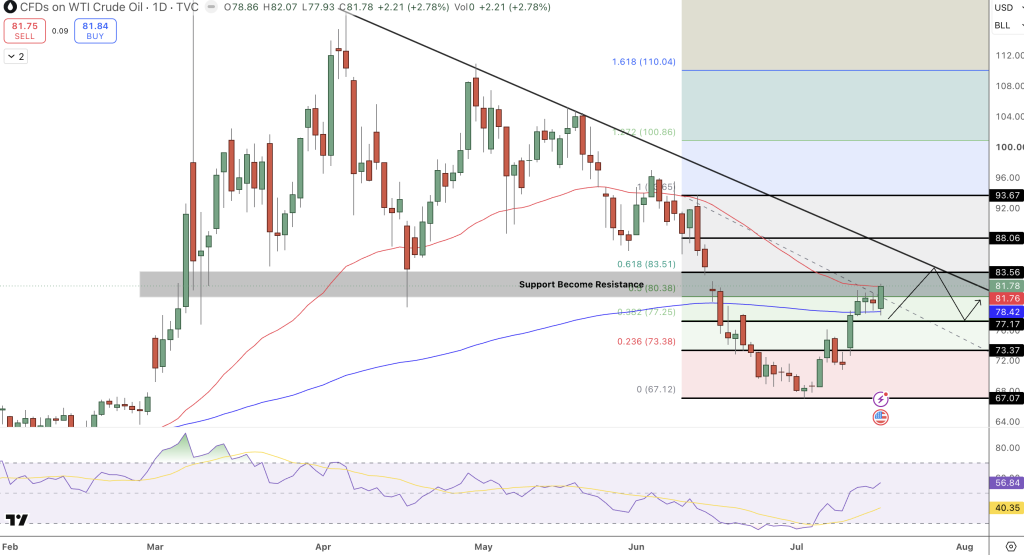
WTI has recovered sharply to around $81.80, reclaiming the important $80.40-$81.80 support zone while testing a long-term descending trendline that has capped rallies since April. The technical picture has improved significantly.

USOIL Price Chart - Source: Tradingview
USOIL Price Chart – Source: Tradingview

Price has moved back above the 50-day EMA, while the 100-day EMA near $77.25 continues providing dynamic support. Meanwhile, the RSI has climbed to approximately 57, showing strengthening momentum without entering overbought territory.

A daily close above the descending trendline and the $81.80-$83.50 resistance zone would confirm a medium-term bullish breakout and expose $88.06, followed by $93.67.

Failure to break higher could trigger another pullback toward $78.42, with stronger support around the 100-day EMA at $77.25, followed by $73.37.

WTI Weekly Outlook

WTI enters the new week with its strongest momentum in months after a remarkable 16% weekly rally.

Near-term fundamentals remain supportive as geopolitical tensions, restricted shipping and strong refinery demand continue underpinning prices. However, a significant risk premium is now embedded in the market.

For the week ahead, $81.80-$83.50 remains the key breakout zone. If Middle East tensions continue escalating, oil could challenge $88. If diplomacy gains traction or tanker traffic begins normalising, traders may quickly shift their focus back to slowing demand and increasing OPEC+ supply.

ABOUT THE AUTHOR See More
Arslan Ali Butt
Lead Markets Analyst – Multi-Asset (FX, Commodities, Crypto)
Arslan Ali Butt serves as the Lead Commodities and Indices Analyst, bringing a wealth of expertise to the field. With an MBA in Behavioral Finance and active progress towards a Ph.D., Arslan possesses a deep understanding of market dynamics. His professional journey includes a significant role as a senior analyst at a leading brokerage firm, complementing his extensive experience as a market analyst and day trader. Adept in educating others, Arslan has a commendable track record as an instructor and public speaker. His incisive analyses, particularly within the realms of cryptocurrency and forex markets, are showcased across esteemed financial publications such as ForexCrunch, InsideBitcoins, and EconomyWatch, solidifying his reputation in the financial community.

Related Articles
HFM

HFM rest

Pu Prime

Ava

Avatrade Broker

Best Forex Brokers