SpaceX (SPCX) Stock Forecast: Starship Success Meets $1.77 Trillion Reality
SpaceX (SPCX) advances Starship while Starlink continues to drive growth. Can the company justify its $1.77 trillion valuation?

SpaceX (SPCX) advances Starship while Starlink continues to drive growth. Can the company justify its $1.77 trillion valuation? Here’s what investors should watch. SpaceX enters the final week of July with investors weighing two competing narratives. Operationally, the company continues to strengthen its leadership in launch services and satellite communications after another encouraging Starship test flight.
Financially, however, the bar is much higher following its June IPO, which valued the company at roughly $1.77 trillion. The key question is no longer whether SpaceX can grow, but whether that growth can justify one of the richest valuations in global equities.
Starship Moves Closer to Commercial Reality
The biggest catalyst remains Starship Flight 13, completed on July 24. The test marked another step forward for the fully reusable launch system, with SpaceX successfully deploying 20 Starlink V3 demonstration satellites before completing atmospheric re-entry with significantly less heat-shield damage than previous flights. Engineers also collected valuable data from redesigned thermal protection tiles, an important milestone for improving vehicle reusability.
Not everything went perfectly. Several Super Heavy booster engines failed to restart during landing, preventing a controlled recovery. While the issue highlights that booster reuse still requires refinement, the mission nevertheless showed steady progress towards routine commercial operations.
For investors, every successful Starship test reduces long-term execution risk and improves confidence that SpaceX can eventually lower launch costs across its entire business.
Starlink Continues to Drive Recurring Revenue
Although Starship dominates headlines, Starlink remains SpaceX’s largest commercial asset. The network now operates roughly 10,000 satellites serving customers across more than 150 countries, supporting residential broadband alongside aviation, maritime, enterprise and government connectivity.
The next growth opportunity is direct-to-device communications, allowing conventional smartphones to connect directly with satellites in areas without terrestrial coverage. If adopted at scale, the service could significantly expand Starlink’s addressable market while creating another recurring revenue stream beyond broadband subscriptions.
Launch Leadership Remains a Competitive Advantage
SpaceX also continues to dominate global launch services. Falcon 9 remains the industry’s most frequently flown reusable rocket, supporting commercial payloads, national security missions, NASA contracts and continuous Starlink deployment. That vertical integration gives SpaceX an advantage few competitors can replicate, allowing it to launch its own satellites while monetising excess launch capacity through government and commercial customers. The combination of reusable rockets, launch infrastructure and satellite services creates one of the strongest competitive moats in the aerospace industry.
PLTR Technical Analysis: Breakout Attempt at the Descending Trendline
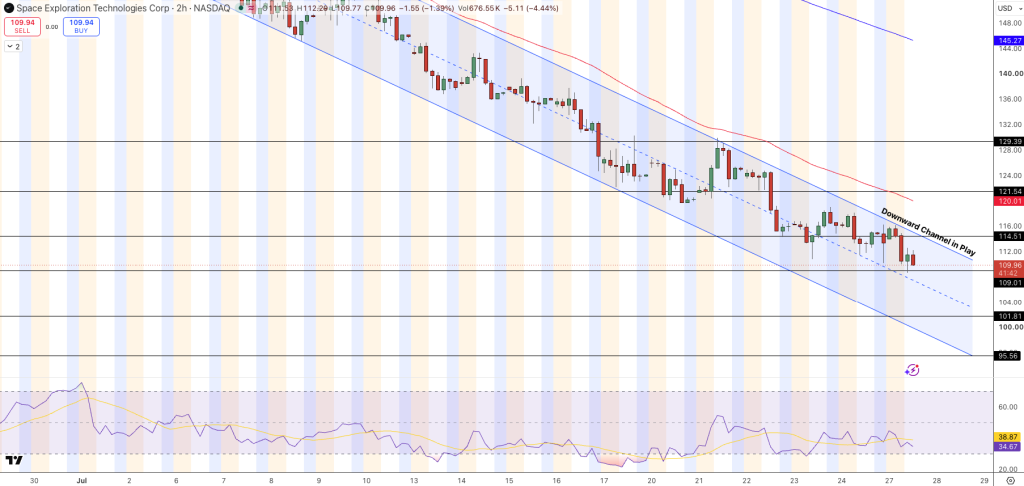
PLTR enters the week with improving momentum after breaking above short-term resistance near $128.70. The price has rebounded from the ascending trendline and is now challenging the long-term descending trendline that has capped rallies since June. The stock has reclaimed both the 50-period EMA at $127.46 and the 200-period EMA at $128.88 on the intraday timeframe. However, the daily 200-day moving average near $154 remains well above the current price, confirming that the broader downtrend has yet to be broken.
The RSI has climbed to nearly 68, signalling strong bullish momentum while approaching overbought territory. There is still room for further upside if the breakout is confirmed.
The Valuation Debate Is Only Beginning
The investment debate now centres on valuation rather than technology. At approximately $1.77 trillion, investors are effectively pricing in years of continued growth across Starlink, launch services and Starship. Expectations also include successful expansion into direct-to-device communications, lunar transportation and future commercial space infrastructure.
That leaves little room for execution mistakes. Delays to Starship certification, slower Starlink subscriber growth, tighter regulation or rising capital expenditure could all pressure the shares if earnings fail to keep pace with expectations. Maintaining a constellation of thousands of satellites also requires continuous replacement launches, meaning SpaceX’s investment cycle is unlikely to slow in the foreseeable future.
Bottom Line
SpaceX remains one of the strongest long-term growth stories in aerospace. Starship is progressing steadily, Starlink continues generating recurring revenue and the company maintains a commanding position in reusable launch technology.
The challenge for investors is valuation. After debuting at $1.77 trillion, future returns will increasingly depend on flawless execution rather than simply maintaining technological leadership. With Starship development, Starlink expansion and NASA programmes all advancing simultaneously, SpaceX has multiple long-term growth engines but the market already expects most of them to succeed.
- Check out our free forex signals
- Follow the top economic events on FX Leaders economic calendar
- Trade better, discover more Forex Trading Strategies
- Open a FREE Trading Account
- Read our latest reviews on: Avatrade, Exness, HFM and XM

Related Articles

Sidebar rates

Related Posts
 Save
SaveAva