NVIDIA’s AI Machine Is Printing Billions, So Why Is NVDA Stock Stuck Below $205?
Even though NVIDIA (NASDAQ: NVDA) is rebounding off $194.13 after a violent selloff, the stock needs to break above the $204.50 to $205.00..
Even though NVIDIA (NASDAQ: NVDA) is rebounding off $194.13 after a violent selloff, the stock needs to break above the $204.50 to $205.00 range to regain a bullish posture. Although NVIDIA’s financial results continue to set new highs, the technical picture has deteriorated as shares have broken below their uptrend and key moving averages.
While NVIDIA’s revenue and net income both climbed 65% year over year in fiscal 2026, the current weakness reflects fears about export restrictions, lofty valuations and stretched expectations.
NVIDIA Revenue Reaches a Record $215.9 Billion
Revenue reached $215.9 billion in fiscal 2026, up from $130.5 billion the year before. Net income rose 65% to $120.1 billion, while diluted EPS hit $4.90. Operating income was $130.4 billion, and gross margin came in at 71.1%.
Compute and Networking revenue rose 67% to $193.5 billion, and Graphics revenue climbed 57% to $22.5 billion. Data Center, which accounts for the majority of NVIDIA’s sales, grew around 68% year over year, driven by cloud operators, AI labs, companies and nations investing in sovereign AI infrastructure.
Fiscal 2027 Off to an Accelerating Start
Revenue in the first quarter of fiscal 2027, ending April 26, hit $81.6 billion, up 85% year over year and 20% sequentially. Data Center revenue surged 92% to a record $75.2 billion, comprising roughly 92% of the total revenue. Data Center networking revenue climbed 199% to $14.8 billion. Networking is an important aspect of NVIDIA’s moat.
By selling integrated solutions that include InfiniBand, Spectrum-X Ethernet and NVLink, NVIDIA creates stickier relationships and higher revenues per customer. GAAP gross margin was 74.9%, and non-GAAP gross margin was 75%. GAAP operating income increased 147% to $53.5 billion, and net income was $58.3 billion. Quarterly operating cash flow was roughly $50 billion.
$91 Billion Second Quarter Guidance Brings High Expectations
In its guidance for the second quarter of fiscal 2027, NVIDIA forecasted revenue of $91 billion, plus or minus 2%, which would be another significant sequential gain if the midpoint of its guidance were reached.
NVIDIA management also expects its GAAP and non-GAAP gross margins to be close to 74.9% and 75%, respectively, plus or minus 50 basis points. Maintaining margins close to 75% as NVIDIA grows at its current rate speaks to the profitability of the company’s AI infrastructure business.
But NVIDIA’s guidance does not include any Data Center compute revenue from China. The export restrictions therefore remain a major concern for NVIDIA since they deprive the company of sales in a large market and present a lucrative opportunity for China’s chipmakers.
Blackwell and CUDA Keep NVIDIA Ahead
Blackwell and its Ultra versions remain the company’s primary engines of growth. The chips are intended to deliver more performance per watt and a lower cost per token for AI training and inference.
But NVIDIA’s competitive edge isn’t just about superior chip capabilities. The company’s software ecosystem, including CUDA, creates high switching costs for customers trying to migrate their established workloads to other hardware.
NVIDIA controls an estimated 75% to 90% of the AI accelerator and Data Center GPU markets, depending on whether you count custom chips, according to industry watchers. Although AMD’s Instinct accelerators, Google’s Tensor Processing Units and Amazon Trainium chips have been used in some specialized workloads, NVIDIA still supplies the lion’s share of the GPUs to cloud service providers and AI developers.
The company is also investing in its next-generation Rubin platform, which is expected to enter production later in the product cycle. As demand for higher computing power and better energy efficiency continues to drive the sector, it will be crucial that NVIDIA keeps launching new products on schedule.
Gaming, Robotics, and Edge Computing Add Diversification
Even though Data Center accounts for the majority of NVIDIA’s revenue, the company still derives some income from Gaming, Professional Visualization, Automotive, and Robotics, among other markets. This enables NVIDIA to leverage its accelerated computing capabilities for consumer hardware and physical AI.
Gaming has been fueled by demand for Blackwell GPUs, though supply issues may hamper short-term demand. Automotive and Robotics represent much smaller markets compared to Data Center, but offer a long-term growth opportunity as AI transitions from cloud-based to vehicle-based or machine-based AI.
Cash Flow Supports an $80 Billion Buyback
NVIDIA generates significant cash flow, which gives management plenty of room to maneuver. In May 2026, the board approved an extra $80 billion for share buybacks and raised the quarterly dividend from $0.01 to $0.25 per share. At the end of fiscal Q1, NVIDIA held tens of billions in cash, equivalents, and marketable securities, with total assets surpassing $250 billion.
Such a balance sheet allows for investment in research and development, product expansion, acquisitions, and shareholder dividends while not straining its financial health. Operating expenses will rise as NVIDIA invests in next-generation architectures, networking, software, and ecosystem development. With its current margin and cash generation, such costs should be easily absorbed.
NVDA Technical Analysis: Can Buyers Reclaim $205?
NVDA just printed a bullish recovery candle after several long bearish candles bottomed out around $194.13. This indicates bargain-hunting, but the stock is still trading below its broken uptrend line and both key EMAs. The 50-period EMA at $204.63 and 200-period EMA at $204.55 represent a strong resistance area.
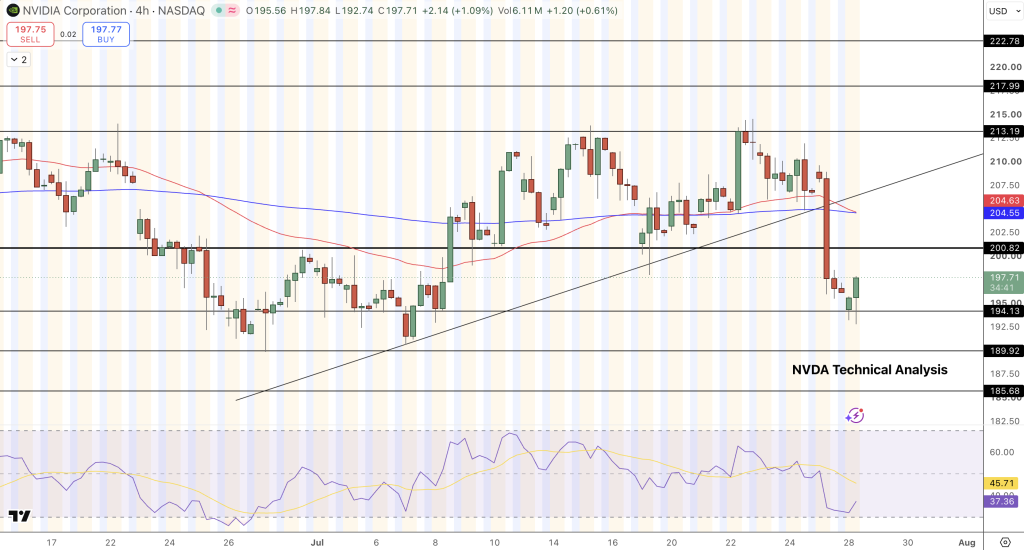
While there’s immediate resistance around $200.82, the stock needs to close decisively around $205 to improve its technical structure and pave the way for a rally toward $213.19. RSI bounced back from oversold levels to around 38, indicating fading selling momentum, but it’s still bearish below the neutral 50 mark.
A breakdown below $194.13 would put $189.92 in play, with stronger support around $185.68. Until NVDA reclaims its trendline and EMA confluence, the current move should be viewed as a correction rather than a bullish reversal.
NVIDIA Stock Outlook
NVIDIA continues to perform well with rapid Data Center growth, 75% margins, demand for Blackwell, and strong cash flow. Key concerns include lofty expectations, China restrictions, and growing competition from bespoke AI chips.
From a technical perspective, the $204.55 to $205.00 range is critical. A breakout may target $213.19, while rejection from the EMA cluster would open up downside risk toward $194.13, $189.92, and $185.68.
- Check out our free forex signals
- Follow the top economic events on FX Leaders economic calendar
- Trade better, discover more Forex Trading Strategies
- Open a FREE Trading Account
- Read our latest reviews on: Avatrade, Exness, HFM and XM

Related Articles


Sidebar rates

Related Posts
 Save
Save