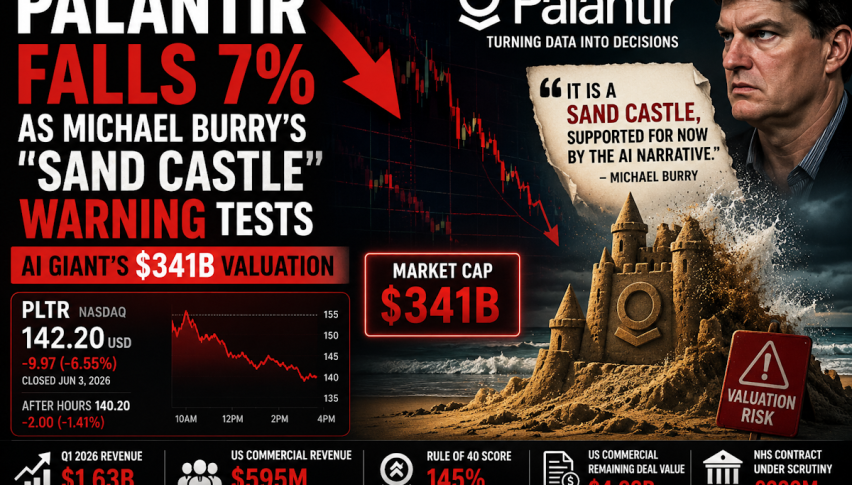
Palantir Falls 7% as Michael Burry’s “Sand Castle” Warning Tests AI Giant’s $341B Valuation
PLTR stock: Palantir shares drop 7% after Michael Burry renews bearish call, despite 85% revenue growth and booming AI demand.
Written by:
Arslan Ali Butt•Thursday, June 4, 2026•3 min read
•Last updated: Thursday, June 4, 2026
Quick overview
Palantir Technologies' stock fell 6.6% after investor Michael Burry criticized its valuation, calling it a 'sand castle' reliant on AI hype.
Despite strong fundamentals, including an 85% revenue growth in Q1 2026, investors are divided on whether Palantir's valuation can sustain future growth expectations.
Concerns about regulatory risks, particularly regarding a £330 million contract with the U.K.'s NHS, have added uncertainty to Palantir's outlook.
The debate now centers on whether Palantir's growth can justify its high valuation, as the company faces increasing competition and scrutiny.
Palantir Technologies (NASDAQ: PLTR) fell 6.6% on Wednesday after investor Michael Burry renewed his criticism of the AI software company, calling the stock a “sand castle” supported by the artificial intelligence narrative.
The selloff pushed shares to $142.20, while after-hours trading saw the stock slip another 1.4% to around $140.
The decline comes despite one of the strongest fundamental growth stories in the software sector. Palantir reported record first-quarter results earlier this year and remains one of the biggest beneficiaries of enterprise AI adoption.
Yet investors continue debating whether the company’s valuation can keep pace with expectations.
Burry Questions PLTR Valuation as Regulatory Risks Emerge
Burry, famous for predicting the 2008 financial crisis, reiterated his short thesis on Palantir this week.
His concerns focus on two key issues:
Extreme valuation multiples
Potential technical topping formation
Dependence on continued AI enthusiasm
Growing scrutiny of major government contracts
The latest pressure also follows renewed attention on Palantir’s £330 million contract with the U.K.’s National Health Service (NHS).
Some members of the British Parliament have questioned the government’s reliance on Palantir, creating uncertainty around a contract that could become reviewable next year.
The NHS deal remains small relative to Palantir’s overall business but has added another layer of headline risk.
Palantir’s Fundamentals Remain Among the Strongest in Software
Despite the stock decline, Palantir’s operating performance remains exceptional.
Recent highlights include:
Q1 2026 revenue surged 85% year-over-year to $1.63 billion
U.S. revenue climbed 104% to $1.28 billion
U.S. commercial revenue jumped 133% to $595 million
Commercial customer count rose 31% to 1,007
U.S. commercial remaining deal value reached $4.92 billion, up 112%
Rule of 40 score hit 145%, among the highest in enterprise software
The company has expanded beyond defense and intelligence applications into healthcare, manufacturing, construction, energy, and enterprise operations.
Recent partnerships, including expanded deployments through construction-sector channel partners, reinforce management’s push into new industries.
Why Investors Remain Divided on Palantir (PLTR)
The investment debate surrounding Palantir increasingly centers on valuation rather than execution.
The Bull Case
Supporters argue Palantir has become one of the few software companies successfully monetizing generative AI at scale.
Key strengths include:
Rapid AIP adoption
Expanding commercial customer base
Industry-leading profitability
Strong government relationships
Massive AI infrastructure spending tailwinds
Palantir’s 85% revenue growth and 46% operating margin have strengthened the argument that the company deserves a premium multiple.
The Bear Case
Skeptics focus on expectations.
Even after the recent pullback, Palantir remains one of the most expensive large-cap software companies.
Bears argue:
Growth expectations remain extremely high
Valuation leaves little room for execution mistakes
Government contract risks could increase
Competition in enterprise AI is intensifying
Any slowdown could trigger multiple compression
As Burry noted, the debate is no longer about whether Palantir is growing—it is about whether future growth can justify today’s valuation.
Why is Palantir stock down today?
PLTR Technical Analysis: Momentum Weakens as Consolidation Continues
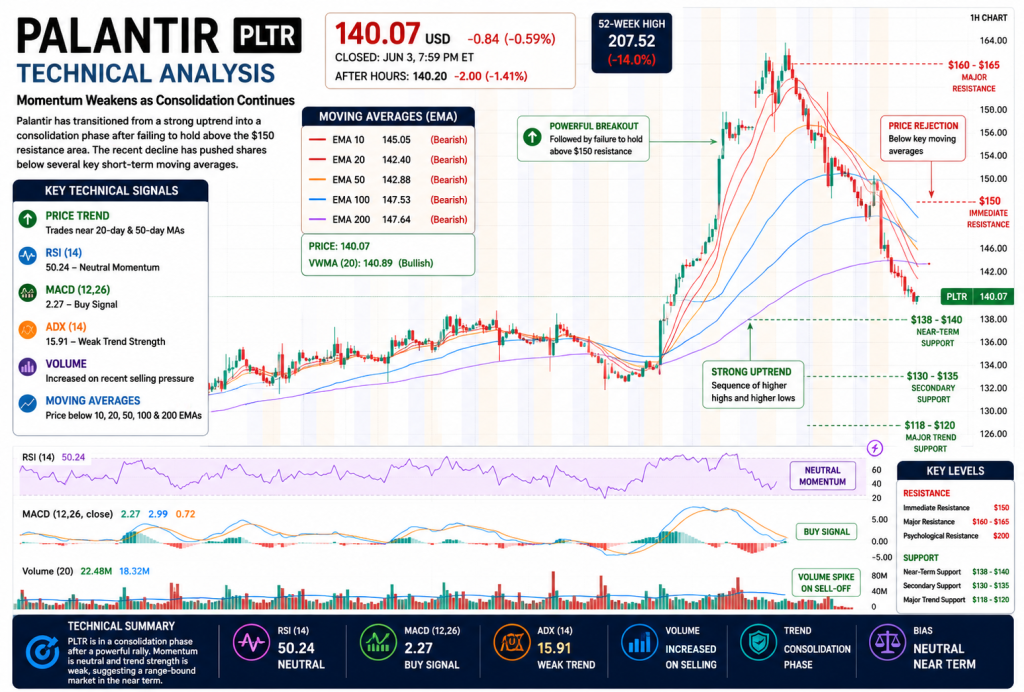
Technically, Palantir has transitioned from a strong uptrend into a consolidation phase after failing to hold above the $150 resistance area.
The recent decline has pushed shares below several key short-term moving averages.
Key Technical Signals
Shares remain roughly 14% below their 52-week high of $207.52
Price trades near the 20-day and 50-day moving averages
RSI has cooled to 50.2, indicating neutral momentum
MACD remains positive at 2.27, preserving a modest bullish bias
ADX at 15.9 signals weak trend strength and lack of directional conviction
Volume has increased during recent selling pressure
Unlike many AI leaders still making new highs, Palantir is currently trading in a broad consolidation range.
RSI and MACD
The RSI near 50 reflects a balanced market where neither buyers nor sellers have a clear advantage.
Meanwhile, MACD remains on a buy signal, suggesting the broader recovery trend has not completely broken down despite recent weakness.
The indicators point toward consolidation rather than a confirmed bearish reversal.
Key Support and Resistance Levels
Level Type
Approximate Area
Immediate Resistance
$150
Major Resistance
$160-$165
Psychological Resistance
$200
Near-Term Support
$138-$140
Secondary Support
$130-$135
Major Trend Support
$118-$120
A decisive move above $150 could revive bullish momentum, while a break below $138 would likely shift attention toward the $130 support zone.
Palantir’s Long-Term Outlook: AIP Growth vs. Valuation Risk
Palantir remains one of the most important AI software companies in public markets.
Its AIP platform has created one of the fastest-growing commercial software businesses globally. Revenue growth, margins, and customer expansion continue outperforming most peers.
However, the stock now faces a different challenge.
Investors are no longer questioning whether Palantir can grow. They are questioning how much growth is already reflected in a company valued at more than $340 billion.
The next phase for PLTR may depend less on AI excitement and more on whether management can continue delivering hypergrowth at a scale large enough to justify one of the market’s richest valuations.
Lead Markets Analyst – Multi-Asset (FX, Commodities, Crypto)
Arslan Ali Butt serves as the Lead Commodities and Indices Analyst, bringing a wealth of expertise to the field. With an MBA in Behavioral Finance and active progress towards a Ph.D., Arslan possesses a deep understanding of market dynamics.
His professional journey includes a significant role as a senior analyst at a leading brokerage firm, complementing his extensive experience as a market analyst and day trader. Adept in educating others, Arslan has a commendable track record as an instructor and public speaker.
His incisive analyses, particularly within the realms of cryptocurrency and forex markets, are showcased across esteemed financial publications such as ForexCrunch, InsideBitcoins, and EconomyWatch, solidifying his reputation in the financial community.




 Save
Save