Palantir PLTR Stock Slumps 6% as Failed Rebound Exposes the $100 Level Again
Palantir shares came under renewed selling pressure as a failed rebound, international contract concerns, stretched valuation expectations, and weakening technical momentum combined to send PLTR stock roughly 5% lower.
Quick overview
- Palantir shares fell approximately 5% due to a failed rebound and concerns over international contracts and valuation.
- The stock's inability to maintain upward momentum raises fears of a deeper correction, particularly if it breaks below the critical $100 support level.
- Technical indicators show weakening momentum, with former support levels now acting as resistance, complicating potential recoveries.
- Despite strong fundamentals, investor sentiment is shifting towards caution, driven by high expectations and a challenging market environment.
Palantir shares came under renewed selling pressure as a failed rebound, international contract concerns, stretched valuation expectations, and weakening technical momentum combined to send PLTR stock roughly 5% lower.
Palantir Stock Slumps 5% as Failed Rebound Exposes Growing Downside Risks
Palantir Technologies shares suffered another sharp reversal on Wednesday, highlighting the growing fragility behind the stock’s powerful rally. After recovering from a steep June decline, PLTR once again struggled to sustain its upward momentum, raising concerns that the latest rebound may have been little more than a temporary recovery within a broader consolidation phase.
The selloff reflects a combination of technical weakness and fundamental concerns. Investors are increasingly questioning whether Palantir’s enormous valuation can be justified by its current growth trajectory, while uncertainty surrounding international contracts and a less supportive macroeconomic environment is adding further pressure.
The broader retreat also comes as investors become more cautious toward high-growth technology stocks. Rising sovereign bond yields and uncertainty surrounding the Federal Reserve’s future interest-rate policy can place additional pressure on companies whose valuations depend heavily on expectations of strong future cash flows.
Palantir Reversal Raises Fresh Downside Risks
Palantir’s latest decline comes after its recent recovery rally failed to deliver a sustained breakout.
The stock plunged toward the $100 area in June before staging an aggressive recovery that accelerated into early July. By Monday, PLTR had climbed to approximately $136, creating renewed optimism that buyers could regain control.
That optimism quickly faded.
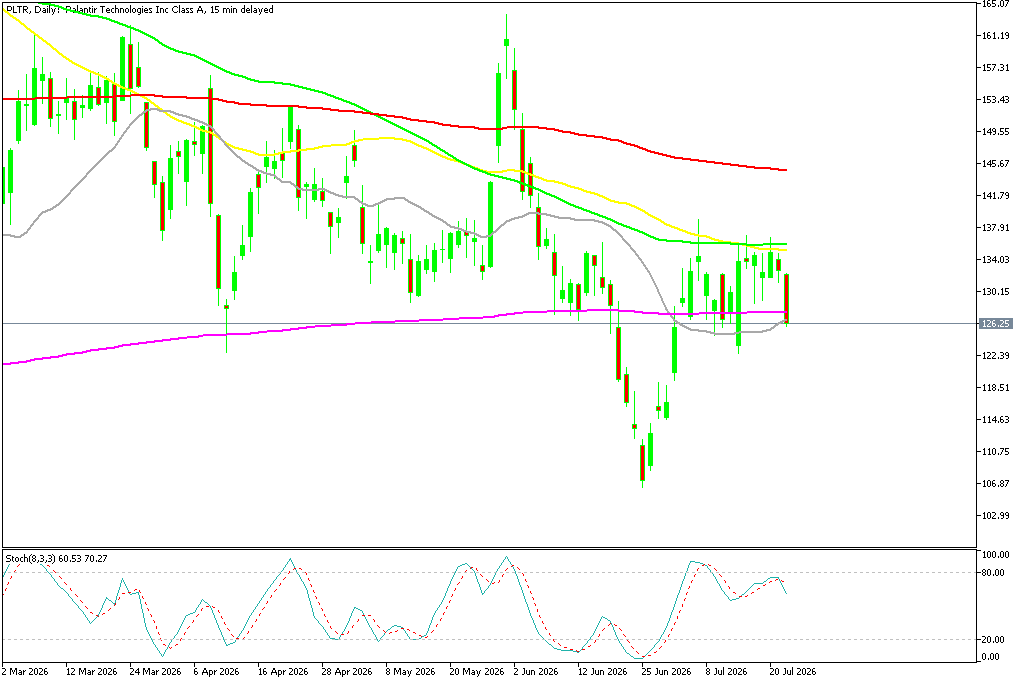
The stock failed to break decisively above resistance and subsequently reversed lower, falling back toward $126. The sharp change in direction has raised concerns that the recovery was unable to attract enough sustained buying interest to support another major leg higher.
The failure to hold recent gains is particularly concerning because Palantir’s valuation leaves little room for disappointment. If the stock continues to lose momentum, investors may increasingly focus on the possibility of a deeper correction, with the psychologically important $100 level once again emerging as a critical downside reference point.
Technical Momentum Turns Against PLTR Bulls
The technical picture has become increasingly uncomfortable for bullish investors.
Palantir has repeatedly struggled to maintain breakouts above resistance, while recent trading action has produced signs of weakening momentum and lower short-term highs.
The failed rebound toward $136 is particularly significant because it suggests that buyers were unable to capitalize on the earlier recovery. Instead, sellers returned aggressively once the stock approached resistance.
This creates the risk of a negative feedback loop. Investors who previously treated every pullback as a buying opportunity may become less willing to step in as volatility increases and rallies repeatedly fail.
A decisive break below key support could therefore accelerate selling pressure and potentially push PLTR into a much deeper correction.
Karp’s AI Arguments Fail to Sustain the Rally
Palantir CEO Alex Karp attempted to address one of the market’s biggest concerns during a July 1 television interview, arguing that the pricing models used by major AI laboratories effectively act as a tax on businesses.
According to Karp’s argument, companies paying continuously for token usage may not receive sufficient value relative to their costs. This creates an opportunity for software platforms that can help businesses deploy AI more efficiently and generate measurable returns.
The comments initially received a positive response from investors, helping Palantir shares rally nearly 8% during the session.
However, the boost proved temporary.
The inability of the stock to maintain its subsequent gains suggests that the argument was insufficient to overcome broader concerns about valuation, competition, and future growth. While Palantir continues to position itself as an important layer between businesses and increasingly powerful AI models, investors appear to be demanding more than a compelling narrative.
International Contracts Create Another Source of Uncertainty
One of the most worrying developments for Palantir investors involves the company’s international expansion.
Reports suggesting that French intelligence agencies could reduce their reliance on Palantir software in favor of domestic alternatives have raised questions about the company’s ability to expand across Europe.
European governments are increasingly emphasizing technological sovereignty, particularly in sensitive defense and intelligence applications. Greater reliance on domestic technology providers could create a structural obstacle for foreign companies seeking government contracts.
The immediate impact on Palantir’s financial performance may be limited, but the broader concern is the potential precedent.
If France represents the beginning of a wider shift toward locally developed alternatives, Palantir could face additional obstacles in one of its key international growth markets.
Technical Breakdown Raises the Stakes
Technically, the picture is getting weaker. Palantir broke below key support levels, including the 100-week simple moving average in green, which had previously acted as a stabilizing floor and is now facing the last technical support.
PLTR Chart Weekly – MAs Turn into Resistance

Former support zones have now turned into resistance, making near-term recoveries more difficult. Last week’s rebound took PLTR stock closer to the 100 SMA above $136 level which was the real test for buyers, but they failed at resistance again and PLTR fell to the 200 daily SMA (purple) which came under attack on the daily chart. If the price breaks below it, PLTR will be heading for $100 again.
PLTR Chart Daily – Reversing After the Doji Candlestick
Lofty Valuation Leaves Little Room for Error
Perhaps the biggest risk remains Palantir’s demanding valuation.
Even after the latest decline, the company continues to trade at a substantial premium to many established software and defense technology companies. That premium is based on expectations for years of exceptional growth from government contracts, commercial adoption, and AI-driven demand.
The problem is that high expectations can quickly become a liability.
When a company trades at an elevated valuation, strong earnings may not be enough to support the share price. Investors increasingly need evidence that growth can consistently exceed already ambitious expectations.
Any slowdown in revenue, weaker contract momentum, slower customer expansion, or disappointing guidance could therefore trigger an outsized reaction.
Geopolitical Tailwinds May Not Last Forever
Palantir has benefited significantly from heightened geopolitical tensions and increased government spending on defense and national security technology.
However, any improvement in geopolitical conditions could reduce some of the urgency that has supported defense-related technology stocks.
At the same time, tighter AI regulation and growing government scrutiny could complicate the industry’s expansion. New compliance requirements could increase costs, slow procurement processes, and make government technology contracts more difficult to secure.
Palantir’s Strong Fundamentals Face a More Hostile Market
Palantir remains a fundamentally strong business with established government relationships, expanding commercial operations, and significant exposure to the growing demand for data analytics and AI-enabled software.
Yet the stock market is increasingly focused on what comes next rather than what Palantir has already achieved.
A failed rebound, weakening technical structure, international contract uncertainty, elevated valuation, and a less forgiving market environment have created a much more challenging backdrop for PLTR.
The $100 level now stands out as the key technical line in the sand. If buyers successfully defend that area, Palantir could attempt another recovery. However, a decisive break below it could expose the stock to a much deeper repricing as investors reassess whether the company’s extraordinary growth expectations have simply gone too far.
- Check out our free forex signals
- Follow the top economic events on FX Leaders economic calendar
- Trade better, discover more Forex Trading Strategies
- Open a FREE Trading Account
- Read our latest reviews on: Avatrade, Exness, HFM and XM

Related Articles
Sidebar rates

Related Posts
 Save
Save