South African Rand: USD/ZAR Breakout Raises R17 Risk as SARB July Interest Rate Announcement and Oil Prices Weigh On
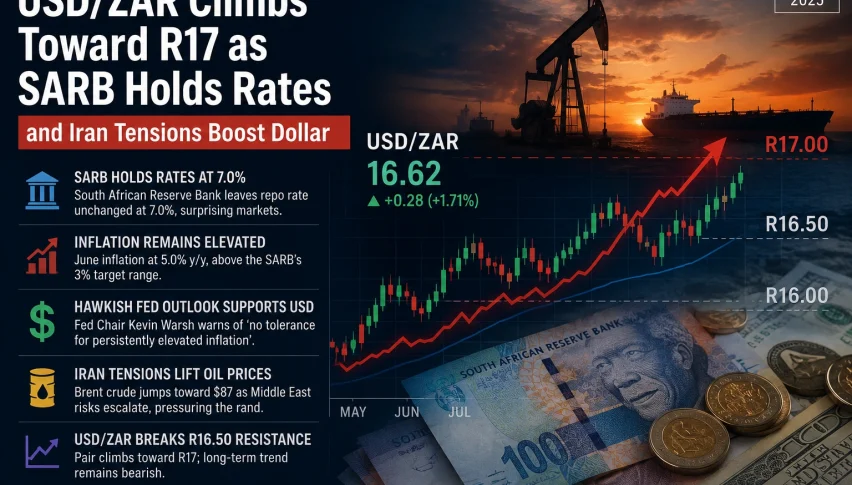
USD/ZAR has climbed above the key R16.50 resistance level and is moving toward R17 as a hawkish Federal Reserve outlook, renewed Middle East tensions, and rising oil prices strengthen the US dollar while creating fresh pressure on the South African rand.
Quick overview
- USD/ZAR has surpassed the R16.50 resistance level and is approaching R17 due to a hawkish Federal Reserve, rising oil prices, and renewed Middle East tensions.
- The South African Reserve Bank maintained its interest rate at 7.0%, disappointing market expectations and adding pressure on the rand amid rising inflation.
- Inflation in South Africa has accelerated, reaching 5.0% in June, which complicates the SARB's ability to cut rates while facing economic growth challenges.
- The recent strength of the US dollar is supported by a more aggressive Fed stance, which may keep interest rates elevated and further pressure emerging-market currencies like the rand.
USD/ZAR has climbed above the key R16.50 resistance level and is moving toward R17 as a hawkish Federal Reserve outlook, renewed Middle East tensions, and rising oil prices strengthen the US dollar while creating fresh pressure on the South African rand.
USD/ZAR Breaks Above R16.50 as Central Bank Rhetoric and Rising Oil Prices Pressure Rand
The USD/ZAR exchange rate has strengthened sharply, breaking above the important R16.50 resistance level and moving closer to the psychologically significant R17 mark.
The latest move higher reflects a combination of global and domestic factors that have temporarily shifted momentum in favor of the US dollar.
A more hawkish Federal Reserve outlook has supported the dollar, while renewed tensions involving Iran have pushed oil prices higher and increased concerns about global inflation. For South Africa, higher energy prices represent an additional risk because rising fuel costs could complicate the inflation outlook and reduce the scope for aggressive interest-rate cuts.
At the same time, the South African Reserve Bank (SARB) left interest rates unchanged at its July meeting, disappointing expectations for another increase and contributing to renewed pressure on the rand.
Despite the recent recovery in USD/ZAR, however, the pair’s broader trend remains bearish following its significant decline from previous highs.
SARB Holds Rates at 7.0%
The SARB left its benchmark repo rate unchanged at 7.0% at its July monetary policy meeting.
The decision was approved by a 4–2 vote, despite market expectations for at least a 25-basis-point interest-rate increase.
The central bank pointed to a somewhat improved inflation outlook and weaker economic growth while maintaining its longer-term commitment to bringing inflation toward its 3% target.
The decision nevertheless created uncertainty for the rand, particularly as markets had positioned for tighter monetary policy.
A less aggressive SARB reduces one of the key factors that can support the rand against the dollar: a relatively high domestic interest-rate differential.
Inflation Remains a Major Risk
The SARB’s decision comes as South African inflation has accelerated significantly.
Annual inflation rose to 5.0% in June, reaching its highest level in two years, while core inflation increased to 4.1%, its strongest reading since September 2024.
Both measures remain above the upper end of the SARB’s 3% ±1 percentage point target range.
Governor Lesetja Kganyago also warned that renewed conflict in the Middle East could create additional inflation risks.
Higher oil and fertilizer prices could eventually feed into transportation, food, and other consumer costs. If these pressures become persistent, the SARB could face renewed pressure to keep interest rates elevated for longer.
For the rand, this creates an uncomfortable situation. Higher inflation may limit the scope for rate cuts, but weaker economic growth makes aggressive monetary tightening more difficult.
Hawkish Fed Outlook Supports the Dollar
The US dollar has received additional support from a more hawkish Federal Reserve stance.
Fed Chair Kevin Warsh emphasized that restoring price stability remains a priority and warned against allowing inflation to remain elevated for an extended period.
The comments reinforced the message from recent Federal Open Market Committee minutes, which indicated that policymakers remain prepared to maintain restrictive monetary policy if inflation risks intensify.
This has reduced expectations for aggressive rate cuts and supported US Treasury yields.
Higher US yields can attract capital toward dollar-denominated assets, creating additional demand for the greenback and increasing pressure on emerging-market currencies such as the rand.
USD/ZAR Chart Daily – The 200 SMA Keeps the Pressure to the Downside

On the daily chart above, the trend has been bearish for more than a year, with moving averages acting as resistance during upside rice action. But the pair has now pushed above the 200 daily SMA in purple, opening the door for R17.
On the monthly chart below, USD/ZAR seems to have bottomed at the 100 SMA (green) where it found support in the last two months. Last month we saw a rebound as the Rand weakened while the Dollar gained, but buyers are facing the 50 SMA (yellow) and in April the forex pair has reversed lower again. For the larger uptrend to resume, USD/ZAR would need to push above this moving average but sellers remain in control for 2 years and the downside is also at risk.
USD/ZAR Chart Monthly – Rebounding Off the 100 SMA

US Inflation Provides Only Temporary Relief
Earlier US inflation data had initially offered some relief to markets.
Consumer inflation reportedly slowed more than expected in June, with annual CPI easing to 3.5% from 4.2% in May. Producer price data also showed signs of moderation.
The softer inflation readings initially reduced expectations for additional Federal Reserve tightening, with market pricing for a July rate hike falling sharply.
However, the more hawkish tone from Fed officials has since shifted the focus back toward the possibility that interest rates could remain higher for longer.
For USD/ZAR traders, this creates a more volatile environment in which US inflation data, Fed communication, and bond yields remain critical drivers.
Rising Oil Prices Add Pressure on the Rand
The renewed increase in oil prices has emerged as another major risk for South Africa.
Escalating tensions involving the United States and Iran have raised concerns about potential disruptions to global energy supplies, particularly around the Strait of Hormuz, a critical route for international oil shipments.
Brent crude has surged sharply, while WTI has also moved higher.
For South Africa, which relies heavily on imported energy, rising oil prices can increase fuel costs and intensify inflationary pressure.
This could make it more difficult for the SARB to ease monetary policy, while simultaneously weakening economic activity by increasing costs for consumers and businesses.
The combination creates a challenging backdrop for the rand.
USD/ZAR Technical Outlook
From a technical perspective, the move above R16.50 represents an important short-term development.
The breakout suggests that buyers have regained momentum and could now target the R17.00 region if dollar strength continues and risk sentiment deteriorates further.
However, the broader USD/ZAR trend remains bearish following the pair’s prolonged decline.
For the current recovery to develop into a more sustained reversal, USD/ZAR would likely need to hold above R16.50 and attract continued support from higher US yields, stronger dollar demand, and persistent geopolitical uncertainty.
Conversely, falling oil prices, easing Middle East tensions, and a renewed dovish shift from the Federal Reserve could quickly weaken the dollar and restore downward pressure on USD/ZAR.
For now, the break above R16.50 has created a more cautious near-term outlook for the rand, with R17 becoming the next major psychological level to watch.
- Check out our free forex signals
- Follow the top economic events on FX Leaders economic calendar
- Trade better, discover more Forex Trading Strategies
- Open a FREE Trading Account
- Read our latest reviews on: Avatrade, Exness, HFM and XM

Related Articles
Sidebar rates

Related Posts
 Save
SaveAva