ORCL Stock Rebounds 2% on $7 Billion Pentagon Deal, but AI Spending Risks Keep Bears in Control
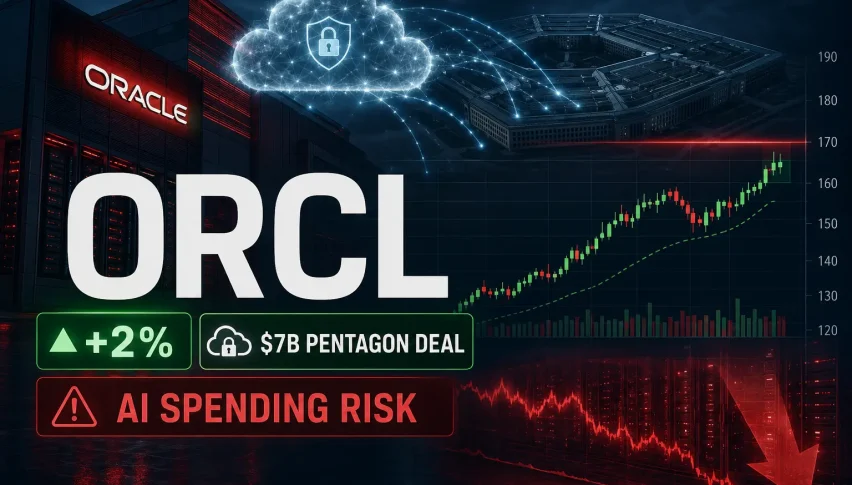
Oracle stock ORCL rebounds after a $7 billion Pentagon deal, but AI spending, debt concerns and $125 resistance remain in focus.
Quick overview
- Oracle shares rebounded after securing a Pentagon software agreement valued at up to $7 billion, despite ongoing investor concerns about its AI infrastructure spending and profit margins.
- The contract, which includes software licenses and cloud services, reinforces Oracle's established role within government operations and could save taxpayers significant costs.
- However, Oracle faces challenges with a projected $95 billion capital expenditure plan and rising debt, raising questions about its ability to finance expansion while maintaining profitability.
- Analysts are closely watching upcoming earnings for signs of cash generation and growth in cloud revenue to offset traditional software declines.
Oracle shares recovered in overnight trading after the company secured a Pentagon software agreement worth up to $7 billion. However, the contract has not erased investor concerns surrounding Oracle’s record AI infrastructure spending, rising financing needs and weakening profit margins.
Oracle shares attempted to recover after the enterprise software company secured one of the largest government contracts in its history.
ORCL ended the regular session at $120.04, falling 4.61% and underperforming the broader market. The stock then climbed to approximately $122.64 in overnight trading after the Pentagon announced a new enterprise-wide software agreement.
The contract provides an important reminder that Oracle’s traditional database and on-premises software operations remain deeply embedded within large government and corporate organizations.
However, the positive announcement arrives during a difficult period for the stock.
Oracle has fallen sharply as investors question how the company will finance an enormous expansion of its cloud infrastructure while protecting margins and maintaining its investment-grade credit profile.
The result is a widening divide between Oracle’s exceptionally strong AI demand and the financial cost of meeting it.
Pentagon Awards Oracle Contract Worth Up to $7 Billion
The U.S. Department of Defense awarded Oracle a five-year enterprise software agreement with an initial maximum value of approximately $3.31 billion.
The agreement includes a five-year extension option that could raise its cumulative value to $6.99 billion.
It covers Oracle software licenses, maintenance, support, cloud services and consulting across the Pentagon, the U.S. Coast Guard and the intelligence community.
The Department of the Navy negotiated the contract as part of a broader effort to replace fragmented purchases across different military branches with centralized enterprise agreements.
Officials expect the Oracle arrangement to save taxpayers at least $441 million during its potential 10-year life.
Those savings will come from improving visibility into software usage, eliminating redundant licenses and reducing the cost of managing separate contracts across different agencies.
The award follows a similar $9.69 billion agreement signed with Microsoft in May, suggesting that the Pentagon is increasingly consolidating technology spending through a smaller number of strategic vendors.
For Oracle, the agreement strengthens an already important relationship with the U.S. government.
The company’s database technology has been used by intelligence and defense organizations for decades. Oracle has also expanded its involvement in classified cloud networks and previously secured an $88 million task order supporting the U.S. Air Force’s Cloud One program.
Deal Highlights the Durability of Oracle’s Software Business
The Pentagon contract matters because Oracle’s investment narrative has become increasingly dominated by AI infrastructure.
Investors now discuss the company primarily as an emerging competitor to Amazon Web Services, Microsoft Azure and Google Cloud.
However, Oracle’s large installed base of databases, enterprise applications and on-premises systems remains a valuable source of recurring revenue.
Government agencies and major corporations often rely on Oracle technology for mission-critical operations. Replacing those systems can involve significant cost, operational disruption and security risk.
The new Pentagon agreement reinforces that advantage.
It standardizes Oracle’s role across military and intelligence organizations while potentially supporting additional demand for consulting, cloud services and database modernization.
The contract’s total value should not be treated as immediate revenue because spending will occur over several years and the second five-year period is optional.
Nevertheless, the agreement provides greater revenue visibility and demonstrates that Oracle’s core software franchise remains strategically important.
AI Cloud Demand Is Growing Faster Than Oracle Can Supply
Oracle’s cloud infrastructure business is expanding rapidly as companies compete for access to AI computing capacity.
The company reported fiscal fourth-quarter revenue of $19.18 billion, slightly ahead of market expectations, while adjusted earnings of $2.03 per share also exceeded estimates.
Oracle’s remaining performance obligations reached $638 billion, substantially above analyst expectations and reflecting signed contracts that have not yet been recognized as revenue.
Management expects around 12% of that backlog, or approximately $76.6 billion, to be recognized during the following 12 months. Another 34%, equivalent to roughly $216.9 billion, is expected during the subsequent two years.
That backlog supports the bullish argument for Oracle.
The company has signed major infrastructure commitments involving customers such as OpenAI, Meta Platforms, Nvidia and other large technology groups.
Demand for AI training and inference capacity continues to exceed available supply, creating a significant expansion opportunity for Oracle Cloud Infrastructure.
Unlike some traditional cloud providers, Oracle has emphasized large-scale, high-performance computing clusters designed for AI workloads.
Its database relationships also give the company an opportunity to move existing enterprise customers into cloud-based AI and data services.
$95 Billion Capital Spending Plan Alarms Investors
The challenge is the cost of building the infrastructure required to fulfil those contracts.
Oracle expects fiscal 2027 capital expenditure of up to $95 billion, far above the approximately $67.7 billion analysts had anticipated.
The company also expects to raise close to $40 billion through a combination of debt and equity financing. That amount includes a previously disclosed $20 billion at-the-market share sale program.
The spending will fund data centers, servers, networking equipment, power systems and other infrastructure needed to support Oracle’s AI contracts.
One of the most prominent projects is the Stargate data-center development in Texas, which Oracle is building with OpenAI and other partners.
Management has said that approximately $70 billion of the projected capital spending will remain Oracle’s responsibility. Between $20 billion and $25 billion could eventually be reimbursed by customers.
Even with those reimbursements, the scale of the investment is testing investor confidence.
Oracle is effectively spending today to create capacity for revenue that may be recognized over several years.
That mismatch places pressure on free cash flow and increases the company’s dependence on capital markets.
Debt and Margin Pressure Remain the Central Risks
Oracle’s AI strategy is supported by an enormous contracted backlog, but investors remain concerned about leverage and customer concentration.
The company has already raised substantial debt to fund its expansion. It previously announced plans to obtain between $45 billion and $50 billion through debt, preferred securities and common equity instruments to expand cloud capacity.
Credit-rating agencies have also highlighted the risks associated with Oracle’s large AI contracts.
A major concern is that a meaningful portion of its future infrastructure revenue could depend on a limited number of customers, particularly OpenAI.
If those companies reduce spending, delay projects or experience funding difficulties, Oracle could be left with expensive data-center capacity and significant outstanding debt.
Management has also warned that gross margins will decline as new infrastructure becomes operational.
Cloud infrastructure generally carries heavier upfront costs than mature software licensing. Margins may improve as capacity utilization rises, but the transition could weaken profitability in the near term.
This helps explain why Oracle shares have continued falling despite rapid cloud growth and record contracted revenue.
The market is not questioning whether demand exists. It is questioning how much capital Oracle must spend to capture it and what returns shareholders will ultimately receive.
Upcoming Earnings Must Show a Path to Cash Generation
Analysts currently expect Oracle’s upcoming quarterly earnings to show revenue of approximately $19.13 billion, representing growth of more than 28% from the previous year.
Consensus estimates also point to earnings of around $1.72 per share.
Those growth expectations reflect expanding cloud capacity and the conversion of Oracle’s backlog into reported revenue.
However, the most important metrics may be capital expenditure, free cash flow and financing requirements.
Investors will want management to demonstrate that cloud revenue is increasing quickly enough to offset data-center spending and pressure on the traditional software business.
Oracle recently reported that quarterly software revenue declined 2%, while cloud revenue grew 47%.
That contrast illustrates the company’s transformation.
The legacy software franchise remains profitable and strategically important, but the faster-growing AI cloud business increasingly determines the company’s valuation and capital requirements.
ORCL Technical Analysis: $120 Is the Key Level Bulls Must Hold
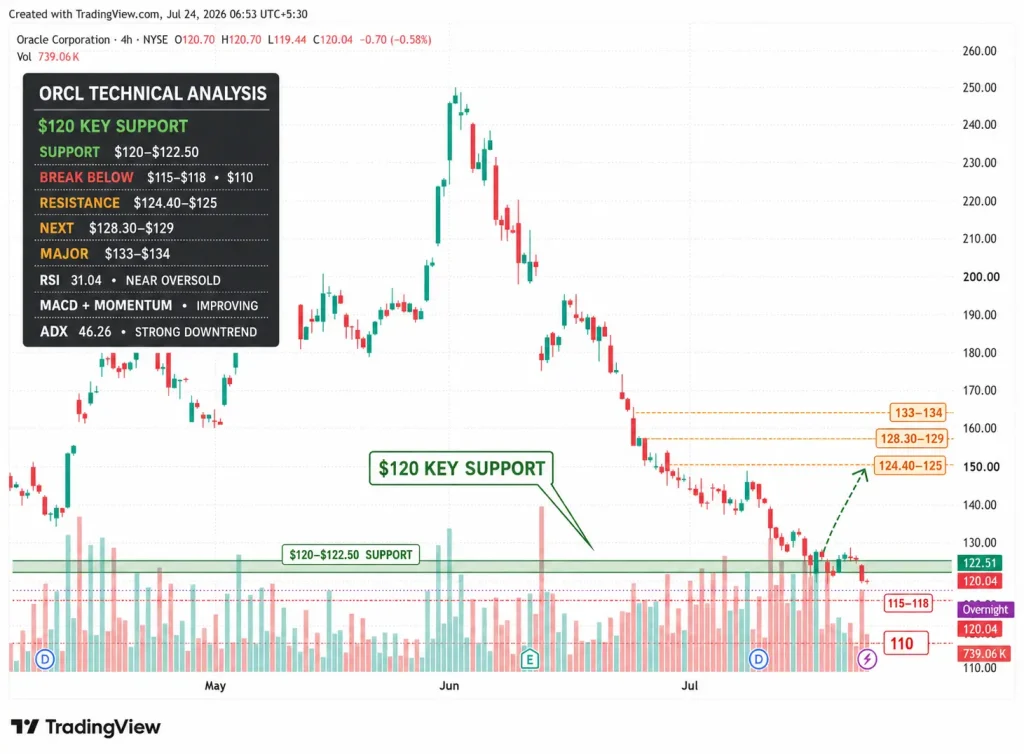
Oracle’s 4-hour chart remains bearish despite the overnight bounce, with the stock still trading below every major moving average.
The immediate support zone sits between $120 and $122.50, anchored by the recent low and the Hull Moving Average. A break below $120 could accelerate selling toward $115-$118, with the psychological $110 level as the next downside target.
On the upside, the first resistance is $124.40-$125, where the 10-period moving averages are clustered. Above that, $128.30-$129 marks the next key barrier, followed by stronger resistance around $133-$134, where the 30-period averages and Ichimoku baseline converge.
Momentum is showing early signs of stabilization. RSI has fallen to 31.04, close to oversold territory, while MACD and Momentum have turned positive, suggesting selling pressure is easing. However, the stock remains in a strong downtrend, with ADX at 46.26, meaning buyers still need confirmation.
A sustained move above $125 would be the first sign of recovery. Reclaiming $129, followed by $133-$134, would significantly improve Oracle’s short-term technical outlook.
Can the Pentagon Deal Reverse Oracle’s Downtrend?
Oracle’s new government agreement is strategically important and provides a visible long-term source of software demand.
It also demonstrates that Oracle’s traditional database and enterprise technology remain critical to government infrastructure, even as the company shifts toward AI cloud computing.
However, the Pentagon deal does not resolve the larger questions facing shareholders.
Oracle still needs to finance one of the most expensive data-center expansions in the technology sector, protect its credit rating and convert its $638 billion backlog into profitable cash flow.
The overnight rebound suggests buyers are responding positively to the government contract and oversold technical conditions.
Even so, the stock remains below all major moving averages.
The first test is whether ORCL can hold the $120-$122.50 support area and reclaim $125.
A breakout above $129 would strengthen the recovery case, while another failure below $120 could expose Oracle to a deeper decline toward $115 and $110.
- Check out our free forex signals
- Follow the top economic events on FX Leaders economic calendar
- Trade better, discover more Forex Trading Strategies
- Open a FREE Trading Account
- Read our latest reviews on: Avatrade, Exness, HFM and XM

Related Articles

Sidebar rates

Related Posts
 Save
Save