RTX Stock Jumps 7% as Missile Demand and Aerospace Recovery Drive Earnings Beat
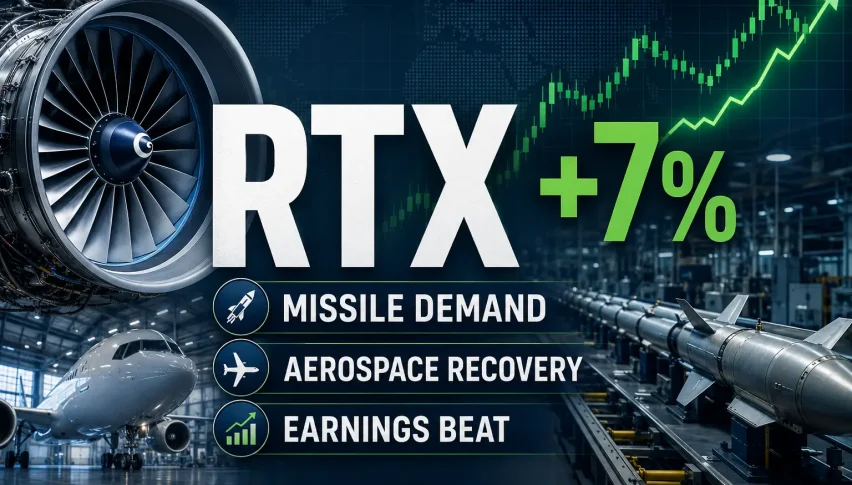
RTX stock jumps 7% after an earnings beat, raised guidance and a record $289 billion backlog strengthen its 2026 outlook.
Quick overview
- RTX Corporation shares surged 7.33% after reporting stronger-than-expected second-quarter results and raising its 2026 forecasts.
- The company disclosed a record backlog of $289 billion, driven by demand in both defense and commercial aerospace sectors.
- Second-quarter revenue reached $24.7 billion, a 14% increase from the previous year, with adjusted earnings rising 21% to $1.89 per share.
- RTX's strong performance is supported by robust demand cycles, including missile restocking and increased spending by commercial airlines.
RTX Corporation shares surged after the aerospace and defense giant reported stronger-than-expected second-quarter results, raised its 2026 forecasts and disclosed a record $289 billion backlog.
RTX shares recorded their strongest rally in months after the company delivered broad-based growth across Raytheon, Pratt & Whitney and Collins Aerospace.
The stock closed at $209.16, gaining 7.33%, before remaining nearly unchanged at approximately $209.22 in overnight trading.
Second-quarter revenue reached $24.7 billion, increasing 14% from the previous year and 16% on an organic basis. Adjusted earnings rose 21% to $1.89 per share, while operating cash flow reached $3.5 billion and free cash flow totaled $2.9 billion.
The results exceeded analyst expectations and demonstrated that RTX is benefiting from two major demand cycles simultaneously.
Governments are rebuilding missile inventories depleted by conflicts in Ukraine and the Middle East, while commercial airlines continue spending heavily on aircraft parts, engines and maintenance services.
That combination allowed RTX to raise its full-year outlook and reinforced expectations that growth could remain elevated beyond 2026.
RTX Raises Sales and Earnings Guidance
RTX now expects adjusted 2026 sales of between $95 billion and $96 billion, compared with its previous forecast of $92.5 billion to $93.5 billion.
The updated outlook also exceeds the approximately $94.08 billion analysts had expected before the report.
Adjusted earnings are now projected between $7.10 and $7.25 per share, up from the previous range of $6.70 to $6.90.
Management also increased its free cash flow forecast to between $8.5 billion and $8.75 billion.
The scale of the guidance increase indicates that RTX’s stronger quarter was not driven by a single contract or temporary accounting benefit. All three of its major businesses generated sales growth, while improving operational execution helped translate higher revenue into stronger earnings and cash flow.
RTX Chairman and CEO Chris Calio said demand remained robust across both commercial aerospace and defense markets, with the company continuing to convert its expanding backlog into revenue.
Record Backlog Reaches $289 Billion
RTX’s total backlog increased 22% year over year to a record $289 billion.
Commercial aerospace represented approximately $170 billion of that amount, while defense orders accounted for the remaining $119 billion.
The backlog provides unusually strong visibility across RTX’s diverse portfolio.
Raytheon has secured large orders for Patriot air-defense systems, AMRAAM air-to-air missiles, Standard Missiles and other interceptors. Pratt & Whitney holds thousands of commercial engine orders and long-term military contracts, while Collins Aerospace supplies components and systems across a large portion of the global aircraft fleet.
Backlog does not convert into revenue immediately, and production can still be affected by supplier shortages, labor availability and government funding delays.
However, the scale of RTX’s order book suggests demand is likely to remain strong through 2027 and beyond.
Raytheon Sales Jump 18% on Missile Demand
Sales at Raytheon, RTX’s defense division, increased 18% to approximately $8.27 billion.
Growth was driven by higher volumes across Patriot, Standard Missile and AMRAAM programs as the United States and its allies attempt to restore depleted weapons inventories.
According to Pentagon data, the United States has used more than 50,000 rockets, missiles and rocket-propelled munitions since the start of the Russia-Ukraine conflict and through subsequent military operations involving Iran.
That consumption has created significant demand for replacement systems while also encouraging governments to increase their long-term inventory targets.
International customers are becoming increasingly important to Raytheon.
Around half of the division’s $10 billion in bookings during the first half came from customers outside the United States. European governments contributed approximately $7 billion of that international total.
Europe’s contribution reflects a broader effort to expand air-defense capacity, strengthen NATO stockpiles and reduce vulnerability to missiles and drones.
RTX is also exploring opportunities in the Middle East, where heightened security concerns could support further orders for air and missile-defense systems.
Pentagon Restocking Supports a Longer Defense Cycle
RTX’s stronger defense outlook is not based solely on short-term wartime demand.
The U.S. government is encouraging contractors to expand production capacity and reduce the time required to deliver advanced weapons.
President Donald Trump has proposed a record $1.5 trillion military budget for fiscal 2027, while the House of Representatives has passed a defense policy bill authorizing approximately $1.15 trillion in spending.
Those proposals remain subject to the political and budget process, but they indicate that military procurement is likely to remain a major government priority.
Missile programs are especially important because production capacity cannot be increased quickly. Contractors need long-term commitments before investing in new facilities, suppliers, tooling and skilled workers.
Multi-year contracts can provide that confidence, enabling RTX to increase output while lowering unit costs over time.
The current environment therefore supports a potentially sustained defense investment cycle rather than a temporary increase in emergency orders.
Pratt & Whitney Benefits From Commercial and Military Demand
Pratt & Whitney delivered another strong quarter, with sales rising 16% to approximately $8.89 billion.
Commercial aftermarket revenue increased 25%, while military volumes rose 23%. The division also benefited from continuing demand for the F135 engine used in Lockheed Martin’s F-35 fighter.
Airlines are spending heavily on maintenance because delayed deliveries from Airbus and Boeing have forced them to keep older aircraft operating for longer.
This creates demand for engine overhauls, spare parts and other high-margin aftermarket services.
The global commercial aircraft backlog exceeds 18,000 planes, while manufacturers remain below pre-pandemic delivery peaks. That shortage has allowed original-equipment demand and aftermarket maintenance activity to remain strong at the same time—an unusual combination for the aerospace industry.
RTX also received new commercial engine orders connected to customers including AirAsia and BOC Aviation, further expanding Pratt & Whitney’s installed base and future service opportunity.
GTF Engine Problems Are Improving but Not Resolved
Pratt & Whitney continues to manage the consequences of the powdered-metal contamination issue discovered in some geared turbofan engines.
The defect resulted in accelerated inspections, unscheduled removals and hundreds of grounded Airbus A320neo-family aircraft.
RTX has paid billions of dollars in compensation and support to customers, making the GTF problem one of the company’s most important operational risks.
There are signs of improvement.
The number of grounded aircraft affected by engine-related issues has fallen approximately 40% from its peak, while disruption has largely disappeared for smaller Airbus A220 and Embraer E2 aircraft.
RTX has also increased maintenance output and reduced turnaround times as more engines move through its repair network.
Even so, several airline customers expect elevated groundings to continue into 2027 or potentially 2028.
Pratt & Whitney must balance several competing priorities: supplying new engines to Airbus, producing spare engines and parts, and expanding maintenance capacity for the existing fleet.
Any setback could increase customer compensation or limit RTX’s ability to benefit fully from strong commercial demand.
Collins Aerospace Sales Rise 8%
Collins Aerospace generated quarterly sales of approximately $8.2 billion, an increase of 8%.
Commercial original-equipment sales grew 26%, supported by higher narrowbody and widebody production, while commercial aftermarket revenue increased 10%.
The division supplies avionics, aircraft interiors, landing systems, power controls and other components used across commercial and military aircraft.
This broad product exposure allows Collins to benefit from both new aircraft production and the continuing use of older fleets.
RTX also expects cost reductions, facility consolidation and operational improvements to support future margin expansion.
Management raised the division’s outlook and sees a potential path back toward the higher profit margins Collins generated before pandemic-related disruption and inflation affected the aerospace supply chain.
RTX Secures Additional F-35 Engine Work
Pratt & Whitney also received a $42.1 million contract modification covering F135 propulsion-system sustainment for the F-35 fleet.
The agreement includes spare parts, engineering support, software maintenance and depot-level repairs across the United States and several international locations.
Although the contract is small compared with RTX’s overall backlog, it reinforces the long-term value of the F135 program.
The global F-35 fleet generates recurring revenue through maintenance, upgrades and parts long after the original engines are delivered.
As more allied governments acquire the aircraft, Pratt & Whitney’s installed base and sustainment opportunity should continue expanding.
RTX Technical Analysis: $205 Becomes the Key Breakout Support
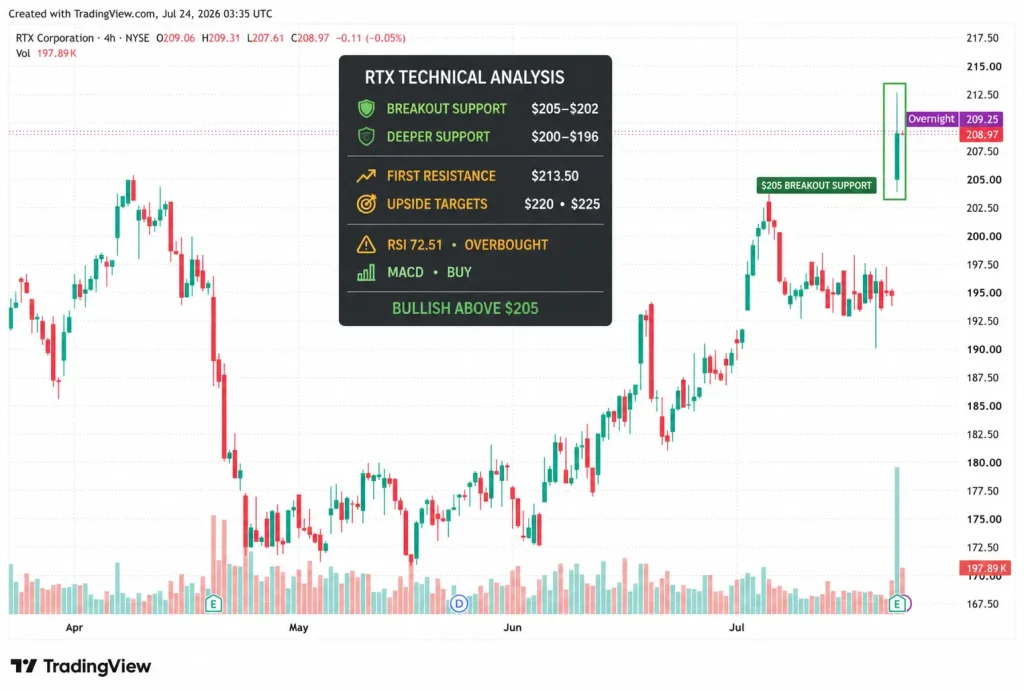
RTX’s four-hour chart has turned strongly bullish following the 7% earnings rally.
The stock is trading above every major moving average, with immediate support near the Hull Moving Average at $204.90 and the Ichimoku baseline around $201.76. This makes $205-$202 the first zone bulls need to defend.
Below that, stronger support sits between $200 and $196, where the 10, 20 and 30-period moving averages and VWMA are concentrated.
On the upside, the intraday high near $213.50 is the first resistance. A breakout above that level could open the way toward $220, followed by $225.
Momentum remains positive, with MACD showing a buy signal. However, RSI has climbed to 72.51, while CCI and Williams %R indicate overbought conditions.
That suggests the breakout remains constructive, but RTX could experience short-term consolidation or profit-taking after its sharp move.
Holding above $205 would keep the bullish setup intact. A break below $202 could trigger a deeper pullback toward $200-$196.
Can RTX Extend Its Earnings Breakout?
RTX’s second-quarter results showed strength across both sides of its business.
Raytheon is benefiting from global missile restocking and higher defense budgets, while Pratt & Whitney and Collins are gaining from strong aircraft maintenance, parts and original-equipment demand.
The record $289 billion backlog provides substantial revenue visibility, and the raised sales, earnings and free cash flow forecasts suggest management expects momentum to continue.
The main risks remain Pratt & Whitney’s GTF engine inspections, broader supply-chain constraints and the possibility that defense budgets fail to match current political proposals.
The stock’s 7% rally also leaves technical indicators near overbought territory, increasing the likelihood of short-term volatility.
Even so, RTX’s fundamental outlook has strengthened.
Technically, $205 is now the key level to watch. Holding above that area would support another move toward $213.50 and $220, while a break below $202 could signal that the earnings breakout is entering a broader consolidation.
These remain likely scenarios rather than predictions.
- Check out our free forex signals
- Follow the top economic events on FX Leaders economic calendar
- Trade better, discover more Forex Trading Strategies
- Open a FREE Trading Account
- Read our latest reviews on: Avatrade, Exness, HFM and XM

Related Articles

Sidebar rates

Related Posts
 Save
SaveAva