Crude Oil Weekly Recap and Outlook: Brent Tops $100, Then Retreats on Peace Talk Hopes — FOMC Week Ahead
WTI closed the week near $90.46 after a 10% weekly surge, while Brent briefly crossed $100 for the first time since May before retreating...
Quick overview
- WTI closed the week at $90.46 after a 10% surge, while Brent briefly surpassed $100 before settling at $97.
- Geopolitical tensions escalated with Houthi attacks on Saudi oil tankers, disrupting shipping routes and prompting military threats from the US.
- Despite a significant weekly gain, Brent fell nearly 4% on Friday due to reports of potential US-Iran negotiations, highlighting market volatility.
- Next week, the Fed's decision and OPEC+ positioning will be crucial for oil prices, with expectations of a production increase amid ongoing geopolitical risks.
WTI closed the week near $90.46 after a 10% weekly surge, while Brent briefly crossed $100 for the first time since May before retreating to $97 on Friday. The week delivered the sharpest geopolitical repricing of 2026: Houthi attacks opened a second shipping front in the Red Sea, Kazakhstan lost 80% of its export capacity, and the US launched its 13th consecutive day of strikes on Iran. Next week brings the Fed decision and OPEC+ positioning.
The Week That Was: A Second Front Opens
The defining event of the week came Thursday, when Iran-aligned Houthi forces claimed drone and missile attacks on two Saudi oil tankers, the Encelia and Layla, in the Red Sea. The Saudi Press Agency confirmed the Encelia was set ablaze while sailing overnight. It marked the first time since the Iran war began that ship attacks spread beyond the vicinity of the Strait of Hormuz, opening a new front in the conflict.
The market reaction was immediate. Brent crossed $100 for the first time since May 26, closing Thursday up 7% at $100.69 after touching $102 intraday, its highest level in eight weeks. WTI jumped 6.2% to settle at $92.19.
The Red Sea attacks matter because they threaten the Bab el-Mandeb Strait, the alternative export route Saudi Arabia has been using while Hormuz traffic remains disrupted. Asian buyers have already begun discussing rerouting Saudi crude through the Suez Canal and around Africa, adding weeks to delivery times and significant cost to freight and insurance.
Trump responded by threatening “major military punishment” against Iran and the Houthis over any further shipping attacks, and said he was considering a “massive attack” on Iran. The US launched its 13th consecutive day of strikes, with both sides ruling out near-term talks for most of the week.
A third supply shock compounded the pressure: the Caspian Pipeline Consortium suspended crude loadings at its Black Sea terminal after Ukrainian tanker attacks, disrupting the route that carries approximately 80% of Kazakhstan’s oil exports. RBC’s Helima Croft noted Kazakhstan’s 1.7 million barrels per day of production could face shut-ins, as alternate routes cannot fully offset the CPC closure.
Friday’s Reversal: Peace Talks Resurface
Brent fell nearly 4% Friday to around $96.70–$97, its biggest one-day drop since late June, after reports that Pakistan, with support from China, was seeking to revive negotiations between the US and Iran. Chinese officials are reportedly increasingly engaged in pressing for a diplomatic path.
Despite the Friday retreat, the weekly gains were substantial: Brent advanced approximately 9.7–13.5% depending on the measurement window, while WTI gained 8–10.9%. Brent is now up roughly 30–40% for the month.
The Friday move is a reminder of how binary this market has become. Momentum indicators had signalled the rally was overdue for a pause, and the peace talk headlines provided the trigger. But nothing structural changed: Hormuz remains disrupted, the Red Sea is now contested, and Kazakhstan’s exports are constrained.
The Week Ahead: Fed Decision Is the Macro Test
FOMC July 28–29. Markets overwhelmingly expect the Fed to hold rates at 3.50–3.75%, but the statement language matters enormously. September hike probability jumped to 80% this week from 68% as oil-driven inflation expectations surged. Chair Kevin Warsh’s assessment of energy costs will determine whether the bond market’s hawkish pricing gets validated. A hawkish Fed strengthens the dollar, which is mechanically bearish for dollar-denominated crude, partially offsetting the geopolitical premium.
OPEC+ positioning ahead of the early-August meeting. The alliance is expected to approve another production increase of approximately 188,000 barrels per day for September. Measured increases have kept OPEC+ from flooding the market, allowing geopolitical risk to remain the dominant price driver.
Shipping developments. Any further Houthi attacks, or conversely any concrete progress in the Pakistan/China-brokered talks, will move prices faster than any scheduled data. The gap between the war premium and the diplomatic discount was roughly $4 per barrel on Friday alone.
US inventory data. Last week’s EIA report showed a 2.0 million barrel build to 411.7 million barrels with refinery utilization at 96.1% and jet fuel demand up 9% year over year. Demand remains resilient despite $90+ prices, but a second consecutive build would suggest the physical market is better supplied than the price implies.
WTI Technical Analysis: Ascending Channel Intact, $93.58 in Focus
WTI enters the new week at $90.46, respecting a well-defined ascending channel with higher highs and higher lows intact. Price trades comfortably above both the 50-period EMA at $84.53 and the 200-period EMA at $80.76, confirming strong medium-term momentum.
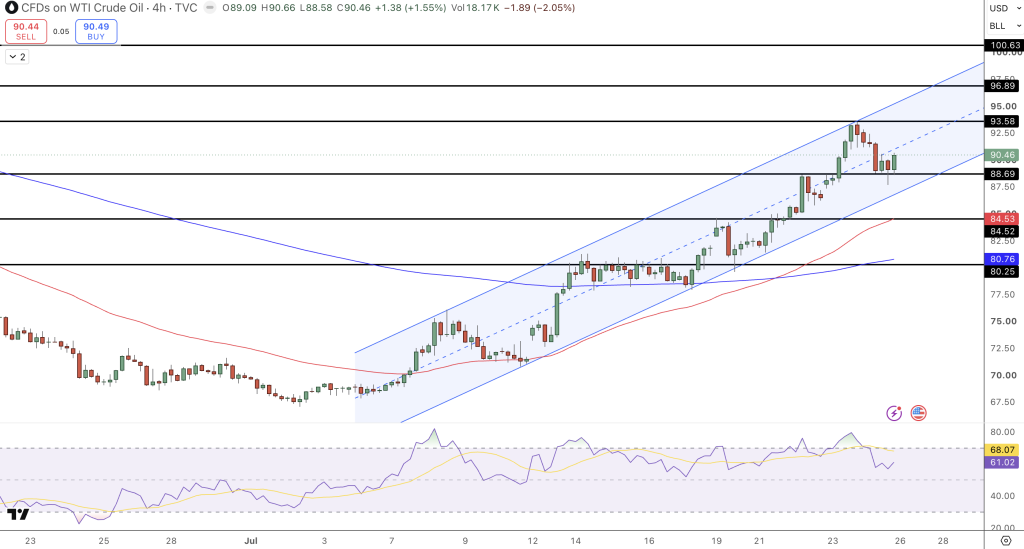
RSI has recovered to 61, turning higher after briefly cooling from overbought territory, suggesting buyers are regaining control without the market becoming overstretched.
Resistance: $90.50 (immediate), then $93.58, then $96.89. A breakout through those levels opens a test of the psychological $100.63 resistance. Support: $88.69 (first key support, lower half of the ascending channel), then $84.52 (50 EMA), with stronger structural support at $80.25–$80.76.
Trade setup: As long as WTI holds above $88.69, the path of least resistance remains higher. Long above $90.50, target $93.58–$96.89, stop below $88.69. A break below $88.69 triggers a pullback toward $84.52 before the trend resumes.
FAQ: Crude Oil — Red Sea Impact, Fed Decision, and the $100 Question
Why did oil fall on Friday if the supply disruptions are still in place?
Friday’s 4% Brent decline was driven by reports of Pakistan and China working to revive US-Iran negotiations, raising hopes for a diplomatic offramp. Nothing in the physical market changed: Hormuz remains disrupted, the Red Sea is contested, and Kazakhstan’s exports are constrained. The move reflects how much war premium is embedded in the price. Roughly $4 per barrel evaporated on headlines alone, which means an actual peace framework would remove considerably more.
How does the Fed decision affect oil prices next week?
The Fed does not target oil, but its reaction to oil-driven inflation shapes the dollar, and crude is priced in dollars. A hawkish hold that validates the 80% September hike probability strengthens the dollar and raises the cost of oil for non-US buyers, dampening demand at the margin. It also signals the Fed sees energy inflation as persistent, which historically has coincided with demand destruction at sustained prices above $90.
Can WTI reach $100 next week?
WTI at $90.46 needs roughly 11% to reach $100.63, the key psychological resistance on the chart. That requires either a failure of the Pakistan/China diplomatic effort, a further Houthi escalation that closes Bab el-Mandeb to Saudi traffic entirely, or confirmed Kazakhstan production shut-ins extending beyond two weeks. The technical structure supports the move if the catalyst arrives: the ascending channel projects toward $96.89 first, and Brent has already demonstrated that $100+ prints are achievable in this environment.
- Check out our free forex signals
- Follow the top economic events on FX Leaders economic calendar
- Trade better, discover more Forex Trading Strategies
- Open a FREE Trading Account
- Read our latest reviews on: Avatrade, Exness, HFM and XM

Related Articles


Sidebar rates

Related Posts
 Save
Save