WTI Crude Oil Forecast: Can WTI Hold Above $88 as Middle East Risks Offset Fed Uncertainty?
WTI crude oil trades near $90 as Middle East tensions, falling US inventories and OPEC+ discipline support prices ahead of next week's...

Quick overview
- WTI crude oil is trading near $90, supported by Middle East tensions, declining US inventories, and OPEC+ production discipline.
- Geopolitical risks, particularly in the Red Sea and Hormuz Strait, are contributing to an elevated oil price premium.
- US crude inventories have decreased, with production nearing all-time highs, while OPEC+ continues to enforce supply cuts.
- Attention is focused on the upcoming Federal Reserve meeting, as a prolonged high interest rate forecast could negatively impact global fuel demand.
WTI crude oil trades near $90 as Middle East tensions, falling US inventories and OPEC+ discipline support prices ahead of next week’s Federal Reserve meeting. West Texas Intermediate crude is set to close the week near the $89.80-per-barrel mark. Already, it is higher in 2026 than at any point prior, which will only encourage further purchases.
A reduction in US crude inventories and continued OPEC+ supply cuts have supported higher prices, which also have been aided by a resurgence of attacks in the Red Sea. While the geopolitical risk of the Middle East has been spiking oil prices, there is concern in the market that a higher-for-longer interest rate forecast from the Federal Reserve will cause global fuel demand to crater.
Middle East risks are keeping oil’s geopolitical premium elevated
Geopolitics, especially as they concern the US, Iran and Iran-backed Houthis, continue to play a key role in determining oil prices. Shipping attacks in the Red Sea are increasing worries over supply. Particularly scary is the Hormuz Strait, through which it is reported that 20 million barrels of crude oil transit each day, which is 20 percent of liquid petroleum production.
Even as exports have continued uninterrupted, a geopolitical risk premium is priced into crude. Any supply disruption of shipping would mean that the whole world will face a shortage of crude.
OPEC+ will continue to support prices
The cartel will continue to keep oil production constrained. The other members in the alliance will continue to support higher prices by continuing to make voluntary production cuts. OPEC+ has planned on increasing supply by 548,000 barrels per day in August, however, constraints will prevent many members from reaching their quota.
OPEC+ swing producer Saudi Arabia, as well as Russia, which is already sanctioned, are both continuing to adhere to OPEC+. OPEC’s latest report expects global oil consumption to increase by 1.3 million barrels per day this year, bringing the total above 106 million barrels per day.
US inventories continue to decline
More inventory reductions have occurred in the US. Last week’s data from the EIA showed:
-
Crude: 419.0 million barrels, down 3.2 million
-
Gasoline: -1.7 million
-
Distillates: -2.9 million
-
Refinery utilization: 94.8 percent
That’s another reason oil continues to trade higher: despite higher fuel prices, US fuel consumption has not decreased. The ongoing inventory drawdown and robust fuel demand have increased the market’s sensitivity to geopolitical issues.
US production nears all-time highs
US production will continue to hold crude prices in check. The EIA estimates US crude output will continue to approach 13.5 million barrels per day. However, US producers, contrary to other periods of shale oil growth, will prioritize capital discipline over expansion. US oil rig counts are well below levels from this time last year, per Baker Hughes. Despite stronger crude prices, producers are choosing to limit drilling.
China Continues to Pose the Biggest Demand Threat
While supply appears robust, uncertainty surrounds the demand side. China, currently the world’s leading crude oil importer, is increasingly turning to targeted measures aimed at bolstering domestic economic activity.
Nevertheless, its production volumes are not picking up pace, specifically its refinery processing rates, compared to the level of growth achieved during the latter portion of the post-pandemic era.
A further slowdown in Chinese industrial and transport oil demand could have a wider adverse impact on global oil consumption during the second half of this year. With the release of Manufacturing PMI data for the week, we will be assessing for further demand improvements.
Federal Reserve Meeting in the Spotlight
Attention shifts to the July 29-30 Federal Reserve meeting. The Federal Reserve is not expected to shift its current monetary policy position though the market will be closely watching any hints that suggest the Fed might alter its plans to come.
The expectation that interest rates will stay elevated for an extended period of time should lead to reduced fuel demand in the economy, especially as the higher rates will also bolster the value of the dollar. Lower rates would have the opposite effect, leading to a surge in fuel demand, alongside a more generally positive outlook for the economy.
WTI Crude Oil (USOIL) Technical Analysis: Buyers Defending the Uptrend
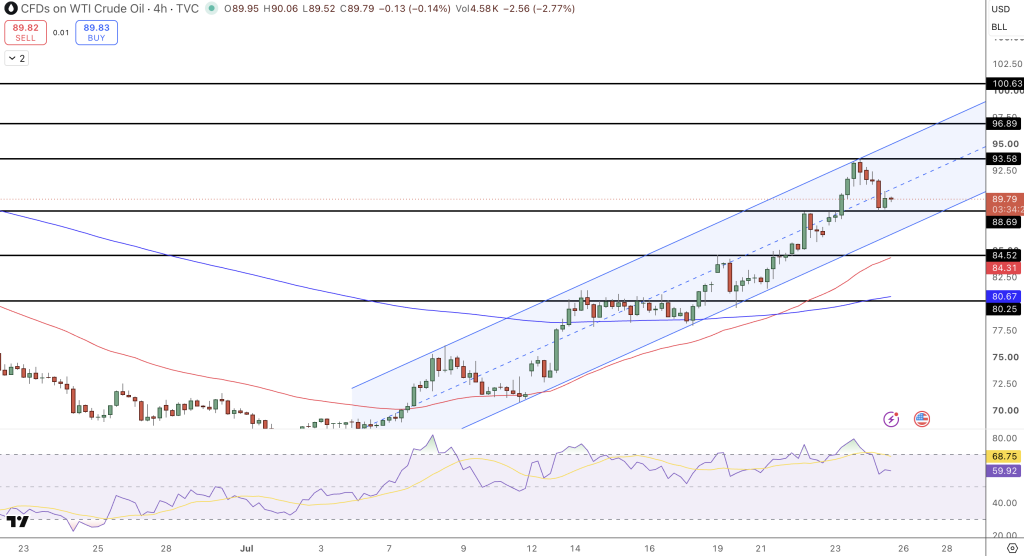
From a technical standpoint, the picture for crude remains quite positive, with WTI sitting at $89.79 inside the trading channel on the retreat from higher prices. The 50 Period EMA ($84.31) is clearly positioned above the 200 Period EMA ($80.67) and prices are well aligned with buyers. RSI at 60 has pulled back from the overbought zone but is still within positive territory.
The nearest support level is at $88.69 while the risk assessment sits at $84.52 with strong support located at the lower boundary of the $80.25-$80.67 band. For bullish momentum to pick up, the market must recapture $93.58. A breakout from here could see WTI trading near $96.89, with further upside towards the round figure of $100.63, in the event that ongoing geopolitical risks persist.
Conclusion
Looking at global commodities, WTI crude possesses the strongest set of fundamentals to end July on a bullish note, underpinned by geopolitical tensions. US crude stockpiles stand at 419 million barrels. OPEC+ has taken a balanced approach to supply adjustments and demand is projected to accelerate by 1.3 mbpd over 2026.
The primary near-term risk relates to next week’s Federal Reserve meeting. If the ‘higher-for-longer’ rate stance is strengthened, then fuel demand may suffer. Given the present geo-political landscape and current inventory situation, WTI oil should trade at a positive valuation into August.
- Check out our free forex signals
- Follow the top economic events on FX Leaders economic calendar
- Trade better, discover more Forex Trading Strategies
- Open a FREE Trading Account
- Read our latest reviews on: Avatrade, Exness, HFM and XM

Related Articles

Sidebar rates

Related Posts
 Save
Save