BE Stock Rebounds 11.8% After Bloom Energy’s Record $1 Billion Quarter, but $200 Resistance Looms
Bloom Energy stock BE rebounds 11.8% after record $1.07B revenue and raised guidance, but bearish charts keep $200 resistance in focus.
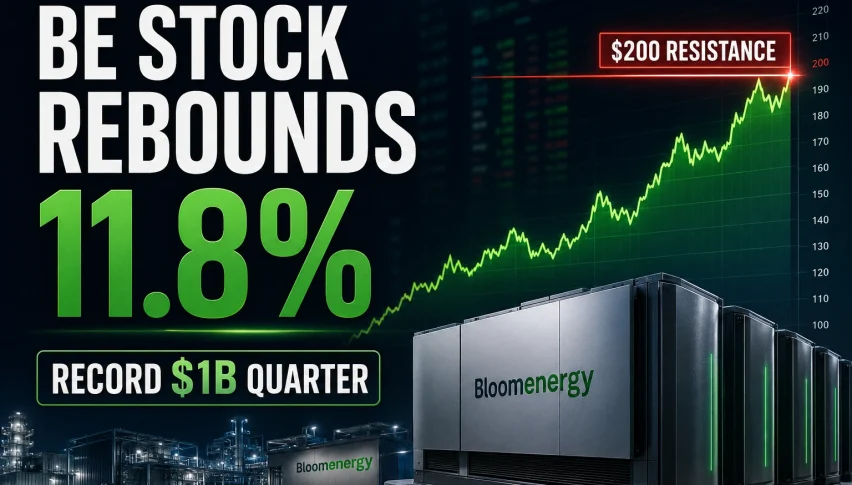
Bloom Energy shares rebounded nearly 12% to $186.54 after record revenue, expanding margins and higher guidance reinforced its position as a major power supplier for AI data centres.
Bloom Energy Stock Surges as Record Results Restore Investor Confidence
Bloom Energy shares jumped $19.70, or 11.81%, to $186.54 in pre-market trading after the fuel-cell manufacturer reported its first billion-dollar quarter and raised its full-year outlook for the second consecutive earnings period.
The recovery followed an extremely volatile session in which BE stock had fallen 11.34% to $166.84. The sharp reversal shows investors are attempting to balance Bloom’s extraordinary fundamental growth against a technical correction that has pushed the stock below every major 4-hour moving average.
Record product revenue, positive operating cash flow and stronger margins support the bullish case. However, the stock must reclaim $190 and then $200–$207 before the technical picture begins to confirm a sustainable recovery.
Bloom Energy Revenue Surpasses $1 Billion
Bloom Energy delivered the strongest quarter in its history as demand for onsite electricity accelerated across AI data centres, hyperscalers and other power-intensive customers.
Revenue reached $1.065 billion, increasing 165.5% from $401.2 million a year earlier and 41.9% from the previous quarter.
Product revenue provided the main source of growth, rising 215.4% to $935.4 million. The increase shows that Bloom is moving beyond small demonstration projects and converting large data-centre demand into recognized sales.
The company’s solid oxide fuel-cell systems generate electricity onsite from natural gas or biogas through an electrochemical process. The technology can provide reliable power without waiting for lengthy grid connections or conventional turbine-delivery schedules.
That speed has become increasingly valuable as AI companies race to construct data centres while electricity infrastructure struggles to keep pace.
Bloom CEO KR Sridhar said all major U.S. hyperscalers and more than a dozen neocloud providers, AI laboratories and colocation operators have validated or approved the company’s power solutions.
The statement strengthens Bloom’s claim that its fuel-cell systems are becoming a standard onsite-power option for AI infrastructure.
Profitability Improves Alongside Revenue Growth
The quarter was not simply the result of higher sales.
Bloom’s GAAP gross margin increased to 33.4% from 26.7% a year earlier, an improvement of 668 basis points. Non-GAAP gross margin reached 34.3%, compared with 28.2% in the second quarter of 2025.
GAAP operating income improved to $182.2 million from a $3.5 million loss. On an adjusted basis, operating income surged to $239.6 million, producing a non-GAAP operating margin of 22.5%.
The company reported GAAP diluted earnings of $0.62 per share, compared with a loss of $0.18 a year earlier. Non-GAAP diluted earnings reached $0.78 per share, almost double some market estimates near $0.40.
This distinction explains the different EPS figures appearing in early reports. The $0.62 figure reflects GAAP earnings, while $0.78 represents Bloom’s adjusted result.
The simultaneous expansion in revenue, gross margin and operating margin is particularly important. It suggests that Bloom is achieving operating leverage as production increases rather than purchasing growth through lower profitability.
Cash Flow Supports Bloom Energy’s AI Power Expansion
Bloom also generated $226.4 million in operating cash flow, improving by $439.5 million from the $213.1 million outflow recorded a year earlier.
Free cash flow reached approximately $175 million, while the company ended the quarter with roughly $2.7 billion in cash.
Positive cash generation makes Bloom’s rapid expansion more credible because the company must invest in manufacturing capacity, inventory, research and field services before receiving the full benefit of customer deployments.
Demand alone will not determine the company’s long-term success. Bloom must prove it can manufacture, deliver and service its Energy Servers at the scale required by hyperscale data centres.
Management insists capacity will not become the main constraint. The company is doubling annual production capacity at its Fremont facility to approximately 2 gigawatts, with the site potentially capable of reaching 5 gigawatts over time.
Investors will now look for evidence that production growth can maintain the margin improvements achieved during the second quarter.
Bloom Raises Guidance for the Second Time
Bloom increased its 2026 revenue outlook to between $3.9 billion and $4.2 billion.
The midpoint implies approximately 100% growth from 2025. The new forecast is significantly higher than the $3.4–$3.8 billion range provided in April and the original $3.1–$3.3 billion outlook issued in February.
Management also expects a non-GAAP gross margin of approximately 34%, non-GAAP operating income of $800 million to $900 million and adjusted earnings of $2.55 to $2.85 per share.
The repeated guidance increases show that demand is arriving faster than management initially expected.
Bloom said its 2026 outlook does not depend on any single project, reducing the risk that one delayed data centre could undermine the annual forecast. Contracts also include protections against project delays, while equipment can be redeployed to other customers if necessary.
Nevertheless, the raised outlook creates a higher execution bar. Investors will expect Bloom to convert its pipeline into revenue without allowing supply constraints, installation delays or higher material costs to weaken profitability.
AI Data Centers Turn Electricity Into a Critical Bottleneck
Bloom’s opportunity has expanded because electricity is becoming one of the most serious constraints on AI infrastructure.
Large data centres require enormous amounts of continuous power, but grid interconnections can take years and conventional gas turbines face long manufacturing queues.
Bloom says its modular systems can be deployed much faster. Oracle agreed to purchase 2.8 gigawatts of Bloom capacity, with some initial deliveries reportedly completed in as little as 55 days.
The company has also expanded its strategic relationship with Brookfield from $5 billion to as much as $25 billion. The funding structure can support new projects as customer demand develops.
This combination of rapid installation and external financing could allow Bloom to capture business that would otherwise be delayed by grid limitations.
However, the AI connection also introduces concentration risk. Any slowdown in data-centre construction or a reassessment of AI infrastructure spending could reduce demand expectations and pressure Bloom’s elevated valuation.
BE Stock Remains Below Every Major Moving Average
Despite the pre-market rebound, Bloom Energy’s 4-hour technical structure remains bearish.
At $186.54, the stock is below its 10-period EMA at $189.96 and its 10-period simple moving average at $196.64. These levels create the first resistance band between approximately $190 and $197.
A stronger recovery would then face the volume-weighted moving average at $201.56, the Ichimoku baseline at $204.83 and the 20-period moving averages near $206–$207.
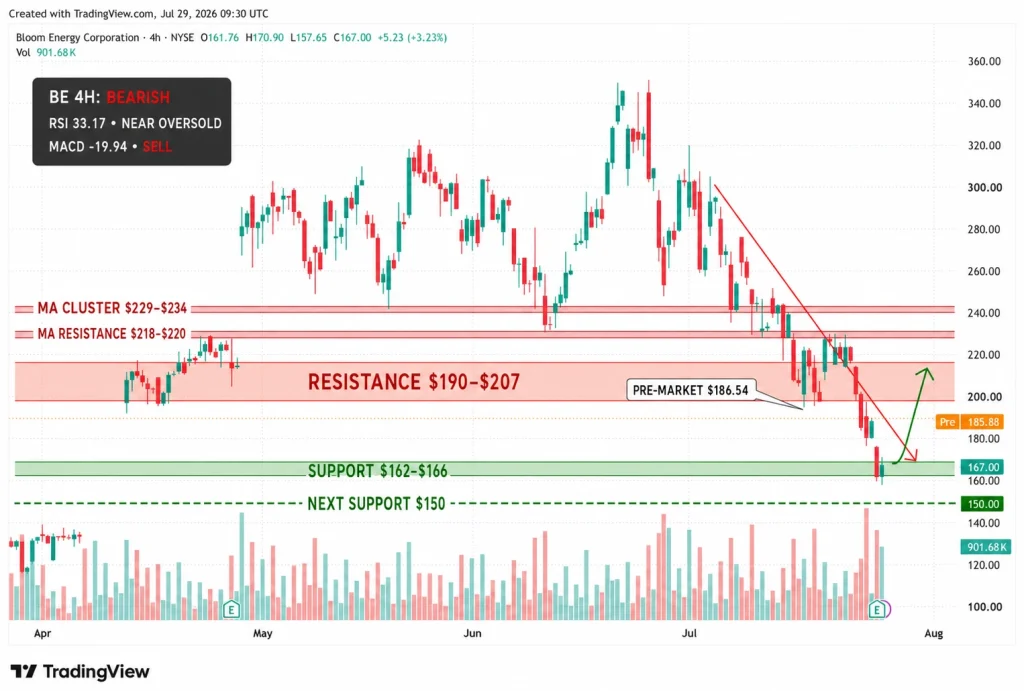
BE Chart 4-Hour – Can Bloom Energy Reclaim the $190–$207 Resistance Zone?
The large number of moving averages above the current price shows how aggressively the stock has corrected. The 30-period averages sit near $218–$220, while the 200-period averages are positioned between approximately $229 and $232.
Longer-term resistance extends toward $245–$266.
A sustained break above $207 would be the first meaningful sign that the post-earnings rebound is changing the short-term trend. Reclaiming $220 would provide much stronger confirmation and expose the $229–$234 region.
Oversold Oscillators Support a Short-Term Rebound
Several oscillators suggest that recent selling may have become excessive.
The 14-period RSI stands at 33.17, approaching the traditional oversold threshold of 30. Stochastic %K has fallen to 12.85, while Stochastic RSI stands at 14.77.
The Commodity Channel Index is deeply oversold at -177.97, and Williams Percent Range is at -87.06. Both are producing buy signals, along with Momentum and Stochastic RSI.
The Hull moving average at $162.34 also gives a buy signal and provides a potential short-term support reference.
However, these indicators show rebound potential rather than a confirmed trend reversal. The MACD remains on sell at -19.94, the Awesome Oscillator is deeply negative and Bull Bear Power stands at -62.28.
If buyers fail to hold $180, BE stock could retest the $166–$162 support zone. A decisive break below that area would expose $150 and signal that the earnings rebound has failed.
Bloom Energy Faces a Critical $200 Test
Bloom Energy’s record quarter provides strong evidence that AI infrastructure demand is translating into revenue, profitability and cash flow.
The company has crossed $1 billion in quarterly sales, raised annual guidance twice and significantly improved margins. Its rapid-deployment technology offers a compelling solution to the electricity shortages delaying large data-centre projects.
Yet the technical damage remains substantial.
Holding above $180 and reclaiming $190–$197 could keep the recovery alive. A decisive break above $207 would open the door toward $220 and potentially the $229–$234 moving-average cluster.
Failure to hold $180 would return attention to $166–$162.
Bloom’s fundamentals have strengthened dramatically, but the stock must now prove that the earnings surge can overcome a bearish technical structure and establish $200 as support rather than resistance.
- Check out our free forex signals
- Follow the top economic events on FX Leaders economic calendar
- Trade better, discover more Forex Trading Strategies
- Open a FREE Trading Account
- Read our latest reviews on: Avatrade, Exness, HFM and XM

Related Articles


Sidebar rates

Related Posts
 Save
Save