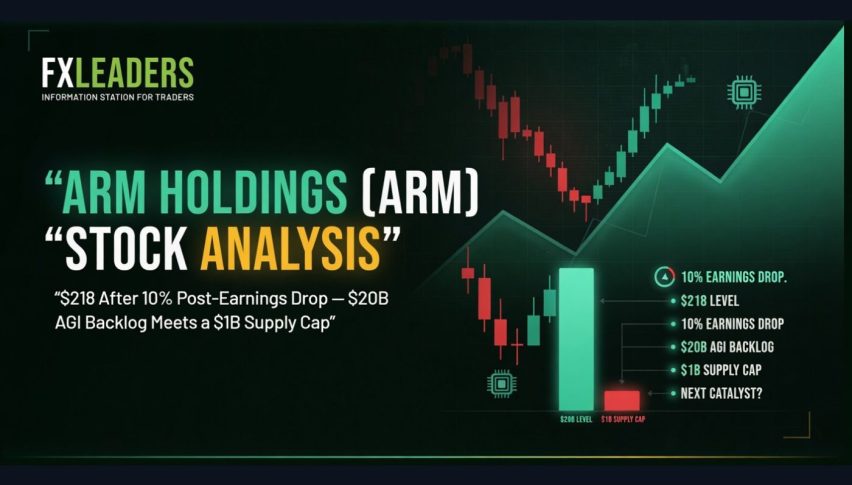
Arm Holdings (ARM) Stock Analysis: $218 After 10% Post-Earnings Drop — $20B AGI Backlog Meets a $1B Supply Cap
ARM closed at $218.70 on May 8, bouncing back from a 10% drop after its record Q4 FY2026 results. Revenue hit $1.49 billion...
Quick overview
- ARM's stock closed at $218.70 on May 8, recovering from a 10% drop despite record Q4 FY2026 results.
- The company reported $1.49 billion in revenue and a 29% increase in licensing revenue, but faces a significant supply constraint with only $1 billion of the $20 billion AGI CPU demand secured.
- Market concerns over a projected revenue drop to $1.26 billion in Q1 FY2027 and a high valuation of 47 times sales have pressured the stock price.
- Long-term prospects remain strong, with a projected $100 billion market for CPUs by 2030 as demand for agentic AI workloads grows.
ARM closed at $218.70 on May 8, bouncing back from a 10% drop after its record Q4 FY2026 results. Revenue hit $1.49 billion, EPS was $0.60, and data center royalties more than doubled year-on-year, all setting new records. Despite this, the market sold the stock. The main issue is that AGI CPU demand has jumped to $20 billion in just six weeks since launch, but Arm only has manufacturing capacity secured for $1 billion of that demand. With a valuation at 47 times sales, any gap in execution quickly affects the stock price.
The $20 Billion Gap Nobody Wants to Price
On the May 6 earnings call, CEO Rene Haas said AGI CPU customer demand doubled to over $20 billion within six weeks of launch, but supply is only secured for the first $1 billion. The issue is not demand, but a lack of manufacturing capacity at TSMC. The AI infrastructure boom that is boosting Arm’s orders is also pulling advanced manufacturing resources away from consumer electronics and Arm’s new chips.
In Q4 FY2026, Arm reported $1.49 billion in revenue, up 20% year-over-year. Licensing revenue rose 29% to $819 million, and royalty revenue increased 11% to $671 million. The non-GAAP operating margin reached 49%, which is among the highest in the semiconductor industry. For the full year, revenue was $4.92 billion, making it the third year in a row that Arm has grown more than 20% since going public.
The market is reacting to a projected drop: Q1 FY2027 guidance is $1.26 billion in revenue and $0.36 EPS, down sharply from Q4’s $1.49 billion and $0.60. This seasonal dip is normal for Arm, as Q4 is always its strongest quarter. However, with the stock trading at 47 times sales and 130 times earnings, any sign of slowing growth puts extra pressure on the valuation, even if the fundamentals haven’t changed much.
The long-term outlook for Arm is stronger than ever. Haas explained that agentic AI workloads need CPUs to coordinate tasks, move data, manage memory, and handle work around accelerators. As agentic AI grows, data centers will need more than four times today’s CPU capacity, creating a market worth over $100 billion by 2030. Arm currently has about 50% CPU market share among major hyperscalers like Amazon and Alphabet. The growth in data center royalties, which have already more than doubled year-on-year, is the key earnings driver that supports Arm’s high valuation for long-term investors.
ARM Technical Analysis: Trendline Breakout, $227–$238 in Focus
On the 4-hour chart, ARM has broken above the descending trendline from its post-earnings high near $237 and is now forming a clear upward channel from the May lows at $168.90. The price has moved past the 0.618 to 0.786 Fibonacci cluster and is now aiming for the 1.0 to 1.272 extension zone between $219 and $227.68.
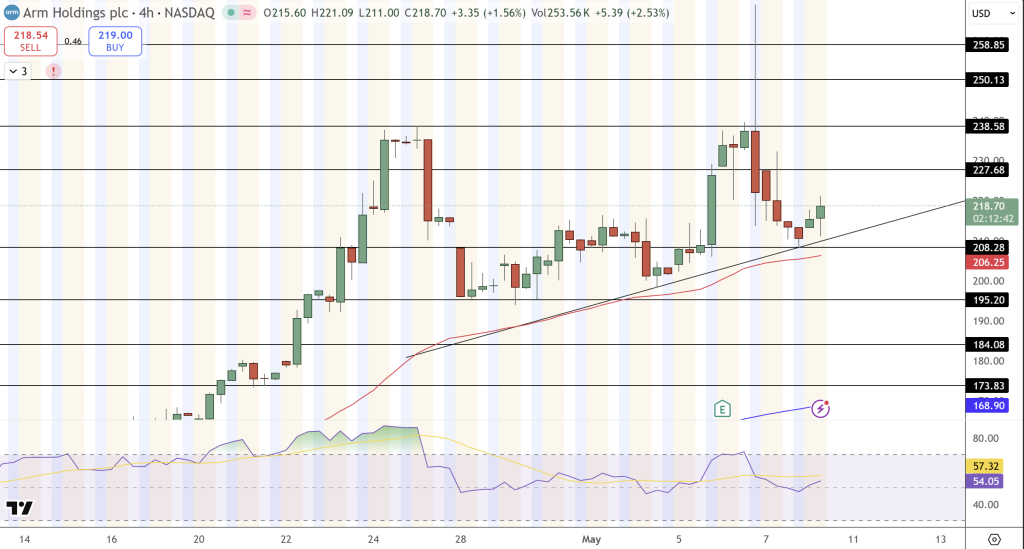
Resistance is at $227.68 (1.272 Fibonacci level), with the next target at $238.58, which is close to the all-time high. Support levels are at $208.28 to $206.25 (yellow and cyan moving average cluster), and then at $168.90, which is the base of the channel.
The RSI is between 54 and 57, which shows positive momentum. The stock is not overbought and has room to keep moving higher.
Trade idea: Go long if the price stays above $220, with a target range of $227.68 to $238.58, and a stop loss below $206.25.
The next earnings report is on July 29. This Q1 FY2027 update will show whether the $1.26 billion guidance is the minimum or if there’s room for upside.
FAQ: ARM — AGI Supply Gap, 47x Sales Valuation, and the $100B CPU Market
Why did ARM stock fall 10% despite record earnings?
The gap between $20 billion in AGI CPU demand and only $1 billion in supply capacity showed that Arm can’t turn its order backlog into revenue as quickly as investors hoped. Along with Q1 FY2027 guidance of $1.26 billion, which is a drop from Q4’s record $1.49 billion, and a high valuation of 47 times sales, this led the market to quickly reprice the stock, even though the fundamentals remain strong.
What is the AGI CPU and why does it matter for Arm’s future revenue?
The Arm AGI CPU is the company’s first in-house chip design, aimed at agentic AI workloads where CPUs coordinate AI agents instead of just running instructions. This marks Arm’s move from only licensing its architecture to actually selling products for the AI infrastructure market. Orders doubling to $20 billion in six weeks show that demand from hyperscalers is real. The main challenge is manufacturing, not market acceptance.
What is the Arm stock price target and when does the supply constraint resolve?
Jefferies has a price target of $265 and TD Cowen targets $290, both based on Arm’s growing share among hyperscalers and the $100 billion data center CPU market expected by 2030. The supply issue is due to limited TSMC advanced node capacity, which management expects to start resolving in the second half of FY2027. The July 29 Q1 FY2027 earnings report will be the first sign of whether the backlog is turning into revenue. With ARM currently at $218, the stock is 18% below the Jefferies target, so the risk and reward depend on how quickly the supply problem is fixed.
- Check out our free forex signals
- Follow the top economic events on FX Leaders economic calendar
- Trade better, discover more Forex Trading Strategies
- Open a FREE Trading Account
- Read our latest reviews on: Avatrade, Exness, HFM and XM

Related Articles
Sidebar rates

