Oracle has emerged as a major player in the AI infrastructure race, benefiting from significant cloud contracts with companies like OpenAI and Meta.
The upcoming earnings report on June 10 is critical, as investors are concerned about whether Oracle can justify its rising valuation amid recent volatility in the tech sector.
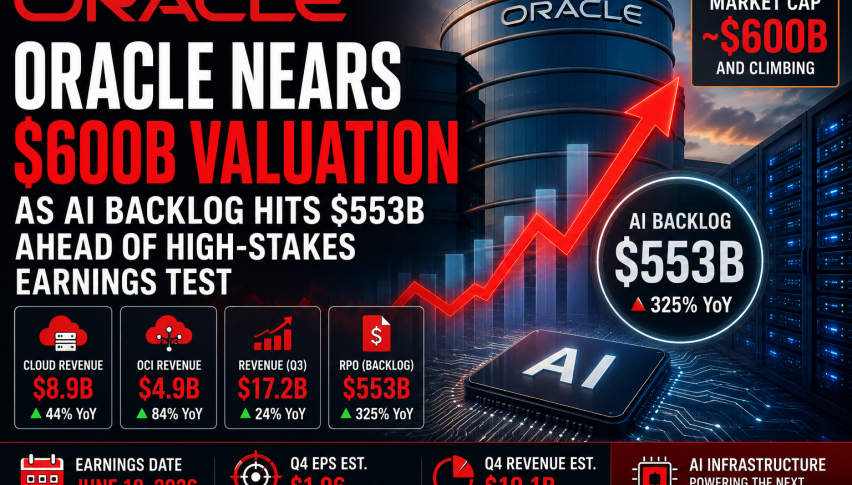
Recent financial performance shows strong growth, with cloud revenue increasing by 44% and Remaining Performance Obligations up 325% year-over-year.
Despite aggressive infrastructure spending and rising debt, analysts remain bullish, suggesting Oracle could join the trillion-dollar market cap club if AI demand continues.
Oracle shares have become one of Wall Street’s biggest AI winners. But after a sharp pullback and a nearly 60% rally from this year’s lows, investors are now focused on a single question: Can Oracle justify its rapidly rising valuation when it reports earnings on June 10?
The software giant has emerged as one of the biggest beneficiaries of the AI infrastructure race. Massive cloud contracts from OpenAI, Meta, and xAI have transformed Oracle from a traditional database company into a major AI cloud provider competing with Amazon, Microsoft, and Google.
However, recent volatility across the technology sector has raised the stakes for the upcoming earnings report.
Oracle Earnings Could Become a Key AI Market Catalyst
Oracle will report fiscal fourth-quarter results after the market closes on June 10.
Wall Street expects:
EPS: $1.96, up 15.3% year-over-year
Revenue: Approximately $19.1 billion
Cloud growth: Expected to remain the primary driver
AI infrastructure demand: Under intense scrutiny
The report arrives during a difficult period for technology stocks.
Broadcom recently delivered strong earnings but disappointed investors with guidance that failed to exceed lofty expectations. The result triggered a broad semiconductor selloff and renewed concerns about whether AI spending can maintain its current pace.
Oracle now faces a similar challenge.
Investors will be watching:
Cloud infrastructure growth
Remaining Performance Obligations (RPO)
AI-related contract wins
Data center expansion plans
Fiscal 2026 and 2027 guidance
Commentary on OpenAI, Meta, and xAI demand
Oracle’s AI Business Is Expanding Rapidly
Oracle’s recent financial performance illustrates why investors have become increasingly bullish.
In its most recent quarter:
Revenue increased 24% to $17.2 billion
Cloud revenue jumped 44% to $8.9 billion
Oracle Cloud Infrastructure (OCI) surged 84% to $4.9 billion
Cloud applications rose 13% to $4 billion
Remaining Performance Obligations reached $553 billion, up 325% year-over-year
That backlog figure has become one of the most closely watched metrics in enterprise software.
Much of the growth has been linked to AI-related contracts with major customers including OpenAI, Meta, and xAI.
Management has also raised long-term targets:
FY2027 revenue target: $90 billion
OCI capacity investment: $45 billion-$50 billion
Annual revenue expected to approach $88 billion next fiscal year
Several analysts now argue Oracle could eventually join the trillion-dollar market cap club if AI demand remains strong.
Balance Sheet Expansion Raises Questions
The growth story is attracting investors, but it comes with costs.
Oracle has aggressively expanded infrastructure spending to meet AI demand.
The company recently raised billions through debt and equity financing.
Long-term debt climbed to approximately $124 billion, up from $85 billion a year earlier.
The strategy resembles the capital-intensive expansion currently underway across the AI industry.
Supporters argue the investments are necessary to capture a once-in-a-generation AI opportunity.
Critics warn that execution risks increase significantly when growth depends heavily on a small number of large AI customers.
How to trade Oracle earnings this week
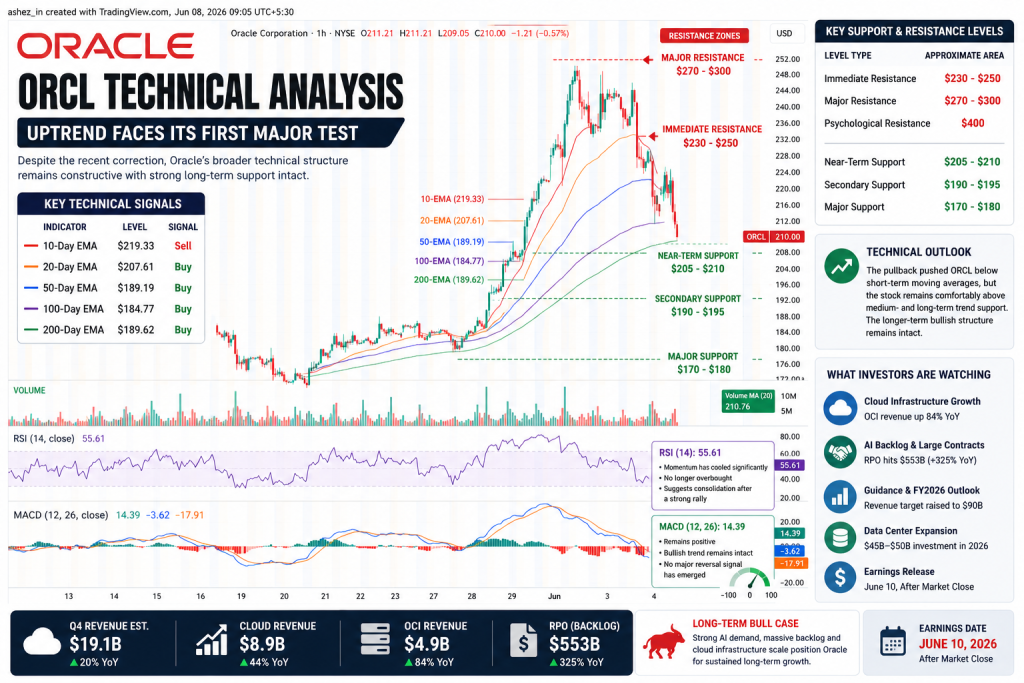
ORCL Technical Analysis: Uptrend Faces Its First Major Test
Despite the recent correction, Oracle’s broader technical structure remains constructive.
The stock pulled back sharply from its recent peak near $250 but continues trading above most key trend indicators.
Key Technical Signals
Indicator
Level
Signal
10-Day EMA
$219.33
Sell
20-Day EMA
$207.61
Buy
50-Day EMA
$189.19
Buy
100-Day EMA
$184.77
Buy
200-Day EMA
$189.62
Buy
The recent decline pushed Oracle below its short-term moving averages, but the stock remains comfortably above medium- and long-term trend support.
The longer-term bullish structure remains intact.
RSI and MACD
RSI: 55.61
Momentum has cooled significantly
No longer overbought
Suggests consolidation after a strong rally
MACD: 14.39
Remains positive
Bullish trend remains intact
No major reversal signal has emerged
The combination suggests Oracle may be digesting recent gains ahead of a potentially market-moving earnings report.
Key Support and Resistance Levels
Level Type
Approximate Area
Immediate Resistance
$230-$250
Major Resistance
$270-$300
Psychological Resistance
$400
Near-Term Support
$205-$210
Secondary Support
$190-$195
Major Support
$170-$180
Holding above the $205-$210 region would suggest buyers remain active despite recent volatility. A strong earnings report could place the $250 level back into focus.
Analysts Continue Raising Targets
Wall Street remains broadly bullish on Oracle.
Recent analyst targets include:
Jefferies: $320
Cantor Fitzgerald: $284
Some bullish forecasts suggest Oracle could eventually approach $379 if earnings growth and valuation multiples continue expanding.
Consensus estimates project earnings per share growing from approximately $7.42 in fiscal 2026 to $10.82 by fiscal 2028.
That implies annualized earnings growth exceeding 20%.
Long-Term Outlook: Oracle Is Becoming an AI Infrastructure Giant
Oracle’s investment case increasingly revolves around AI rather than traditional enterprise software.
The company’s cloud infrastructure business is growing faster than nearly every major software peer. Its partnerships with OpenAI, Meta, Nvidia, and other AI leaders have positioned Oracle at the center of one of the largest technology spending cycles in history.
The key question is whether Oracle can continue converting its massive backlog into revenue while expanding infrastructure fast enough to meet demand.
For now, investors appear willing to bet that AI spending remains strong.
The June 10 earnings report could determine whether Oracle’s next move is driven by fundamentals—or by the same valuation concerns that recently triggered sharp declines across the broader AI sector.
Lead Markets Analyst – Multi-Asset (FX, Commodities, Crypto)
Arslan Ali Butt serves as the Lead Commodities and Indices Analyst, bringing a wealth of expertise to the field. With an MBA in Behavioral Finance and active progress towards a Ph.D., Arslan possesses a deep understanding of market dynamics.
His professional journey includes a significant role as a senior analyst at a leading brokerage firm, complementing his extensive experience as a market analyst and day trader. Adept in educating others, Arslan has a commendable track record as an instructor and public speaker.
His incisive analyses, particularly within the realms of cryptocurrency and forex markets, are showcased across esteemed financial publications such as ForexCrunch, InsideBitcoins, and EconomyWatch, solidifying his reputation in the financial community.




 Save
Save