META Stock Crashes Below $550 as AI Spending Wipes Out Cash Flow Despite 28% Revenue Growth
Meta earnings: Meta stock crashes 6.7% as EPS misses, cash flow falls 91% and its $145B AI spending plan overwhelms strong ad growth.
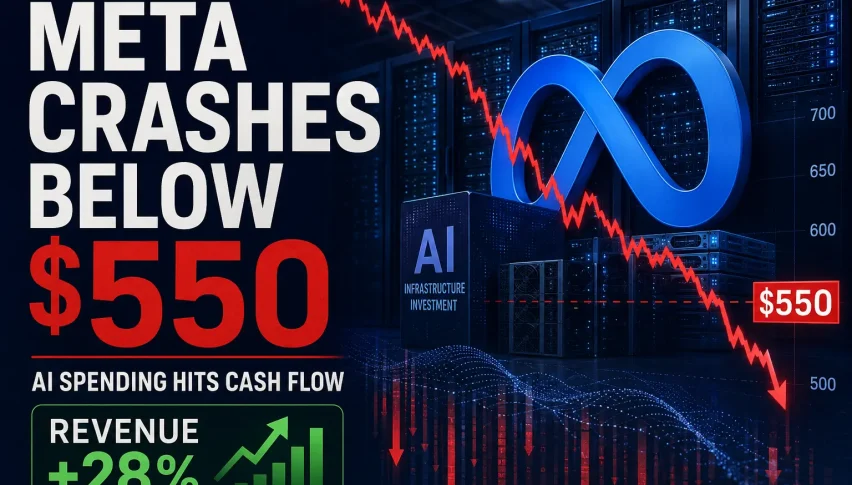
Meta shares plunged 6.72% to $546.28 after earnings missed estimates, free cash flow collapsed to $784 million and higher AI spending overshadowed 28% revenue growth.
Meta Stock Falls Below $550 After Earnings Miss
Meta Platforms shares dropped sharply after the company missed second-quarter earnings forecasts and raised the lower end of its 2026 capital-expenditure outlook.
META initially fell 1.31% to $585.61 before sliding another $39.33 to $546.28 overnight.
Revenue beat expectations and advertising remained strong. However, expenses rose 55%, operating profit declined and free cash flow fell 91%.
The earnings gap pushed Meta further below every major 4-hour moving average. Unless buyers quickly reclaim $585–$600, the stock remains exposed to $530 and potentially $500.
Strong Advertising Growth Fails to Support META
Meta reported revenue of $60.8 billion, up 28% from $47.52 billion a year earlier and ahead of the $60.2 billion consensus estimate.
Its advertising engine remained strong.
Ad impressions across Meta’s Family of Apps increased 14%, while average price per ad rose 12%. Family daily active people reached 3.60 billion, up 3%.
These figures suggest Meta’s AI recommendation and advertising systems continue improving engagement and campaign performance.
But advertising growth was not enough to offset rapidly rising costs.
Meta Earnings Miss as Expenses Surge
Diluted earnings fell to $6.18 per share from $7.14 a year earlier, missing Wall Street expectations.
Net income declined 14% to $15.85 billion, while operating income fell 8% to $18.78 billion. The operating margin dropped sharply to 31% from 43%.
Total costs and expenses jumped 55% to $42.03 billion.
That figure included $2.40 billion in legal charges and $1.18 billion in severance costs related to Meta’s May workforce reduction. Excluding those items, management said operating income would have increased approximately 9%.
Meta nevertheless raised its full-year expense outlook to $165–$169 billion from $162–$169 billion.
The market’s concern is straightforward: costs are increasing almost twice as fast as revenue.
Free Cash Flow Collapses 91%
Free cash flow was the report’s biggest weakness.
It fell to just $784 million from $8.55 billion a year earlier as AI infrastructure consumed nearly all of Meta’s operating cash generation.
Operating cash flow remained strong at $31.86 billion, but capital expenditure reached $31.08 billion.
Meta still held $90.26 billion in cash, cash equivalents and marketable securities at quarter-end. However, long-term debt increased to $83.66 billion as the company used more external financing for data-centre expansion.
Meta can afford its AI buildout. The harder question is whether the investment will produce returns quickly enough to justify its scale.
AI Spending Outlook Moves Higher Again
Meta now expects 2026 capital expenditure of $130–$145 billion, compared with its previous $125–$145 billion range.
At the beginning of 2026, the company forecast only $115–$135 billion.
Meta spent $50.92 billion during the first half. It must therefore deploy another $79–$94 billion over the final six months to reach its guidance.
That implies average quarterly spending of roughly $40–$47 billion during the second half.
Unless operating cash flow accelerates substantially, this level of investment could keep free cash flow under pressure.
Meta Wants to Turn AI Infrastructure Into Revenue
Management outlined several ways to monetize its expanding computing capacity.
Meta plans to offer business agents, AI models through application-programming interfaces, productivity tools and potentially direct computing access to outside customers.
Mark Zuckerberg said Meta sees a large opportunity to serve both its existing advertiser base and larger enterprises. The company could also sell excess computing capacity at a premium to its own cost.
This strategy could help Meta earn returns beyond advertising and place it in limited competition with Microsoft, Amazon and Google.
However, the business remains at an early stage.
Microsoft’s latest results showed that investors will tolerate enormous AI spending when cloud growth and cash flow clearly demonstrate returns. Meta has not yet provided the same evidence.
Reality Labs and Legal Costs Add Pressure
Reality Labs recorded another operating loss of approximately $4.6 billion.
Meta has spent tens of billions on virtual reality, augmented reality and related hardware without building a comparable revenue stream. Its newer AI-powered smart glasses may offer a clearer consumer use case, but the division remains a significant financial burden.
Legal risks are also increasing.
Meta recorded $2.4 billion in legal charges and warned that U.S. youth-safety lawsuits could result in material losses. Additional restrictions on youth access, advertising or platform design could also affect the company’s core business.
Meta is therefore funding multiple expensive technology bets while facing rising liabilities from its established social-media platforms.
META Stock Breaks Far Below Major Moving Averages
Meta’s 4-hour technical structure was bearish before earnings and has deteriorated further following the drop to $546.28.
The stock is now far below every major moving average.
The Hull moving average stands at $589.72, the 10-period simple moving average at $596.82 and the 10-period EMA at $600.52. This turns the entire $585–$601 region into major resistance.
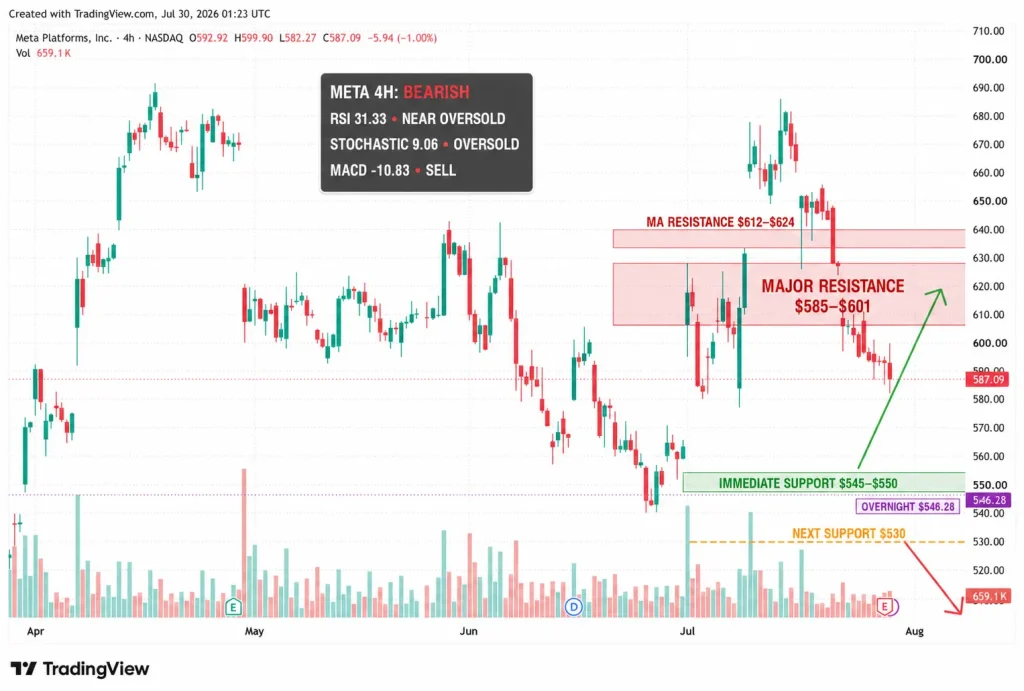
META Chart 4-Hour – Earnings Gap Exposes the $530 Support Zone
Additional resistance sits between $612 and $624. The 20-period EMA is at $611.96, the 100-period EMA at $612.33 and the 200-period EMA at $620.01.
The Ichimoku baseline and 30-period simple moving average are higher near $634.
Meta must first reclaim $585–$600 before a more durable technical recovery becomes possible.
Oversold Signals Could Produce a Rebound
The stock was already approaching oversold conditions before the overnight decline.
The RSI stood at 31.33, while Stochastic %K was at 9.06. Stochastic RSI had fallen to 0.13 and Williams Percent Range to -93.51.
These readings increase the possibility of a short-term rebound.
However, the trend remains firmly bearish. MACD is on sell at -10.83, Momentum is on sell at -40.07 and the Awesome Oscillator stands at -37.88.
The first support area is $545–$550. A decisive break below that range could expose $530, followed by $500.
Meta’s $530 Support Faces a Critical Test
Meta’s advertising business remains strong, but the earnings report confirmed that spending is rising faster than revenue.
A recovery above $585–$600 would begin closing the earnings gap. Meta would then need to reclaim the $612–$624 moving-average cluster to reverse the bearish structure.
Failure to defend $545 could send META toward $530. A break below $530 would expose $500 and signal a deeper repricing of the company’s AI strategy.
For now, the market wants proof that Meta’s $130–$145 billion investment plan can generate cash rather than consume it.
- Check out our free forex signals
- Follow the top economic events on FX Leaders economic calendar
- Trade better, discover more Forex Trading Strategies
- Open a FREE Trading Account
- Read our latest reviews on: Avatrade, Exness, HFM and XM

Related Articles


Sidebar rates

Related Posts
 Save
SaveAva