Palantir Stock PLTR Dips Below $150 as Trump AI Order Sparks New Investor Fears
After President Trump's new AI oversight push rekindled regulatory concerns, Palantir's strong gain lost steam, putting additional pressure on a stock already dealing with issues with execution and valuation.
Quick overview
- Palantir's stock experienced a sharp decline after President Trump's new AI oversight initiative raised regulatory concerns, reversing a strong rally that had pushed shares above $160.
- Despite reporting strong earnings and revenue growth, investor focus has shifted towards valuation challenges and potential regulatory burdens stemming from the executive order.
- Palantir's close ties to defense operations enhance its strategic importance but also expose it to geopolitical risks and legal uncertainties.
- The combination of regulatory scrutiny, legal issues, and increasing competition has led investors to question whether Palantir's high valuation is still justified.
After President Trump’s new AI oversight push rekindled regulatory concerns, Palantir’s strong gain lost steam, putting additional pressure on a stock already dealing with issues with execution and valuation.
Palantir Rally Reverses Sharply
Shares of Palantir Technologies Inc. came under heavy selling pressure after a strong multi-week rally pushed the stock above $160. The move followed stronger-than-expected earnings results and an increase in the company’s 2026 revenue guidance, which initially reinforced investor optimism surrounding Palantir’s position in artificial intelligence and government software markets.
However, the rally stalled at a key resistance level, and the stock has since reversed sharply, falling roughly 5% and dropping back below $150. The pullback reflects growing investor concern that expectations may have become stretched following one of the strongest runs among major software companies.
Trump Executive Order Raises New AI Concerns
A major catalyst behind the latest weakness was a new executive order signed by President Trump focused on oversight of advanced artificial intelligence systems.
The initiative requests that developers of certain frontier AI models participate in a government benchmarking program before public release. Under the framework, companies would provide government access to qualifying models up to 30 days before broader deployment and cooperate in assessments designed to evaluate capabilities and potential risks.
While participation is not formally mandatory, investors appear concerned that the order could create new regulatory expectations and informal compliance burdens for leading AI developers.
The proposal is particularly relevant for companies operating at the forefront of advanced software development. Because Palantir maintains extensive government relationships and derives a significant portion of its revenue from federal contracts, some investors worry the company could face greater scrutiny than many of its peers.
Even if the practical impact proves limited, the order introduces another layer of uncertainty at a time when markets are already questioning the sustainability of elevated AI valuations.
Strong Earnings Failed to Eliminate Doubts
Fundamentally, Palantir continues to deliver impressive operational performance.
The company reported first-quarter revenue of $1.63 billion, exceeding analyst expectations and demonstrating continued demand for both its government and commercial platforms. Growth remained particularly strong within the United States, where commercial revenue surged 133% to $595 million and government revenue climbed 84% to $687 million.
Management highlighted strong adoption of its enterprise software products and continued expansion across both public-sector and private-sector clients.
CEO Alex Karp emphasized the strength of domestic demand and described U.S. operations as a critical long-term growth driver.
Despite these results, investors appear increasingly focused on valuation rather than growth alone.
Technical Breakdown Raises the Stakes
Technically, despite the rebound for the last three days, the picture remains weak. Palantir broke below key support levels, including the 50-week simple moving average, which had previously acted as a stabilizing floor and is now facing the last technical support.
PLTR Chart Daily – Reversing After the Doji Candlestick
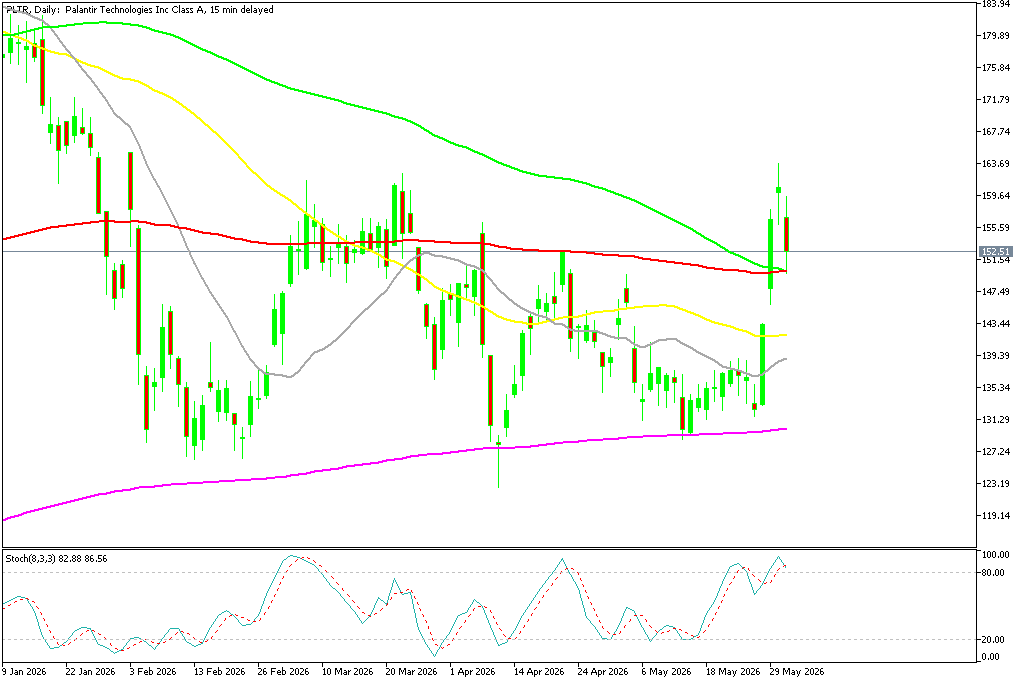
Former support zones have now turned into resistance, making near-term recoveries more difficult. Early last week’s rebound took PLTR stock closer to the 100 SMA above $155 which was the real test for buyers, and they failed and PLTR fell to the 200 daily SMA (purple) which is holding for now. The price pierced it in April, but PLTR reversed and today we saw a rebound for three days, but it didn’t last and sellers are back at it again.
PLTR Chart Weekly – MAs Turn into Resistance

Defense Exposure Remains a Double-Edged Sword
Palantir’s close ties to defense and national security operations continue to attract attention.
Recent meetings between Alex Karp and Volodymyr Zelenskyy highlighted the company’s growing role in battlefield intelligence, military analytics, and real-time decision-making systems. Ukrainian defense initiatives continue utilizing advanced software platforms to improve targeting, surveillance, and operational efficiency.
While these relationships reinforce Palantir’s strategic importance, they also increase exposure to geopolitical developments. Earlier enthusiasm surrounding defense-related technology stocks benefited from elevated global tensions, but as ceasefire discussions and diplomatic negotiations progress, some of the geopolitical premium embedded in valuations has started to fade.
Legal and Regulatory Risks Continue to Build
Beyond government oversight concerns, Palantir faces several additional challenges.
A federal order requiring the company to arbitrate claims involving former engineers has introduced fresh legal uncertainty. The case centers on allegations involving confidential information and arrives at a time when scrutiny around data governance and software security remains elevated.
Internationally, questions surrounding access to healthcare data within the United Kingdom have also generated regulatory concerns, potentially increasing pressure on certain public-sector contracts.
While none of these issues currently threaten the core business, they add to a growing list of risks that investors must evaluate.
Valuation Remains the Biggest Question
Perhaps the most significant concern remains valuation.
Palantir continues to command one of the highest valuation multiples in the software sector, reflecting investor expectations for years of rapid growth. However, maintaining those expectations becomes increasingly difficult as competition intensifies.
Companies such as Anthropic and other enterprise AI providers are expanding aggressively, creating a more competitive landscape than existed just a few years ago.
The combination of regulatory uncertainty, legal risks, increasing competition, and fading geopolitical tailwinds has caused some investors to reassess whether the stock’s premium valuation remains justified.
For now, Palantir remains one of the strongest operational performers in the AI sector. Yet the sharp reversal to $150 lows serves as a reminder that even exceptional growth may not be enough when expectations become excessively high and new risks begin to emerge simultaneously.
- Check out our free forex signals
- Follow the top economic events on FX Leaders economic calendar
- Trade better, discover more Forex Trading Strategies
- Open a FREE Trading Account
- Read our latest reviews on: Avatrade, Exness, HFM and XM

Related Articles
Sidebar rates

Related Posts
 Save
Save