Microsoft MSFT Stock Slumps Below $400 as AI Spending Fears Return Pre-Earnings
Microsoft shares reversed sharply lower on Wednesday, falling around 5% and back below $400 as massive AI spending, rising competition, and growing doubts over future profitability undermined the stock’s recent recovery.
Quick overview
- Microsoft shares fell approximately 5% on Wednesday, dropping below the $400 mark due to concerns over massive AI spending and rising competition.
- Investors are increasingly questioning whether Microsoft's significant investments in AI will yield sufficient profits, raising doubts about the company's future profitability.
- Despite a recent partnership with AMD aimed at diversifying AI hardware supply, the central issue remains whether Microsoft can achieve attractive returns on its substantial investments.
- The stock's return below $400 is seen as a psychological setback, with investors demanding clearer evidence of sustainable earnings growth from AI initiatives.
Microsoft shares reversed sharply lower on Wednesday, falling around 5% and back below $400 as massive AI spending, rising competition, and growing doubts over future profitability undermined the stock’s recent recovery.
Microsoft Stock Slumps 5% Below $400 as AI Spending Fears Return
Microsoft Corporation shares have suffered another setback after a brief recovery from their sharp June decline, highlighting the growing unease surrounding the company’s expensive artificial intelligence strategy.
After heavy selling pushed Microsoft stock below the $350 area in June, the shares staged a recovery and climbed back above the psychologically important $400 level. However, the rebound has failed to develop into a convincing bullish reversal.
On Wednesday, MSFT stock fell approximately 5%, once again slipping below $400 and raising fresh concerns about whether the recovery has already run out of momentum.
The renewed selling pressure reflects a broader shift in investor sentiment. The market is no longer simply asking whether Microsoft can emerge as one of the biggest winners from the AI boom. Instead, investors are increasingly questioning whether the enormous capital required to compete in AI will ultimately generate sufficient profits.
Microsoft’s AI Spending Becomes a Growing Liability
For much of the past two years, Microsoft was widely viewed as one of the strongest beneficiaries of the AI revolution.
Its Azure cloud platform, dominant enterprise software ecosystem, and close relationship with OpenAI positioned the company at the center of the technology industry’s AI expansion.
However, that advantage comes with a significant cost.
Microsoft continues to invest billions of dollars in data centers, advanced processors, networking infrastructure, electricity, and specialized computing capacity required to support AI workloads.
The scale of this spending is becoming increasingly difficult for investors to ignore.
Microsoft’s traditional software business has historically delivered attractive margins and relatively predictable recurring revenue. The AI transition, however, is pushing the company toward a significantly more capital-intensive model.
The concern is that Microsoft could be forced to spend enormous sums simply to maintain its competitive position, rather than generating proportionally higher profits from those investments.
AMD Partnership Provides Only Temporary Relief
Microsoft’s expanded partnership with AMD recently provided a short-term boost to investor sentiment.
The agreement will bring AMD’s latest AI infrastructure into Microsoft Azure, potentially giving customers additional alternatives to Nvidia-powered computing systems.
Microsoft plans to deploy AMD technology for its own AI services while also making the infrastructure available to Azure customers.
At the center of the collaboration is AMD’s Helios AI infrastructure platform, which combines advanced Instinct AI accelerators with EPYC processors, networking technology, and supporting software.
The partnership represents an important strategic move as Microsoft attempts to diversify its AI hardware supply chain and reduce reliance on a single chip provider.
However, the announcement has failed to resolve the central issue facing MSFT investors.
The question is not simply whether Microsoft can access enough AI hardware. The bigger concern is whether the company can earn an attractive return on the enormous investments required to deploy it.
MSFT Stock Weakness – Breaks Key Support
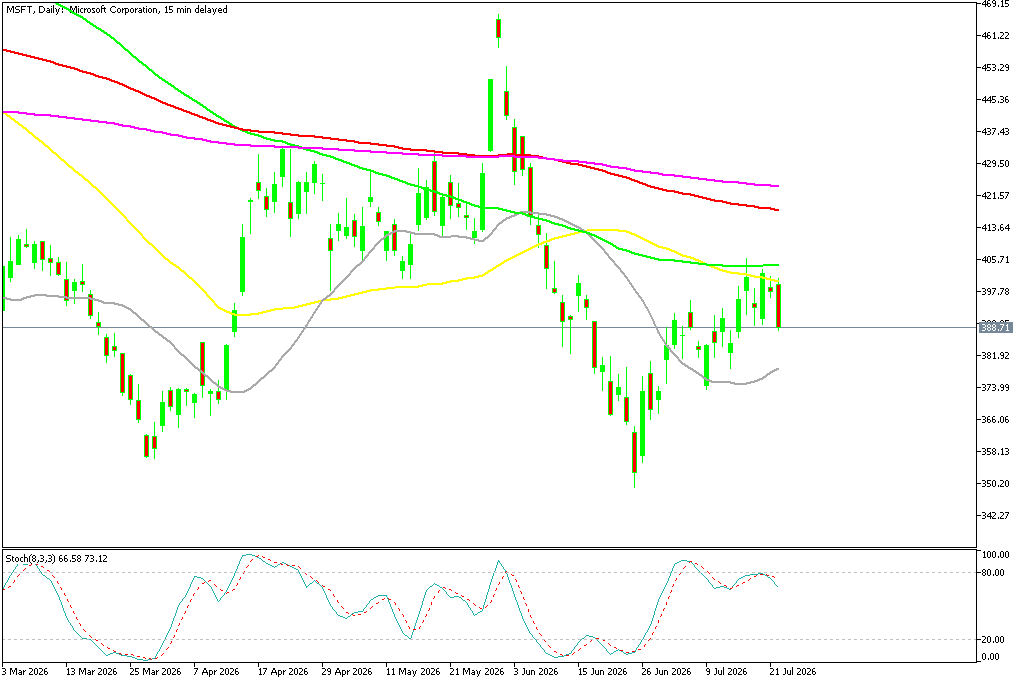
Microsoft shares slipped below the critical $400 level but rebounded strongly last month, climb above $465. This area represents both psychological and technical resistance where a number of moving averages stand, making it an important line in the sand. Buyers failed to break above 50 SMA on the weekly chart and we’ve seen 4 weekly pullbacks, with MSFT down below $350 at the end of June and breaking below the 100 weekly SMA and the March low. But MSFT rebounded in July and has regained the $400 level.
MSFT Chart Weekly – The 100 SMA Is Giving Up as Support

Microsoft’s stock has undergone a notable repricing in recent months, signaling a broader reset in how investors are assessing mega-cap technology leaders. After peaking above $555 in October, shares retreated sharply, shedding around $200.
However the 50 monthly SMA (yellow) held as support once again and we saw a strong rebound in April and May. But, buyers gave up and sellers returned and MSFT stock failed to push above the 50 SMA which opened the door for further declines.
MSFT Chart Monthly – Breaking Below the 50 SMA
AI Monetization Fails to Keep Pace With Spending Concerns
Microsoft’s biggest challenge may be converting AI demand into meaningful incremental profitability.
The company continues expanding its Copilot ecosystem and introducing AI-powered products across its enterprise software portfolio.
However, operating advanced AI systems requires enormous amounts of computing power, energy, storage, and semiconductor capacity.
As AI adoption increases, Microsoft’s costs could also rise significantly.
This has created a growing gap between the market’s enthusiasm for AI revenue potential and concerns over the expense required to generate that revenue.
Investors are increasingly demanding evidence that Microsoft’s AI products can produce enough additional income to offset the infrastructure costs associated with supporting them.
Until that becomes clearer, rising capital expenditures could remain a major source of pressure on the stock.
Competition and OpenAI Risks Add to Investor Anxiety
Microsoft also faces an increasingly competitive AI landscape.
Alphabet, Amazon, Meta, and other technology companies continue pouring billions into AI infrastructure and developing their own platforms.
This raises the risk that Microsoft’s current advantage could narrow as competitors improve their technology and expand their cloud offerings.
The company’s relationship with OpenAI also remains a key area of investor attention.
Microsoft’s partnership with the AI company has been a major component of its AI investment thesis. However, any expansion of OpenAI’s relationships with other cloud providers could potentially weaken Microsoft’s perceived exclusivity and reduce one of its biggest competitive advantages.
Regulatory scrutiny adds another layer of uncertainty.
Authorities continue examining the competitive dynamics surrounding cloud computing, enterprise software, and AI. While Microsoft’s core business remains highly resilient, increased regulatory intervention could create additional costs and operational restrictions.
Rising Costs Extend Beyond Artificial Intelligence
Microsoft’s cost pressures are not limited to AI infrastructure.
The company has also faced higher expenses across other areas of its business, while increased prices for Xbox hardware reflect broader inflationary pressures affecting components, memory, and storage.
Price increases may help offset some of these costs, but they also highlight the broader inflationary environment facing the company.
For investors, the combination of higher AI spending and rising operational costs creates concerns about whether Microsoft’s historically strong margins can remain as robust.
MSFT Stock Outlook Turns More Uncertain
Microsoft remains one of the world’s most powerful technology companies, supported by strong cash generation, a dominant enterprise software ecosystem, and a massive cloud computing business.
However, the stock market appears to be becoming less forgiving.
Investors are increasingly demanding evidence that AI spending can translate into sustainable earnings growth rather than simply higher capital expenditures.
The return below $400 is therefore an important psychological setback for the stock. If Microsoft fails to reclaim that level convincingly, the recent recovery could increasingly look like a failed rebound rather than the beginning of a new bullish phase.
For now, the biggest risk facing MSFT is not a collapse in its core business. It is the possibility that the enormous cost of winning the AI race will prove harder to justify than investors initially expected.
Until Microsoft demonstrates that its AI investments can generate substantial and sustainable returns, the stock could remain vulnerable to further volatility, especially if competition intensifies, spending continues accelerating, or growth fails to meet increasingly demanding expectations.
- Check out our free forex signals
- Follow the top economic events on FX Leaders economic calendar
- Trade better, discover more Forex Trading Strategies
- Open a FREE Trading Account
- Read our latest reviews on: Avatrade, Exness, HFM and XM

Related Articles

Sidebar rates

Related Posts
 Save
SaveAva
