TMUS Stock Plunges 11% as T-Mobile’s Pricier Plans Raise Churn and Subscriber Growth Concerns
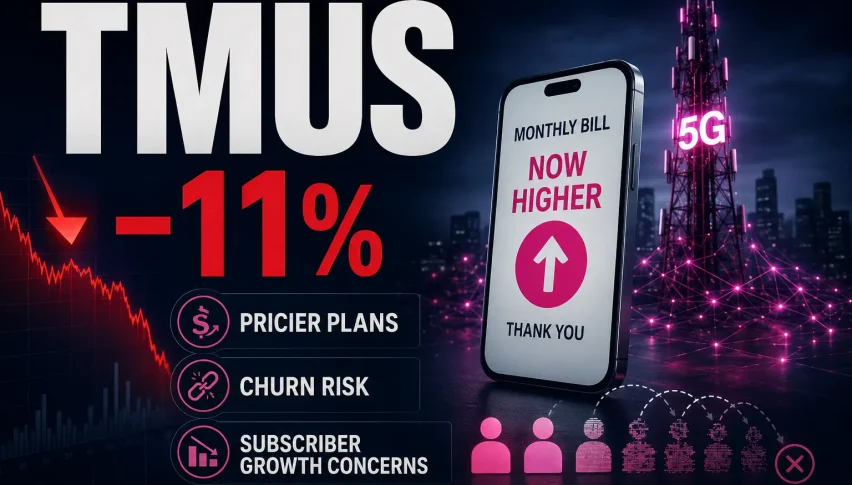
T-Mobile TMUS stock falls 11% as pricier plans threaten near-term subscriber growth despite an earnings beat and stronger cash flow.
Quick overview
- T-Mobile US shares experienced their largest decline in years after management warned of potential customer churn due to a shift to more expensive wireless plans.
- Despite reporting stronger earnings and increased service revenue, the company's forecast for slower subscriber growth in the third quarter raised investor concerns.
- T-Mobile's average revenue per account increased, with a significant portion of new customers opting for premium plans, but the market remains skeptical about the impact on overall subscriber numbers.
- The company has raised its full-year free cash flow guidance, indicating strong operational performance, yet investor focus remains on subscriber trends amid intense competition.
T-Mobile US shares suffered their sharpest decline in years after management warned that a transition toward newer, more expensive wireless plans could temporarily increase customer churn and slow account growth during the third quarter.
T-Mobile shares plunged despite reporting stronger earnings, rising service revenue and continued customer migration toward premium wireless plans.
TMUS ended the regular session at $170.42, down 10.75%, before recovering slightly to around $171.66 in overnight trading.
The market’s reaction reflected concern about the company’s near-term subscriber outlook rather than the second-quarter results themselves.
T-Mobile added more postpaid accounts than analysts expected, increased average revenue per account and raised its full-year free cash flow guidance. However, management warned that changes to legacy wireless plans could create a temporary increase in churn and reduce account additions during the current quarter.
That warning arrived at a sensitive time for the U.S. wireless market. Subscriber growth is slowing, competition from AT&T and Verizon remains intense, and investors are increasingly focused on whether price increases can support revenue without driving customers away.
T-Mobile Earnings Beat Wall Street Expectations
T-Mobile reported second-quarter net income of approximately $3.2 billion, compared with $3.22 billion in the same quarter last year.
Diluted earnings increased 5% to $2.99 per share, exceeding the analyst consensus estimate of $2.59. Revenue rose 7.9% to $22.79 billion, although that was slightly below expectations of around $22.95 billion.
The company’s core operating performance remained strong.
Total service revenue increased 9% to approximately $19 billion, while postpaid service revenue rose 13% to $15.85 billion. Core adjusted EBITDA climbed 12% to approximately $9.5 billion.
T-Mobile also generated around $4.8 billion in adjusted free cash flow during the quarter and maintained a free cash flow margin of approximately 25%.
Those figures suggest the business remains profitable and cash generative despite the sharp decline in its share price.
The problem for investors was that the earnings beat was overshadowed by management’s expectations for weaker subscriber momentum during the third quarter.
Q3 Subscriber Forecast Falls Below Expectations
T-Mobile expects to add around 250,000 net postpaid accounts in the third quarter.
That forecast is below the roughly 304,000 additions analysts had expected and also below the 277,000 accounts added during the second quarter.
Second-quarter postpaid account additions were already down approximately 13% from the previous year, even though they came in slightly above Wall Street estimates.
Management attributed the expected third-quarter slowdown partly to the modernization of T-Mobile’s wireless plan portfolio.
The company is phasing out selected legacy plans and moving affected customers toward newer products that include features such as unlimited premium data, streaming benefits and more frequent device upgrades.
Those plans are generally more expensive.
While the transition is intended to improve long-term customer value and average revenue, T-Mobile expects it to produce a temporary increase in customer churn.
This trade-off appears to be at the center of the stock’s selloff.
Investors are concerned that price increases could encourage some households to switch providers, reduce the number of lines on their accounts or move toward lower-cost prepaid alternatives.
Premium Plans Lift Revenue per Account
T-Mobile’s pricing strategy is already supporting revenue growth.
Average monthly postpaid revenue per account increased 2% to $152.91, compared with $149.87 one year earlier. Management expects account revenue growth to accelerate during the second half as more customers move to current plans.
Approximately 60% of customers opening new accounts are selecting T-Mobile’s most premium plans.
Management has argued that these customers are more valuable because they generate higher monthly revenue, remain with the company for longer and are more likely to use additional services.
Customer lifetime value reportedly increased at a double-digit rate during the quarter, while the revenue associated with customers joining T-Mobile remained around 20% higher than the revenue from those leaving.
That supports the company’s view that it can prioritize customer quality rather than simply maximizing the number of new accounts.
However, the market appears unconvinced that higher revenue per customer will fully offset slower subscriber growth and increased churn.
The U.S. wireless market is mature, leaving carriers with fewer opportunities to add entirely new mobile subscribers. As a result, much of the industry’s growth increasingly depends on taking customers from competitors or raising prices.
AT&T and Verizon Increase Competitive Pressure
T-Mobile’s plan transition comes as AT&T and Verizon compete aggressively for high-value wireless customers.
All three major carriers use device promotions, bundled services and loyalty benefits to reduce churn.
T-Mobile has historically gained market share through a combination of lower prices, fewer restrictions and a strong 5G network. Moving customers toward more expensive plans could weaken part of that value proposition if competitors offer comparable benefits.
Management continues to argue that T-Mobile’s network quality and customer experience justify premium pricing.
The company reported a net promoter score of 46 during the quarter, which it described as the highest among the three largest U.S. wireless carriers.
T-Mobile is also gaining share in smaller markets and rural areas, where it estimates it has only around 24% of household relationships despite those regions accounting for roughly 40% of the U.S. population.
That leaves room for expansion, particularly as the company integrates customers and spectrum acquired through its UScellular transaction.
Nevertheless, the weaker third-quarter forecast indicates that pricing changes may temporarily interrupt T-Mobile’s previous subscriber momentum.
Free Cash Flow Guidance Moves Higher
Despite the cautious account outlook, T-Mobile increased its full-year adjusted free cash flow forecast.
The company now expects between $18.4 billion and $18.8 billion, up from its previous range of $18.1 billion to $18.7 billion.
Operating cash flow guidance was also raised to between $28.4 billion and $28.8 billion.
Management attributed the improvement primarily to lower cash income taxes, working capital benefits and operational efficiencies, including the use of advanced artificial intelligence tools.
T-Mobile maintained its full-year forecast for between 950,000 and 1.05 million postpaid account additions.
It also continues to expect core adjusted EBITDA of $37.1 billion to $37.5 billion and total service revenue of approximately $77 billion.
The stronger cash flow outlook allows T-Mobile to continue investing in its network while returning substantial capital to shareholders.
During the second quarter, the company returned approximately $3.3 billion through $2.2 billion in share repurchases and $1.1 billion in dividends.
However, the stock’s reaction shows that investors currently place more weight on subscriber trends than incremental cash flow improvements.
Broadband Remains an Important Growth Opportunity
T-Mobile continues expanding beyond traditional mobile services through fixed wireless internet and fiber partnerships.
Its 5G home internet product uses excess wireless network capacity to deliver broadband services without requiring a physical cable connection.
Management said total broadband additions were in the upper 400,000 range during the quarter, while fixed wireless access has accumulated millions of customers.
The service is particularly attractive in areas where cable competition is limited or consumers lack affordable fiber connections.
T-Mobile has also entered fiber joint ventures and completed acquisitions designed to expand its broadband footprint.
However, its planned fiber network remains substantially smaller than the infrastructure operated by AT&T and Verizon.
Management has emphasized that it does not intend to pursue fiber expansion simply to maximize the number of homes passed. Instead, it is targeting locations where penetration rates and returns can justify the investment.
Broadband diversification could support growth as the wireless market matures, but it is unlikely to fully offset near-term concern about slowing mobile account additions.
Satellite Connectivity Is Complementary, Not a Replacement
T-Mobile is also developing direct-to-device satellite connectivity through its relationship with SpaceX’s Starlink.
The technology is designed to extend messaging and limited mobile services into remote locations where terrestrial cellular coverage is unavailable.
Management does not currently view satellite broadband as a major threat to its fixed wireless product.
T-Mobile’s leadership has argued that satellite capacity is constrained in densely populated areas and that most customer usage will continue to rely on terrestrial networks.
The company has also dismissed the idea of significantly expanding its Starlink relationship to resell conventional satellite broadband, focusing instead on direct-to-device connectivity and its own 5G home internet service.
Satellite services could improve network coverage and reduce dead zones, but they remain a complementary feature rather than a primary growth driver.
TMUS Technical Analysis: $170 Is the Line Bulls Need to Defend
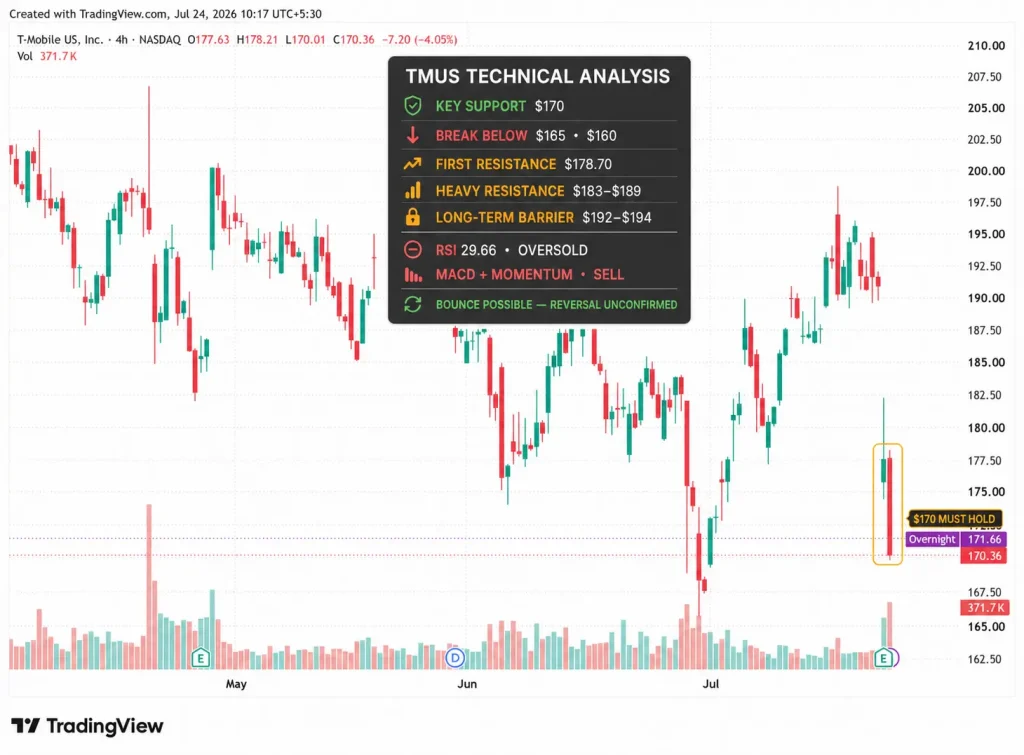
T-Mobile’s four-hour chart has turned sharply bearish following the 11% earnings selloff.
TMUS is trading below every major moving average, with immediate support near the psychological $170 level.
A sustained break below $170 could extend the decline toward $165, followed by the $160 region.
On the upside, the Hull Moving Average at $178.70 represents the first recovery barrier. Above that, a heavy resistance cluster sits between $183 and $189, containing the 10, 20, 30, 50 and 100-period moving averages, the VWMA and Ichimoku baseline.
Longer-term resistance remains near $192-$194, where the 200-period moving averages are located.
Momentum remains bearish, with MACD and Momentum showing sell signals. However, RSI has fallen to 29.66, while Stochastic, Williams %R and CCI indicate deeply oversold conditions.
That creates the possibility of a technical bounce, but not yet a confirmed reversal.
Holding above $170 could support a rebound toward $179. Bulls would still need to reclaim $184-$189 to meaningfully improve the four-hour trend.
Can T-Mobile Recover After Its 11% Selloff?
T-Mobile’s second-quarter results were stronger than the stock reaction suggests.
Earnings exceeded expectations, service revenue continued growing and the company raised its free cash flow outlook.
The selloff instead reflects concern about what comes next.
Management expects pricier plan migrations to temporarily increase churn and reduce third-quarter account additions. In a mature and highly competitive wireless market, investors are unwilling to ignore even a short-term slowdown in subscriber growth.
The strategy may ultimately prove successful if higher revenue per account and stronger customer lifetime value offset the lost accounts.
For now, however, the market is demanding evidence.
Technically, $170 is the immediate level to watch. Holding that support could produce an oversold rebound toward $179, while a break lower may expose $165 and $160.
A sustained recovery above $184-$189 would be needed to show that the post-earnings downtrend is beginning to reverse.
These remain likely scenarios rather than predictions.
- Check out our free forex signals
- Follow the top economic events on FX Leaders economic calendar
- Trade better, discover more Forex Trading Strategies
- Open a FREE Trading Account
- Read our latest reviews on: Avatrade, Exness, HFM and XM

Related Articles



Sidebar rates

Related Posts
 Save
Save