AMZN Stock Tests $230 Before Amazon Earnings as $200 Billion AI Spending Raises the Stakes
Amazon earnings: AMZN stock tests $230 as 31% AWS growth must justify a $200B AI budget and collapsing free cash flow before earnings.
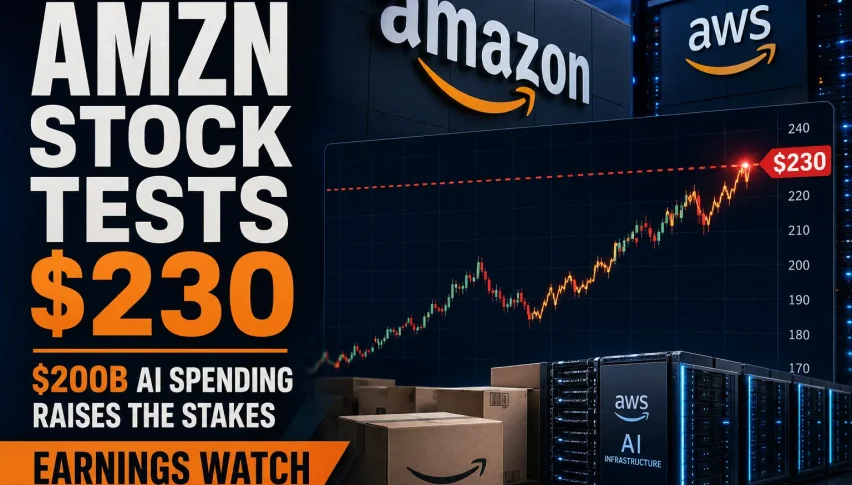
Amazon stock recovered to $230.37 overnight ahead of earnings as investors weighed accelerating AWS growth against a $200 billion AI spending plan and collapsing free cash flow.
Amazon Stock Rebounds Toward $230 Before Earnings
Amazon shares recovered 1.67% to $230.37 in overnight trading after falling 1.82% to $226.65 during the regular session.
The rebound follows a steep five-day decline as investors prepare for Amazon’s second-quarter results on Thursday after the market closes.
Wall Street expects another strong quarter, supported by Amazon Web Services, advertising and the movement of Prime Day into the second quarter.
However, expectations have changed across the technology sector. Investors are no longer rewarding revenue growth automatically when it comes with rising capital expenditure and weaker cash generation.
Amazon must show that AWS growth is accelerating fast enough to justify its record AI infrastructure investment.
Amazon Revenue and Earnings Face a High Bar
Analysts expect Amazon to report approximately $196.5 billion in second-quarter revenue, up around 17% from $167.7 billion a year earlier.
Earnings are forecast near $1.82 per share, compared with $1.68 in the second quarter of 2025.
Amazon previously guided for revenue between $194 billion and $199 billion and operating income of $20 billion to $24 billion.
Consensus estimates sit close to the middle of those ranges. That means a modest headline beat may not be enough to move the stock higher.
Prime Day also occurred between June 23 and June 26 this year, placing the event inside the second quarter. In 2025, Prime Day took place in July and contributed to the third quarter.
The calendar shift should strengthen retail revenue, but the benefit is widely known and likely reflected in forecasts.
The more important earnings tests are AWS growth, cloud margins, capital expenditure and free cash flow.
AWS Growth Must Accelerate Above 30%
AWS remains Amazon’s most important profit engine.
Analysts expect cloud revenue of approximately $40.5 billion, up around 31% from $30.9 billion a year earlier.
That would mark a fourth consecutive acceleration after AWS growth improved from 20% in the third quarter of 2025 to 24% in the fourth quarter and 28% in the first quarter of 2026.
Amazon’s first-quarter results showed AWS revenue reaching $37.6 billion and operating income of $14.2 billion. Its operating margin rose to a record 37.7%.
The second-quarter margin is expected closer to 34% as depreciation and AI infrastructure costs increase.
That decline matters because AWS may generate roughly 60% of Amazon’s operating profit while contributing only about one-fifth of revenue.
AWS growth above 32% with a stable margin would provide strong evidence that Amazon’s AI investments are producing returns.
Growth below 30%, or a sharper margin decline, could intensify the selloff.
AI Backlog Supports the Spending Case
Amazon’s contracted cloud backlog reached approximately $364 billion at the end of the first quarter, up from $244 billion at the end of 2025.
Large commitments from OpenAI, Anthropic and other AI customers helped drive the increase.
Chief Executive Andy Jassy has argued that Amazon is not investing $200 billion without customer demand. Much of the capacity under construction already has commitments attached, although some infrastructure will not produce revenue until 2027 or 2028.
AWS must purchase land, power equipment, data centres, chips and servers months before it can bill customers.
This creates a delay between spending and revenue.
The backlog gives Amazon greater confidence that future capacity will be used. However, investors still need evidence that the contracts can produce acceptable margins and cash returns.
Free Cash Flow Has Nearly Disappeared
Amazon’s AI buildout has placed severe pressure on free cash flow.
Trailing operating cash flow increased 30% to $148.5 billion in the first quarter. Yet free cash flow dropped to $1.2 billion from $25.9 billion a year earlier.
The decline primarily reflected a $59.3 billion increase in property and equipment spending, much of it related to AI.
Amazon expects approximately $200 billion in capital expenditure during 2026. Some analysts believe higher memory and infrastructure costs could push that figure toward $210 billion.
A large increase would risk an Alphabet-style reaction.
Alphabet recently beat earnings expectations and delivered strong cloud growth, but its shares fell after management raised capital-expenditure guidance to as much as $205 billion.
Amazon therefore needs to combine strong AWS results with spending discipline. Another major increase without stronger cash-flow visibility could overshadow an otherwise positive quarter.
Bond Market Shows Signs of AI Debt Fatigue
Amazon recently completed a $25 billion bond sale to help finance its investment program.
Demand was weaker than during its March issue. Orders covered approximately 1.6 times the bonds offered, compared with 3.4 times in March.
Amazon, Alphabet, Meta and Oracle issued approximately $194 billion of bonds through early July, already far above their total issuance during 2025.
As more hyperscalers borrow to build AI infrastructure, investors are demanding higher yields.
The weaker bond demand does not create an immediate financing problem for Amazon. The company has substantial operating cash flow and access to capital.
However, rising borrowing costs increase the pressure to prove that AI spending can deliver strong returns.
Anthropic Gains Could Distort Amazon’s Earnings
Amazon’s headline earnings may also be affected by its investment in Anthropic.
First-quarter net income reached $30.3 billion, or $2.78 per share. That result included a $16.8 billion pre-tax gain from revaluing Amazon’s Anthropic investment.
Another mark-to-market adjustment could materially affect second-quarter earnings.
Investors should therefore separate investment gains from operating performance.
AWS revenue, margins, operating income and cash flow provide a clearer measure of Amazon’s underlying business than an unusually large EPS figure driven by Anthropic’s valuation.
Advertising and Retail Provide Additional Support
Amazon’s advertising revenue is expected near $19.3 billion, up approximately 22% to 23%.
The business benefits from Amazon’s direct knowledge of customer purchasing activity and has become an increasingly important source of high-margin revenue.
North American e-commerce revenue is also expected to benefit from Prime Day and continued growth in delivery volumes.
Amazon has improved retail profitability through faster delivery, regionalized fulfillment and tighter cost control.
However, neither retail nor advertising is likely to determine the immediate stock reaction. AWS and capital expenditure remain the key variables.
AMZN Stock Remains Below Major Moving Averages
Amazon’s 4-hour technical structure remains bearish despite the overnight rebound to $230.37.
The stock is above the Hull moving average at $229 but remains below every other major average.
The first resistance zone sits between $231.65 and $232.82, where the 10-period simple and exponential moving averages are positioned.
A break above that area would expose the 20-period EMA at $237.06 and the volume-weighted moving average at $239.86.
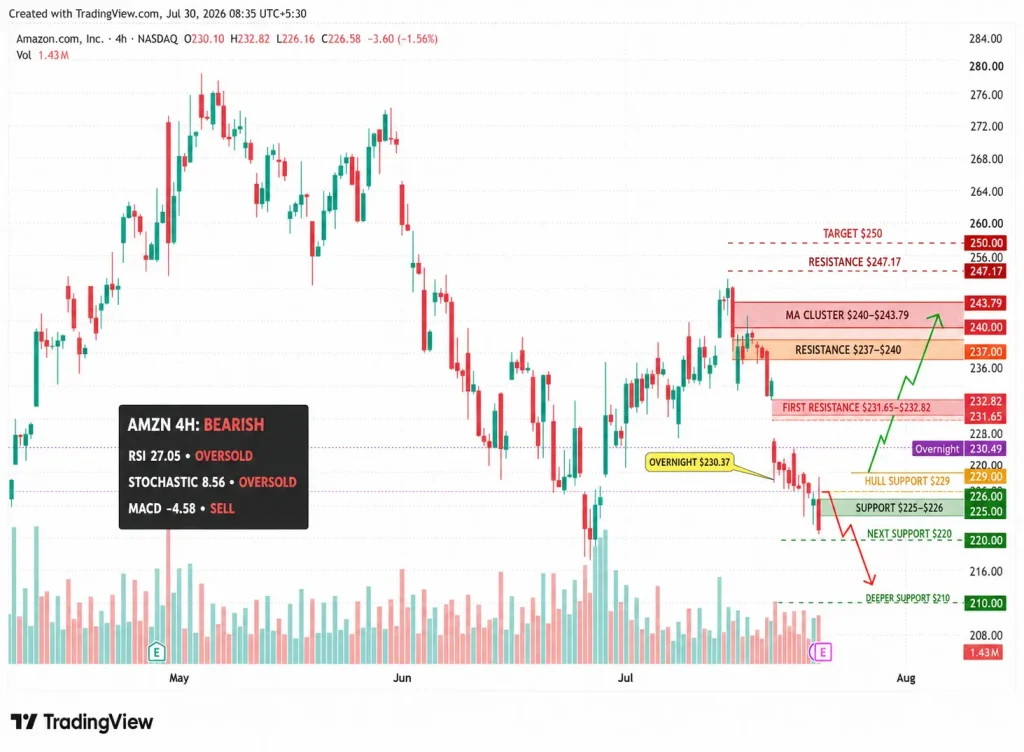
AMZN Chart 4-Hour – Can Earnings Reclaim the $232–$240 Resistance Zone?
A much larger resistance cluster sits between $240 and $243. The 20-period simple moving average is at $240.16, while the 50-period averages and 200-period averages are concentrated around $241.50–$241.93.
The Ichimoku baseline stands at $242.12, followed by the 100-period EMA at $243.79.
Amazon must reclaim $243–$244 to confirm a meaningful technical reversal. Above that, the next major resistance sits near the 100-period simple moving average at $247.17, followed by $250.
Oversold Indicators Create Rebound Potential
The 4-hour oscillators indicate that Amazon is becoming oversold.
The RSI stands at 27.05, below the traditional oversold threshold of 30. Stochastic %K has fallen to 8.56, while Stochastic RSI is at 0.41 and Williams Percent Range at -98.23.
These readings increase the possibility of an earnings-driven rebound.
However, momentum remains firmly bearish. MACD gives a sell signal at -4.58, while Momentum stands at -18.20. The Awesome Oscillator and Bull Bear Power are also deeply negative.
The first support area is $225–$226. A break below it could expose $220, followed by $210.
Amazon Earnings Could Decide Whether $225 Holds
Amazon enters earnings with accelerating AWS growth, a vast cloud backlog and expanding advertising revenue.
But the company is also committing approximately $200 billion to infrastructure while free cash flow approaches zero.
AWS growth above 32%, stable margins and unchanged spending guidance could lift AMZN above $233 and toward $240–$244.
A capex increase toward $210 billion, AWS growth below 30% or weaker cloud margins could push the stock below $225 and expose $220.
For now, the technical structure remains bearish. Amazon must prove that record AI spending is strengthening its most profitable business rather than simply consuming cash.
- Check out our free forex signals
- Follow the top economic events on FX Leaders economic calendar
- Trade better, discover more Forex Trading Strategies
- Open a FREE Trading Account
- Read our latest reviews on: Avatrade, Exness, HFM and XM

Related Articles
Sidebar rates

Ava