SoFi Stock Crashes 9% Below $16 as Unchanged Profit Guidance Overshadows Record Growth
SoFi stock falls 8.9% despite record revenue as unchanged $0.60 EPS guidance and technology-platform weakness alarm investors.
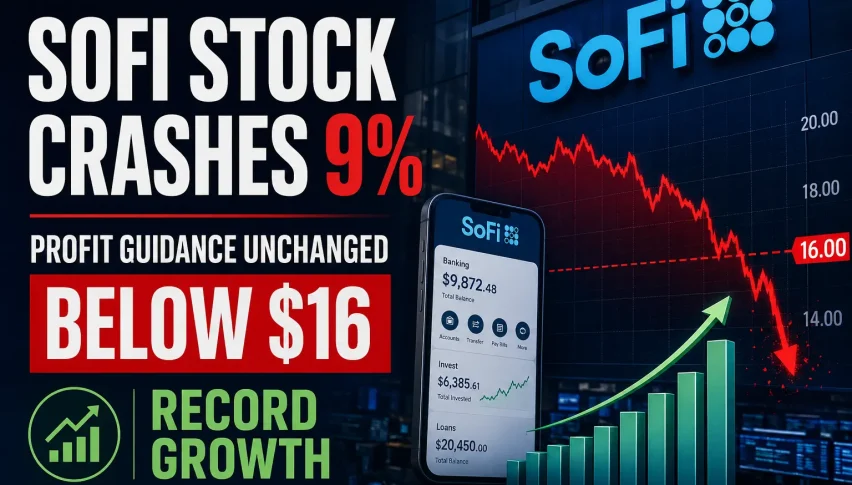
SoFi shares fell 8.9% to $15.25 despite record revenue, lending and member growth as unchanged profit guidance signaled that higher sales will not immediately translate into stronger earnings.
SoFi Stock Falls Below $16 Despite Record Quarter
SoFi Technologies shares suffered a sharp post-earnings selloff after management raised its 2026 revenue forecast but left its profit outlook unchanged.
SOFI stock dropped $1.49, or 8.90%, to $15.25 before recovering 1.18% to $15.43 in overnight trading.
The digital financial-services company exceeded quarterly revenue and earnings expectations, while loan originations, members and products reached record levels.
However, investors focused on management’s decision to reinvest much of the additional revenue in marketing, products and growth rather than raise its adjusted EBITDA or earnings forecast.
Weakness in SoFi’s Technology Platform business added further pressure and pushed the stock below every major moving average on the 4-hour chart.
Record Revenue and Earnings Beat Expectations
SoFi reported adjusted second-quarter revenue of approximately $1.21 billion, an increase of 40% from a year earlier and above analyst estimates near $1.12 billion.
GAAP revenue increased 43% to roughly $1.22 billion.
Adjusted earnings reached $0.12 per share, up 50% from the previous year and slightly above the market consensus of approximately $0.11.
Adjusted EBITDA increased 44% to a record $357.8 million, demonstrating that SoFi continues to deliver strong operating growth.
The company’s performance was supported by higher lending activity, rising net interest income and rapid member acquisition.
Yet investors have become less willing to reward revenue growth without corresponding increases in forward profit expectations.
The market reaction suggests SoFi’s quarterly beat was already reflected in the share price, while the unchanged earnings forecast created disappointment.
Loan Originations Reach a Record $14.8 Billion
Total loan originations rose to a record $14.8 billion as demand remained strong across personal, student and home loans.
Chief Executive Anthony Noto said members continued to demonstrate resilient spending and credit performance despite an uncertain economic environment.
SoFi’s lending segment generated approximately $724.8 million in revenue, an increase of 63% from a year earlier.
Net interest income climbed 52% to $788.2 million, reflecting a larger loan portfolio and the benefit of SoFi’s deposit-funded model.
As a nationally chartered bank, SoFi can fund a substantial portion of its lending through customer deposits rather than relying exclusively on more expensive warehouse facilities.
This provides a cost advantage and supports stronger net interest income.
The Loan Platform Business also allows SoFi to originate loans for third parties, generating fees without retaining every loan on its balance sheet. This capital-light model can reduce credit exposure while adding another source of revenue.
SoFi’s diversification between interest income and fee-based activity remains one of the strongest elements of its long-term strategy.
Member Growth Strengthens SoFi’s Financial Ecosystem
SoFi ended the quarter with approximately 15.8 million members, an increase of 35% from a year earlier.
Total products rose 42% to 24.4 million.
The growth supports SoFi’s Financial Services Productivity Loop strategy, in which customers acquired through one product can be offered additional services such as checking, investing, credit cards, insurance or loans.
Cross-selling can lower customer-acquisition costs and increase revenue per member.
The company has expanded far beyond its original student-loan refinancing business and now operates a broad digital platform covering borrowing, saving, spending and investing.
However, rapid member growth also requires continued spending on marketing, technology and product development.
That tradeoff is central to the market’s negative reaction. Investors want proof that SoFi’s expanding customer base can produce stronger earnings without requiring proportionately higher investment.
Higher Revenue Guidance Fails to Lift SoFi’s Profit Outlook
SoFi raised its full-year adjusted revenue forecast to between $4.75 billion and $4.85 billion.
The new range implies annual growth of approximately 32% to 35% and exceeds the market consensus near $4.7 billion.
Despite the stronger revenue outlook, management maintained its adjusted EBITDA forecast at approximately $1.6 billion.
SoFi also kept adjusted net income guidance near $825 million and adjusted earnings guidance at $0.60 per share.
This suggests the additional revenue will largely be reinvested rather than flowing directly to the bottom line.
Investors interpreted the unchanged forecast as a sign that operating leverage may arrive more slowly than expected.
A future increase to EBITDA or EPS guidance would provide a clearer bullish catalyst. Until then, the market may remain cautious about paying a premium valuation for growth that is not producing faster profit expansion.
Technology Platform Weakness Creates Another Risk
SoFi’s Technology Platform remains the clearest area of weakness.
Segment revenue fell 23% to approximately $84.5 million after a major client left the Galileo platform.
Galileo provides payment processing, digital banking infrastructure and account-management technology to other financial-services companies.
The business was previously expected to give SoFi a high-margin, capital-light growth engine. Its recent contraction has weakened that part of the investment thesis.
SoFi is combining its enterprise technology services under the SoFi Technology Solutions brand, covering payment processing, banking ledgers, risk tools and fraud management.
Stabilizing the segment will be important because SoFi’s current growth depends heavily on lending.
A stronger Technology Platform would improve revenue diversification and reduce sensitivity to credit conditions and interest rates.
Continued weakness would increase concerns that SoFi is becoming more dependent on balance-sheet lending just as economic and rate uncertainty remains elevated.
Interest Rates and Credit Quality Remain Critical
SoFi’s lending performance has benefited from strong consumer demand and stable credit trends.
However, management is now assuming two interest-rate increases, creating a more complicated outlook for funding costs and borrower demand.
Higher rates could support asset yields, but they may also reduce demand for refinancing and increase financial pressure on borrowers.
Credit deterioration represents another major risk.
SoFi has said charge-offs and delinquencies remain within expectations, but rapid loan growth makes consistent underwriting increasingly important. A rise in defaults could weaken margins and force the company to increase credit reserves.
For now, management says its members remain resilient and credit performance continues to meet or exceed expectations.
SOFI Stock Breaks Below Every Major Moving Average
SoFi’s 4-hour technical structure has deteriorated significantly.
At $15.43, the stock remains below every major exponential and simple moving average in the supplied setup.
The Hull moving average at $15.79 creates the first resistance level. Above that, the 10-period EMA and simple moving average stand at $16.37 and $16.45.
The 20-period averages are positioned between $16.81 and $16.88.
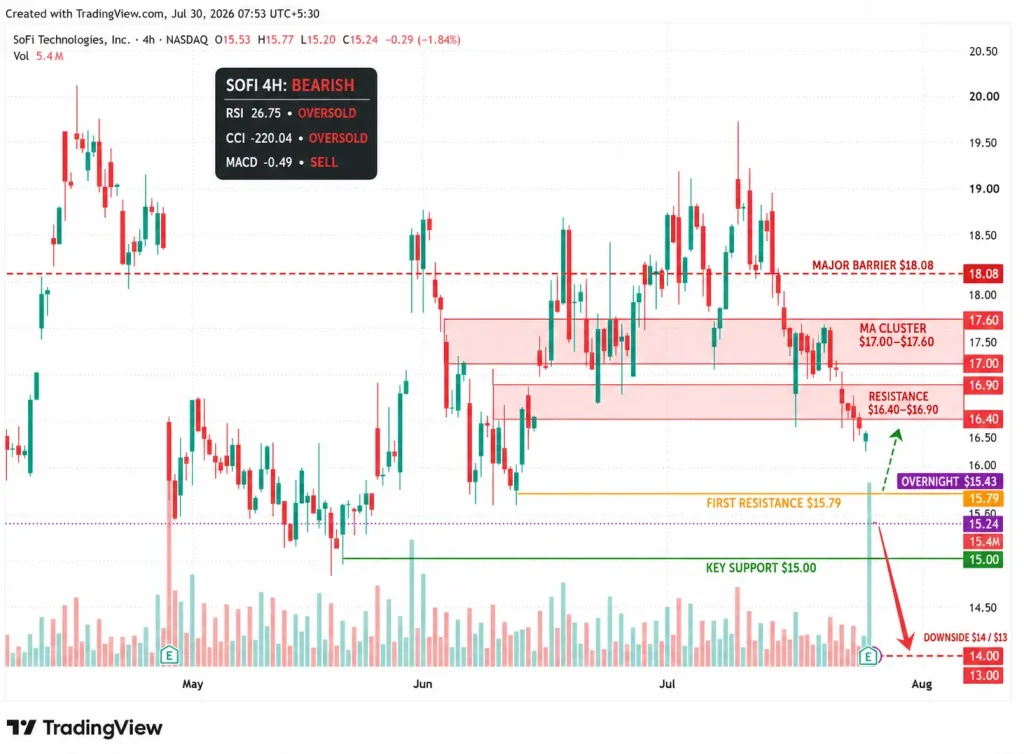
SOFI Chart 4-Hour – Can Buyers Reclaim the $16.40–$16.90 Resistance Zone?
A sustained recovery above $16.90 would allow the stock to challenge a large moving-average cluster around $17.00–$17.60.
The 30-period EMA stands at $17.05, the 200-period simple moving average at $17.12 and the 50-period EMA at $17.24.
The 200-period EMA at $18.08 represents a more significant barrier. SoFi would need to reclaim that level before the broader technical structure turns constructive.
Oversold Signals Could Support a Short-Term Rebound
Several oscillators indicate that the selloff is becoming stretched.
The 14-period RSI stands at 26.75, below the traditional oversold threshold of 30. The Commodity Channel Index is deeply oversold at -220.04 and gives a buy signal.
Stochastic RSI stands at 14.35, while Williams Percent Range is at -87.25.
These readings increase the possibility of a technical rebound, particularly after the overnight stabilization near $15.43.
However, the broader momentum signals remain bearish.
MACD gives a sell signal at -0.49, while Momentum is on sell at -1.86. Bull Bear Power remains negative at -2.09, confirming that sellers retain control.
The $15 level is now the first important support. A decisive break below it could expose $14, followed by the $13 area.
SoFi Faces a Critical Test at $15
SoFi delivered record revenue, lending activity, member growth and adjusted EBITDA.
But the market is demanding more than rapid expansion. Investors want additional revenue to produce higher profit guidance and stronger operating leverage.
Holding $15 could support an oversold rebound toward $15.80 and $16.40. Reclaiming $16.90 would improve the short-term outlook and expose $17.00–$17.60.
Failure to defend $15 could send SOFI toward $14 or lower.
The company’s fundamentals continue to improve, but the stock may remain under pressure until management raises its profit outlook or demonstrates that higher growth spending can produce stronger earnings.
- Check out our free forex signals
- Follow the top economic events on FX Leaders economic calendar
- Trade better, discover more Forex Trading Strategies
- Open a FREE Trading Account
- Read our latest reviews on: Avatrade, Exness, HFM and XM

Related Articles



Sidebar rates

Related Posts
 Save
SaveAva