SpaceX Targets Record $75 Billion IPO at $1.77 Trillion Valuation, Putting Elon Musk Within Reach of Trillionaire Status
SPCX IPO: SpaceX aims for a historic $75B IPO and $1.77T valuation, reshaping markets and boosting Elon Musk's trillionaire ambitions.
Quick overview
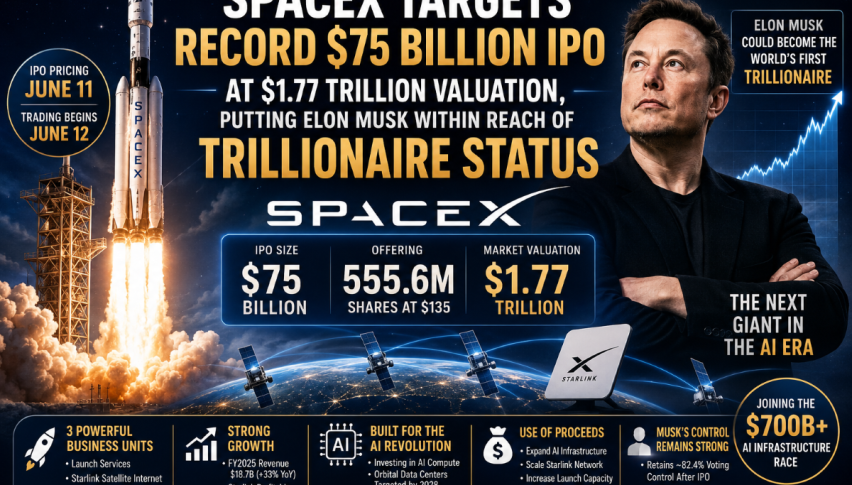
- SpaceX is preparing for a historic IPO, aiming to raise $75 billion at a valuation of approximately $1.8 trillion, which would make it one of the most valuable publicly traded companies.
- The IPO is set for June 11, with shares priced at $135 each, potentially eclipsing Saudi Aramco's 2019 record IPO.
- SpaceX's business model now includes space launch services, Starlink satellite broadband, and artificial intelligence infrastructure, with Starlink being a significant profit driver.
- Despite generating $18.7 billion in revenue, SpaceX reported a net loss of $4.9 billion, raising questions about whether it can sustain its high valuation.
SpaceX is preparing for what could become the largest initial public offering in history, seeking to raise $75 billion at a valuation approaching $1.8 trillion as Elon Musk’s space company attempts to redefine both the aerospace and artificial intelligence industries.
The company plans to price its IPO on June 11 and begin trading on June 12, offering 555.6 million shares at $135 each. If completed at that level, the deal would eclipse Saudi Aramco’s 2019 IPO, which raised $25.6 billion, and immediately rank SpaceX among the world’s most valuable publicly traded companies.
The proposed valuation of roughly $1.77 trillion would place SpaceX behind only a handful of mega-cap technology giants. It would also cement the company as one of the most significant beneficiaries of the global AI infrastructure boom.
SpaceX IPO Is Musk’s Biggest Financial Milestone Yet
The IPO could move Elon Musk closer to becoming the world’s first trillionaire.
Musk is not expected to sell shares in the offering and would retain approximately 82.4% voting control after the listing. Forbes currently estimates his net worth at more than $800 billion, with SpaceX accounting for a substantial portion of that value.
At a $1.77 trillion valuation, Musk’s SpaceX stake alone would be worth well over $500 billion.
The proposed listing represents a dramatic transformation for a company founded in 2002 with the ambitious goal of making humanity a multi-planetary species.
Today, SpaceX has evolved into a sprawling technology conglomerate spanning launch services, satellite communications, artificial intelligence infrastructure, and advanced semiconductor development.
SPCX Investors Are Buying More Than Rockets
The SpaceX investment story extends far beyond launch vehicles.
The company’s business now rests on three major pillars:
- Space launch and transportation
- Starlink satellite broadband
- Artificial intelligence and orbital computing infrastructure
Starlink has emerged as the company’s most important commercial asset. The satellite internet network generates the majority of SpaceX’s profits and continues expanding globally.
Meanwhile, the company’s AI ambitions are becoming increasingly central to its valuation.
SpaceX recently integrated xAI into its broader ecosystem and has outlined plans to deploy orbital computing infrastructure, potentially creating AI data centers in space by 2028.
The company argues that space-based computing could eventually offer lower energy costs, improved cooling efficiency, and access to abundant solar power.
That vision places SpaceX at the intersection of two of the most powerful investment themes in the market: space commercialization and artificial intelligence.
AI Is Driving the SpaceX Valuation
SpaceX’s timing is no coincidence.
The IPO arrives as technology companies race to secure capital for AI infrastructure investments.
Alphabet recently announced plans to raise $80 billion to expand AI capacity. Anthropic has filed for its own IPO, while OpenAI is widely expected to pursue a public offering in the future.
Against that backdrop, SpaceX is positioning itself as an AI infrastructure company rather than simply an aerospace contractor.
The company plans to use IPO proceeds to:
- Expand AI compute infrastructure
- Scale Starlink satellite networks
- Increase launch capacity
- Enhance launch vehicles
- Fund orbital computing initiatives
- Repay portions of a $20 billion bridge loan
The company’s Terafab joint venture with Tesla further highlights Musk’s strategy of building a vertically integrated AI ecosystem.
Terafab aims to manufacture advanced semiconductors for autonomous vehicles, humanoid robots, AI systems, satellites, and future orbital data centers.
Wedbush analyst Dan Ives described SpaceX as a central component of Musk’s broader AI strategy, suggesting the company could eventually become part of an integrated AI ecosystem spanning Tesla, xAI, Starlink, and SpaceX.
SpaceX (SPCX) Financials Reveal Both Opportunity and Risk
Despite investor enthusiasm, SpaceX remains loss-making.
The company generated approximately $18.7 billion in revenue during 2025, representing growth of roughly one-third from the previous year.
However, SpaceX reported a net loss of approximately $4.9 billion.
Those losses largely reflect aggressive investments in launch infrastructure, satellite deployment, AI development, and future growth initiatives.
The market appears willing to tolerate those losses because of the company’s growth profile.
Revenue continues accelerating, Starlink profitability is improving, and management believes future AI infrastructure demand could dramatically expand its addressable market.
Still, the valuation implies enormous expectations.
At nearly $1.8 trillion, investors are effectively pricing SpaceX as one of the dominant infrastructure providers of the AI era.
SPCX Stock’s S&P 500 Inclusion May Take Longer Than Expected
One potential disappointment for investors involves index inclusion.
While SpaceX’s size would likely make it one of the largest companies in the S&P 500, reports suggest immediate inclusion is unlikely.
Index rules typically require companies to demonstrate sufficient trading history and meet additional eligibility criteria before joining the benchmark.
That means passive investment funds may not become major buyers immediately after the IPO.
Nevertheless, the company is expected to become a future candidate for inclusion due to its enormous market capitalization and anticipated trading liquidity.
Demand Appears Extraordinary
Early signs suggest investor demand is exceptionally strong.
According to Reuters, SpaceX has informed banks that it intends to maintain the proposed $135 share price despite overwhelming interest during the roadshow process.
Sources described demand as “insatiable,” with analysts reportedly handling significantly more investor inquiries than typical large IPOs.
The enthusiasm reflects both the scarcity value of SpaceX shares and broader investor appetite for AI-related assets.
After several years of muted IPO activity, SpaceX’s debut may become a defining moment for public markets.
Should You Invest in SpaceX IPO?
SpaceX’s IPO represents far more than a traditional public listing.
The deal is a referendum on Musk’s vision of the future: reusable rockets, global satellite connectivity, artificial intelligence infrastructure, and eventually computing platforms extending beyond Earth itself.
At $75 billion, it would become the largest IPO ever completed.
At $1.77 trillion, it would immediately rank among the world’s most valuable companies.
And for investors, the offering provides something markets have rarely seen: direct exposure to one of the most ambitious technology platforms ever assembled under a single corporate umbrella.
The challenge now is whether SpaceX can grow fast enough to justify one of the richest valuations in modern market history.
- Check out our free forex signals
- Follow the top economic events on FX Leaders economic calendar
- Trade better, discover more Forex Trading Strategies
- Open a FREE Trading Account
- Read our latest reviews on: Avatrade, Exness, HFM and XM

Related Articles
Sidebar rates

Related Posts
 Save
Save