Top Earnings to Watch This Week, July 27-31: What to Expect From MSFT, META, AAPL, AMZN, KO, BA, and F
Big Tech and industrial heavyweights report earnings July 27–31, 2026. What to expect from MSFT, META, AAPL, AMZN, KO, BA, and F this week.
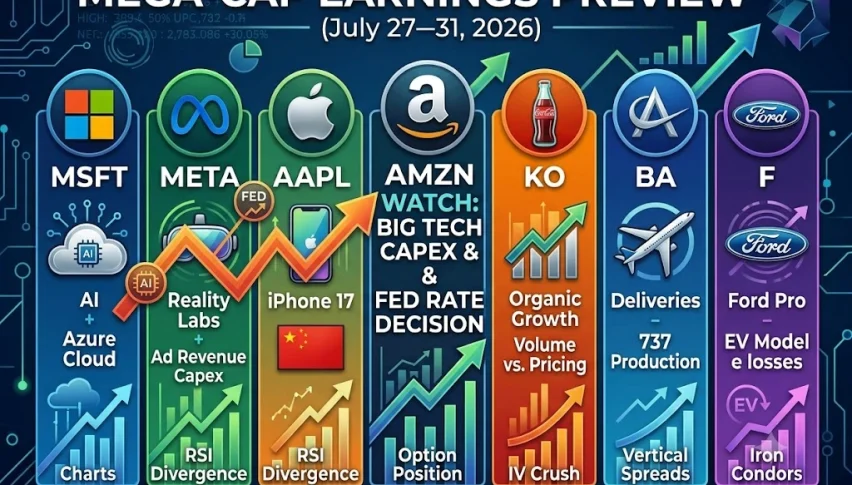
Quick overview
- Wall Street is set for a crucial earnings week from July 27-31, featuring major companies like Microsoft, Apple, and Amazon alongside key economic data releases.
- Investors are particularly focused on capital expenditures and margin resilience in the tech sector, with Microsoft and Amazon's spending under scrutiny.
- Ford, Boeing, and Coca-Cola will also report earnings, with analysts adjusting expectations due to cautious market conditions and operational challenges.
- The Federal Reserve's rate decision and June Core PCE inflation data will further influence market reactions to these earnings reports.
Wall Street faces its most pivotal stretch of Q2 2026 earnings from July 27–31. Seven major corporate titans—Microsoft (MSFT), Meta Platforms (META), Apple (AAPL), Amazon (AMZN), Coca-Cola (KO), Boeing (BA), and Ford Motor (F)—will release results alongside the Federal Reserve’s rate decision on Wednesday and June Core PCE inflation data on Thursday. Big Tech’s ballooning capital expenditure ($200B+ annual pacing) and margin resilience amid high interest rates remain the key focal points for investors.
1. Tuesday, July 28: Industrials & Consumer Staples Take the Stage
Ford Motor (NYSE: F)
-
Report Time: Tuesday, July 28 (After Market Close)
-
Consensus EPS: $0.33 (down 10.8% YoY)
-
Consensus Revenue: $45.72 billion (down 2.6% YoY)
Analysts have trimmed Q2 EPS estimates by 5.3% over the past month, reflecting execution caution. Pay close attention to commercial fleet performance in the Ford Pro division (projected revenue of $18.41 billion and adjusted EBIT of $1.68 billion) versus electric vehicle losses in Ford Model e (projected revenue of $1.62 billion, down 31.3% YoY). Ford Blue legacy internal-combustion revenues are pegged at $25.71 billion.
Wall Street has revised EPS downward by 5.3% over the past 30 days, lowering the hurdle for a beat. The core spread to trade is Ford Pro ($1.84B EBIT estimate) vs. Model e EV losses (-31.3% YoY revenue drop). Shares have demonstrated short-term strength (+4.2% over the last month). Look for momentum above key resistance if Ford Pro margins surprise to the upside; downside risk centers on EV cash burn commentary.
Boeing Co. (NYSE: BA)
-
Report Time: Tuesday, July 28 (Before Market Open)
-
Consensus EPS: -$0.34 (Loss per share)
-
Consensus Revenue: $24.05 billion (+5.73% YoY)
Commercial jet deliveries rose 14% YoY in Q2, aided by 737 production stabilizing at 42 aircraft per month with a target of 47. However, engine supply bottlenecks on the 787 program and a heavy $47.2 billion debt load continue to weigh on cash flow. Look for operational margin recovery at Boeing Global Services and factory rework reductions (20% lower on 737 assembly).
Boeing carries a negative Earnings ESP (-17.41%) and trades at a forward P/S discount relative to peers. Operational momentum is improving—737 factory rework hours dropped ~20%, and delivery growth hit 14% YoY. However, 787 engine bottlenecks and $47.2B in total debt remain major overhangs.
BA shares are down 5.4% over the past month. Options pricing reflects significant uncertainty. Range traders should monitor whether dips toward 200-day support attract buying, while breakout traders require clear delivery target confirmation to go long.
The Coca-Cola Company (NYSE: KO)
-
Report Time: Tuesday, July 28 (Before Market Open)
-
Consensus EPS: $0.93 (+6.9% YoY)
-
Consensus Revenue: $13.14 billion (+4.8% YoY)
As a premier defensive consumer staple, Coca-Cola’s core debate centers on organic growth breakdown—specifically whether top-line gains are driven by sustainable unit case volume or pricing actions that test consumer elasticity. Key watchpoints include North American consumer sentiment, input cost trends (sweeteners and packaging), and operating margin progression relative to last year’s strong 34.1%.
Analysts have quietly trimmed estimates by 1.1% over 90 days. The critical metric is the volume vs. price/mix decomposition; traders want to see if top-line growth comes from unit case volume or aggressive pricing that could trigger consumer pushback. KO serves as a macro hedge during tech-heavy volatility. A hold above $80.00 with organic volume expansion provides a low-beta defensive long opportunity for equity traders seeking shelter from hyperscaler capex swings.
2. Wednesday, July 29: AI Capex Under the Microscope
Microsoft Corp. (NASDAQ: MSFT)
-
Report Time: Wednesday, July 29 (After Market Close)
-
Consensus EPS: $4.24 (~15% YoY growth)
-
Consensus Revenue: $87.7 billion (guidance $86.7–$87.8B)
Closing out fiscal 2026, Microsoft faces intense market scrutiny over AI return on investment. The key benchmark is Azure cloud growth, where management guided for 39–40% constant-currency growth and investors expect a 36% “bogey” cleared. Investors will scrutinize projected FY2027 capital expenditure, modeled near $262 billion by analysts, against monetization from Copilot’s 20 million-plus paid seats.
MSFT is down nearly 20% over the past 52 weeks as investors aggressively penalize ballooning capital expenditures ($190B+ FY2026 pacing). The key binary trigger is Azure growth: management guided for 39–40% constant-currency growth. Any print below 36% risks triggering a sell-off regardless of headline EPS.
With MSFT’s forward P/E sitting near a multi-year low (20.6x), bad news is partially priced in. Options traders should watch for implied volatility (IV) crush post-announcement; defining risk via vertical call spreads or waiting for post-print price discovery reduces exposure to capex panic.
Meta Platforms (NASDAQ: META)
-
Report Time: Wednesday, July 29 (After Market Close)
-
Consensus EPS: $7.23
-
Consensus Revenue: $60.26 billion (+27% YoY; guidance $58–$61B)
Meta enters the print trading near record highs, supported by robust digital ad impressions (+19%) and ad pricing (+12%). However, capital spending is the main swing factor; following full-year 2026 capex guidance of $125–$145 billion, Wall Street will watch whether Reality Labs losses and expanding AI infrastructure costs compress operating margins below Q1’s 41.4%.
Ad demand remains strong (+19% impression growth), but META trades as an AI infrastructure story. The single swing factor is FY26 Capex guidance ($125B–$145B current range) and whether operating margins hold above Q1’s 41.4%. Key technical levels surround $620 (mid-band pivot) and $650 (resistance). A close above $650 with controlled capex targets opens a path toward $700; losing $600 exposes support at $575–$550.
3. Thursday, July 30: E-Commerce, Cloud, and Consumer Hardware
Amazon.com Inc. (NASDAQ: AMZN)
-
Report Time: Thursday, July 30 (After Market Close)
-
Consensus EPS: $1.82 (up from $1.68 YoY)
-
Consensus Revenue: $196.7 billion (guidance $194–$199B)
AWS growth is the primary driver after accelerating to 28% in Q1, with consensus looking for ~$40.5 billion in cloud revenue. Wall Street remains wary of Amazon’s expanding FY2026 capital expenditure target, now pacing over $200 billion, and its near-term squeeze on free cash flow relative to its swelling AI backlog. The market is focused on whether full-year capex projections will expand past the current $200B mark, squeezing short-term free cash flow.
AMZN has pulled back 7% over the last quarter. Options implied volatility drops an average of 31% immediately following earnings releases (IV Crush). Premium sellers may look to exploit elevated pre-earnings IV, while directional traders should demand an AWS growth acceleration above 28% before entering long positions.
Apple Inc. (NASDAQ: AAPL)
-
Report Time: Thursday, July 30 (After Market Close)
-
Consensus EPS: $1.88
-
Consensus Revenue: $110.0 billion (+14% to 17% YoY guidance)
Apple reports fiscal Q3 boosted by sustained iPhone 17 momentum and stabilizing Greater China sales. Revenue in the Services division (App Store, iCloud, Apple Intelligence subscriptions) is projected at a record $31–$32 billion. Investors will listen for guidance on component cost pressures, recent price adjustments, and commentary surrounding the upcoming leadership transition to John Ternus.
AAPL has surged ~20.5% YTD, hitting record highs near $335 following late-June price increases. Bearish RSI divergence on the daily chart warns that upward momentum is stretching. Focus falls on iPhone 17 upgrade cycles, Services revenue ($31B–$32B expected), and China demand recovery. Resistance rests at $335 (all-time high). Support zones sit at $315 and $300–$302. Buying dips near support after the event offers a cleaner risk/reward than chasing breakouts into elevated options pricing.
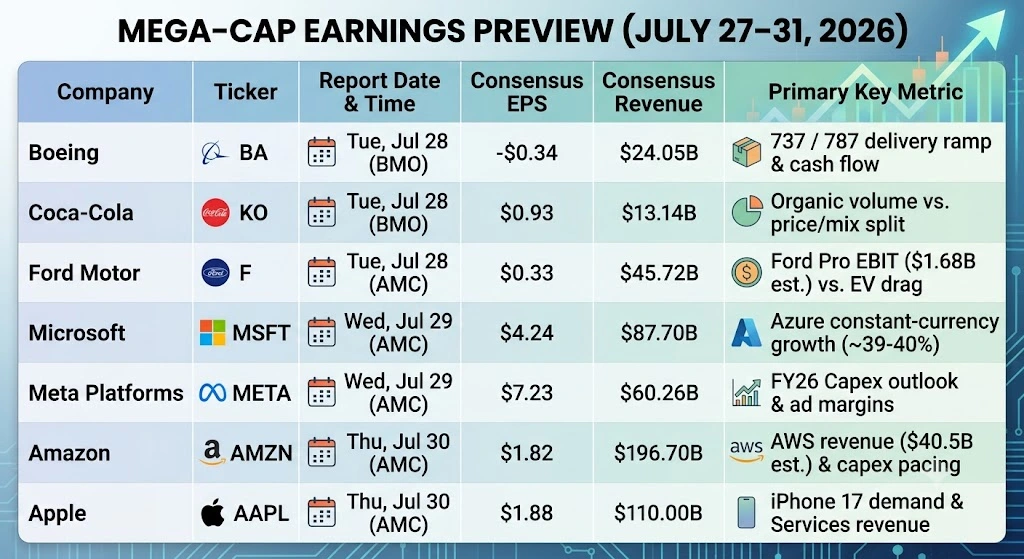
Earnings Preview and Consensus Estimates, July 27–31, 2026
| Company | Ticker | Report Date & Time | Consensus EPS | Consensus Revenue | Primary Key Metric |
| Boeing | BA |
Tue, Jul 28 (BMO) | -$0.34 | $24.05B | 737 / 787 delivery ramp & cash flow |
| Coca-Cola | KO |
Tue, Jul 28 (BMO) | $0.93 | $13.14B | Organic volume vs. price/mix split |
| Ford Motor | F |
Tue, Jul 28 (AMC) | $0.33 | $45.72B | Ford Pro EBIT ($1.68B est.) vs. EV drag |
| Microsoft | MSFT |
Wed, Jul 29 (AMC) | $4.24 | $87.70B | Azure constant-currency growth (~39-40%) |
| Meta Platforms | META |
Wed, Jul 29 (AMC) | $7.23 | $60.26B | FY26 Capex outlook & ad margins |
| Amazon | AMZN |
Thu, Jul 30 (AMC) | $1.82 | $196.70B | AWS revenue ($40.5B est.) & capex pacing |
| Apple | AAPL |
Thu, Jul 30 (AMC) | $1.88 | $110.00B | iPhone 17 demand & Services revenue |
Macro Context: FOMC Rate Decision & June Core PCE
Corporate earnings will not report in a vacuum this week:
-
Fed Rate Decision (Wed, July 29): The FOMC is overwhelmingly expected to hold benchmark rates at 3.50%–3.75%. Markets will scrutinize Chair Kevin Warsh’s press conference for signals on whether a September rate hike remains on the table following recent energy price spikes.
-
June Core PCE Inflation (Thu, July 30): The Fed’s preferred inflation metric is expected to show an annual core rate of 3.4%. A month-over-month print of 0.2% or lower is required to reassure markets that inflation remains on a downward trajectory.
How to Trade Earnings This Week: Actionable Positioning Strategy
To navigate this high-catalyst week effectively, traders should structure positions around three key rules:
1. Harness the Implied Volatility (IV) Crush
Options pricing is inflated across MSFT, META, and AMZN ahead of earnings. Purchasing naked long calls or puts right before the print subjects your position to immediate volatility collapse the moment numbers drop.
Utilize vertical spreads (debit or credit) or iron condors to offset high Vega risk, or wait 15–30 minutes post-market open the day after earnings to enter directional momentum plays after IV resets.
2. Isolate Macro Cross-Currents (Fed & Core PCE)
Wednesday’s FOMC decision (3:00 PM ET) and Thursday’s June Core PCE print (8:30 AM ET) will drive broad index beta (SPY, QQQ). A hawkish tone from Chair Warsh or a hot PCE print (>0.2% MoM) could suppress stock-specific earnings beats across tech.
Avoid holding over-leveraged directional index futures into Wednesday afternoon. Keep position sizes 25–30% smaller than average until Thursday morning’s PCE print provides macro clearance.
3. Trade the Capex Narrative, Not Just the Headline Beat
Recent market action in Alphabet and Tesla shows that beating top-line EPS is no longer sufficient if capital expenditures blow past estimates. Wall Street is actively punishing free cash flow compression.
If MSFT or AMZN beat earnings but raise FY26/FY27 capex guidance significantly without clear AI revenue offset, prepare for immediate short-side or put-spread opportunities on intraday rallies.
- Check out our free forex signals
- Follow the top economic events on FX Leaders economic calendar
- Trade better, discover more Forex Trading Strategies
- Open a FREE Trading Account
- Read our latest reviews on: Avatrade, Exness, HFM and XM

Related Articles



Sidebar rates

Related Posts
 Save
Save