TSLA Slides Toward $360 on Tesla Earnings Miss, Negative Cash Flow and AI Spending Alarm Investors
Tesla stock TSLA slides as weak earnings, negative cash flow and surging AI spending overshadow record Q2 revenue and vehicle deliveries.
Quick overview
- Tesla shares fell over 3% after second-quarter earnings missed expectations, highlighting concerns over weakening margins and negative free cash flow.
- Despite reporting a revenue increase to $28.24 billion, adjusted earnings of $0.33 per share significantly missed analysts' forecasts.
- Operating expenses surged 47% year-over-year as Tesla ramped up investments in AI and robotics, leading to a decline in operating margin to just 1.4%.
- Investors are increasingly focused on the financial implications of Tesla's ambitious AI and robotics strategy, with the $360 support level becoming critical for the stock.
Tesla shares fell sharply in overnight trading after second-quarter earnings missed expectations, with weakening margins, negative free cash flow and rapidly rising AI investment overshadowing record vehicle deliveries and stronger-than-expected revenue.
Tesla shares came under renewed selling pressure after the electric vehicle manufacturer delivered a mixed second-quarter report that highlighted the growing financial cost of Elon Musk’s transition toward artificial intelligence, autonomous driving and robotics.
Tesla Stock Falls Toward $360 as Earnings Miss Overshadows Revenue Beat
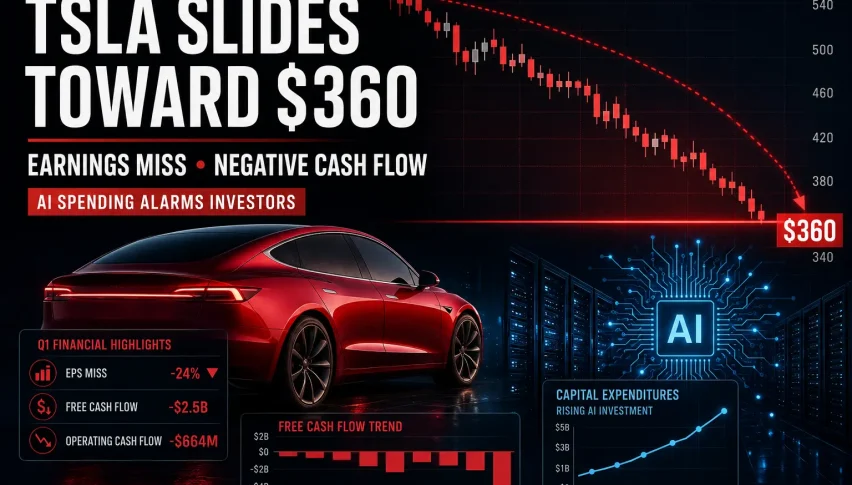
Tesla shares dropped more than 3% in extended trading, falling from a regular-session close near $374 toward the $360 region after investors focused on weaker profitability and negative free cash flow.
The market reaction came despite Tesla reporting revenue of $28.24 billion, comfortably above Wall Street expectations and 26% higher than during the same quarter last year.
However, adjusted earnings of $0.33 per share missed analysts’ forecasts near $0.51 by a wide margin.
Net profit declined 5% year-over-year to $1.11 billion, while GAAP operating income fell sharply as expenses connected to artificial intelligence, robotics and other development projects increased.
The earnings reaction suggests investors are becoming less willing to reward revenue growth when it comes with falling margins and rapidly increasing spending commitments.
Tesla’s long-term strategy remains ambitious, but shareholders increasingly want evidence that its AI investments can generate meaningful returns before profitability deteriorates further.
Revenue Growth Fails to Protect Profitability
Tesla’s underlying business delivered strong top-line growth during the quarter.
Automotive revenue increased 23% year-over-year to $20.52 billion, supported by stronger deliveries and increased sales of lower-cost Model 3 and Model Y vehicles.
Energy generation and storage revenue rose 13% to $3.14 billion, while services revenue also expanded as Tesla’s global vehicle fleet continued growing.
However, the shift toward cheaper vehicles placed additional pressure on profitability.
Tesla’s overall gross margin declined to 16.8%, below the 19.4% level analysts had expected. Automotive gross margin excluding regulatory credits fell to approximately 16.3%.
The company sold more affordable versions of the Model 3 and Model Y after ending production of its higher-priced Model S and Model X vehicles.
That strategy helped support volume but reduced the average selling price per vehicle.
For Tesla, the challenge is increasingly clear.
Higher sales are no longer enough. Investors want the company to demonstrate that expanding deliveries can generate stronger earnings rather than simply adding lower-margin revenue.
Operating Expenses Surge as Tesla Funds AI Ambitions
Tesla’s operating expenses increased 47% year-over-year to approximately $4.35 billion, significantly faster than revenue growth.
Research and development spending climbed as the company accelerated investment across Robotaxi, Full Self-Driving, Optimus robotics, semiconductor manufacturing and AI computing infrastructure.
As a result, Tesla’s operating margin fell to just 1.4%, down from 4.1% during the same quarter last year.
The decline represents one of the clearest signs that Tesla’s strategic transition is placing pressure on its current earnings base.
Management argues that this investment is necessary to build future businesses capable of generating software-like margins and recurring revenue.
However, these operations remain at an early stage.
Robotaxi coverage is still limited, Optimus has not entered large-scale commercial production, and the timing of meaningful autonomous-driving revenue remains uncertain.
Until those businesses begin contributing substantial profits, Tesla must continue relying heavily on automotive revenue to finance its broader technology ambitions.
Negative Free Cash Flow Becomes the Biggest Warning
The most concerning part of Tesla’s earnings report was the sharp deterioration in free cash flow.
Tesla recorded negative free cash flow of approximately $1.09 billion, compared with positive free cash flow of $146 million a year earlier and $1.44 billion during the previous quarter.
Operating cash flow remained relatively strong at $4.70 billion, but capital expenditure more than doubled to $5.79 billion.
That spending pushed free cash flow into negative territory for the first time in more than two years.
Tesla expects full-year capital expenditure to exceed $25 billion as it funds AI computing capacity, Robotaxi infrastructure, Optimus production lines, battery manufacturing, semiconductor facilities and other projects.
The company still maintains a substantial liquidity position, with more than $43 billion in cash, equivalents and short-term investments.
Nevertheless, the cash burn raises an important question for investors: how long can Tesla sustain this level of spending before its emerging businesses begin generating returns?
Unlike some major technology companies funding AI infrastructure, Tesla does not currently have a large, high-margin cloud or advertising business supporting its investment cycle.
That makes the company’s spending strategy potentially more sensitive to further margin pressure or weaker automotive demand.
Record Vehicle Deliveries Offer Some Support
Tesla’s operating performance was not entirely negative.
The company delivered approximately 480,126 vehicles during the quarter, an increase of around 25% from the same period last year and a new second-quarter record.
Model 3 and Model Y deliveries accounted for the overwhelming majority of sales, while inventory declined to around 15 days of supply.
The improvement suggests that lower-priced models and stronger international demand helped stabilize vehicle sales following previous periods of weakness.
Tesla also deployed 13.5 GWh of energy storage products, representing one of the strongest quarters in the history of its battery business.
Full Self-Driving subscriptions reached approximately 1.48 million, increasing 56% year-over-year.
These figures provide evidence that Tesla’s ecosystem continues expanding.
However, strong deliveries offered limited support to the stock because investors remained focused on the amount of spending required to generate future growth and the weaker margins attached to current vehicle sales.
Robotaxi and Optimus Become Central to Tesla’s Valuation
Tesla increasingly wants investors to evaluate the company as an artificial intelligence and robotics platform rather than a conventional automaker.
The Robotaxi business expanded into additional U.S. markets during the quarter, while production of the purpose-built Cybercab began at Gigafactory Texas.
Tesla also continued increasing AI computing capacity to support autonomous-driving development.
Meanwhile, the company is converting former Model S and Model X production space at Fremont into manufacturing capacity for the Optimus humanoid robot.
Musk again described Optimus as potentially Tesla’s largest product, although he acknowledged that building a reliable autonomous humanoid robot and scaling production remain extremely difficult.
That tension remains central to Tesla’s investment case.
Robotaxi and Optimus could eventually create enormous new markets, but the commercial timeline remains uncertain.
For a company already spending more than $25 billion annually, investors may become increasingly impatient unless Tesla provides measurable progress in paid autonomous miles, Robotaxi fleet expansion, software revenue and robot production.
TSLA Technical Analysis: $360 Becomes the Immediate Support Test
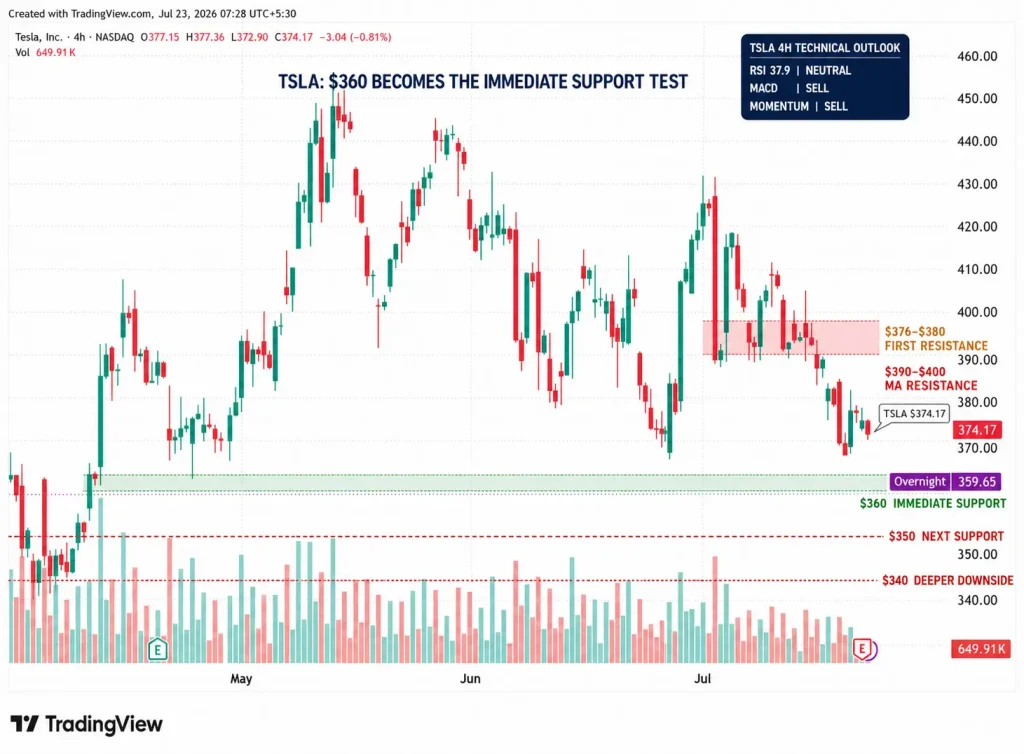
Tesla’s four-hour technical picture remains bearish following the earnings selloff, with TSLA trading below every major moving average.
Immediate support sits around $360, where overnight trading is testing buyer demand. A decisive break could expose the $350 psychological level, followed by deeper downside toward $340.
The first resistance is near the Hull moving average at $376, followed by the 10-period averages around $380. Stronger resistance sits between $386 and $400, where the 20, 30, 50, 100 and 200-period moving averages are concentrated.
Momentum also favors sellers. MACD and Momentum remain on sell signals, while the RSI at 37.9 reflects weak momentum without confirming oversold conditions.
For sentiment to improve, buyers need to reclaim $376-$380 first. A stronger reversal would require TSLA to move back above the heavier $390-$400 resistance zone.
Tesla’s Investment Cycle Faces a Critical Test
Tesla’s second-quarter results demonstrate the growing divide between its current financial performance and its long-term technology ambitions.
Revenue growth, record deliveries, rising FSD subscriptions and energy-storage expansion show that the company continues making operational progress.
However, falling margins, weak earnings and negative free cash flow show that the transition toward AI, autonomy and robotics will be expensive.
Tesla may eventually benefit from recurring software revenue, autonomous fleets and humanoid robotics, but investors must decide how much uncertainty they are willing to tolerate before those opportunities become profitable.
For now, the market appears more concerned about the cost of Tesla’s ambitions than the size of the potential reward.
Until the company demonstrates that record capital spending is translating into stronger margins, sustainable free cash flow and meaningful AI revenue, TSLA may remain under pressure, with the $360 support level becoming the next major battleground for buyers and sellers.
- Check out our free forex signals
- Follow the top economic events on FX Leaders economic calendar
- Trade better, discover more Forex Trading Strategies
- Open a FREE Trading Account
- Read our latest reviews on: Avatrade, Exness, HFM and XM

Related Articles


Sidebar rates

Related Posts
 Save
Save