UBER Stock Slips 1.7% as AI Job Cuts and $14.8 Billion Delivery Hero Deal Raise Execution Risks
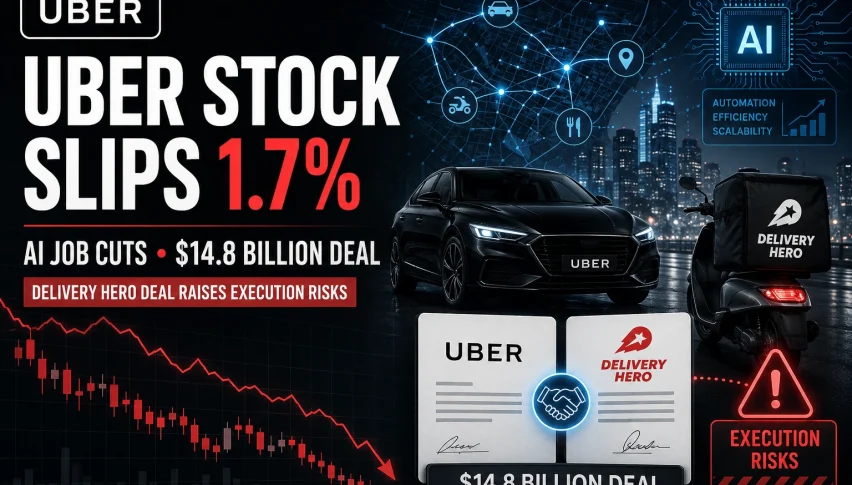
Uber stock falls 1.7% as AI-linked job cuts and its $14.8 billion Delivery Hero takeover raise execution risks before Q2 earnings.
Quick overview
- Uber's stock is under pressure as investors evaluate the impact of AI-driven cost reductions against risks from its Delivery Hero acquisition.
- The company is cutting 10% of its community operations workforce to streamline operations and enhance AI adoption, marking a significant shift in its strategy.
- Uber's proposed acquisition of Delivery Hero aims to create the largest food-delivery platform outside China, but it faces integration challenges and regulatory scrutiny.
- The upcoming earnings report on August 5 will be crucial for assessing Uber's financial health and the effectiveness of its recent restructuring efforts.
Uber Technologies shares moved lower as investors weighed the near-term benefits of AI-driven cost reductions against the integration and regulatory risks surrounding the company’s largest acquisition. With second-quarter earnings approaching, the stock is testing an important technical support zone near $70.
Uber shares remained under pressure after the ride-hailing company announced another round of workforce reductions while simultaneously pursuing a major expansion of its global delivery business.
UBER declined to $70.33 during Wednesday’s regular session, representing a loss of 1.71%, before recovering modestly in overnight trading.
The latest developments illustrate the two sides of Uber’s current strategy.
Internally, the company is simplifying operations, slowing hiring and using artificial intelligence to reduce costs. Externally, it is committing billions of dollars to food delivery, autonomous vehicles and industrial automation.
That combination could strengthen long-term growth and profitability, but it also creates significant execution risk ahead of Uber’s second-quarter results on August 5.
Uber Cuts Customer-Service Jobs as AI Adoption Accelerates
Uber is eliminating approximately 10% of the positions in its community operations division, which handles customer service, driver support and other platform-related issues.
The company described the move as part of an effort to simplify operations, improve in-person collaboration and continue adopting AI.
Remote employees within the affected organization have reportedly been asked to relocate to designated office hubs under Uber’s return-to-office policy.
Management acknowledged that the community operations department had become too complex and divided across separate teams. While the company had already made progress in using AI, it said those tools could not be deployed effectively on top of fragmented processes.
The reductions represent Uber’s second restructuring in less than two months. In June, it cut approximately 23% of its people division, although those positions accounted for less than 1% of Uber’s roughly 34,000 global employees.
The latest cuts are particularly significant because they mark the first time Uber has directly linked a workforce reduction to an AI efficiency program.
For investors, the immediate financial argument is straightforward.
Customer support is a large operational expense for a platform that processes millions of rides and deliveries. AI systems can potentially handle routine questions, payment issues and basic account inquiries more quickly and at a lower cost than traditional support teams.
However, customer-service automation is not risk-free.
Uber must also manage safety complaints, driver disputes, lost property, fraudulent transactions and urgent delivery problems. Poorly designed AI systems could increase frustration, weaken customer loyalty or expose the company to additional regulatory scrutiny.
The success of the restructuring will therefore depend on whether automation improves service efficiency without damaging the user experience.
Uber Is Cutting Support Roles but Still Hiring Engineers
The layoffs do not represent a broad withdrawal from investment.
Uber said earlier this year that it would slow hiring because of productivity gains from internal AI tools. However, the company still lists hundreds of open positions, including engineering jobs supporting autonomous vehicles and robotaxi partnerships.
This suggests Uber is reallocating spending rather than simply reducing it.
The company is cutting positions in areas where repetitive work can be automated while continuing to hire for technologies that could reshape its long-term business model.
Autonomous vehicles remain especially important.
Instead of attempting to build every self-driving system internally, Uber is positioning its app as a distribution and fleet-management platform for multiple robotaxi developers.
If that strategy succeeds, Uber could gain access to autonomous vehicles without carrying the full cost and technical risk of developing the cars itself.
The company’s AI strategy therefore has two objectives: improving the efficiency of existing operations and strengthening its position in the future of transportation.
Delivery Hero Acquisition Reshapes Uber’s Global Footprint
Uber’s proposed takeover of Delivery Hero is the more consequential development for shareholders.
The company has offered €41.50 per share for the German delivery group, valuing Delivery Hero at approximately $14.8 billion, or $13.7 billion after adjusting for Uber’s existing stake. Uber expects the transaction to add to non-GAAP earnings per share immediately after completion and produce high-single-digit percentage accretion by the third year.
If approved, the acquisition would create the largest food-delivery platform outside China.
Delivery Hero operates across dozens of markets through regional brands including foodpanda and Baedal Minjok. The transaction would expand Uber’s reach across Asia, Europe, the Middle East, Africa and Latin America.
Uber’s strategic goal is not limited to adding more food-delivery orders.
The company wants to increase the number of markets where customers can use the same platform for transportation, restaurant delivery, groceries and other local services.
Consumers who use both ride-hailing and delivery tend to interact with the app more frequently. They may also be more likely to subscribe to Uber One, the company’s membership program.
By combining those services, Uber can spread marketing, payments, maps, logistics technology and customer acquisition costs across a larger number of transactions.
The expanded group would also place Uber in a stronger competitive position against DoorDash, Just Eat and other international delivery platforms. The companies together generated approximately $236 billion in gross bookings during 2025, according to figures reported after the announcement.
Deal Offers Scale but Creates Integration Risk
The Delivery Hero acquisition could generate substantial efficiencies.
Uber may be able to combine overlapping technology systems, reduce duplicated corporate functions and improve purchasing power with restaurants, retailers and advertisers.
A larger network could also strengthen Uber’s delivery advertising business.
Restaurants and consumer brands pay for visibility within delivery apps because users are often close to making a purchase. Those advertising revenues can carry higher margins than the delivery transaction itself.
However, the scale of the deal also creates considerable risk.
Delivery Hero operates across markets with different regulations, labor rules, consumer habits and competitive conditions. Integrating those businesses could take years and cost more than initially expected.
The deal must also clear regulatory reviews across numerous jurisdictions.
Delivery Hero has agreed to sell operations covering 14 markets to SSW Partners, partly reducing areas where the two companies overlap. The wider Uber transaction is expected to close in the second half of 2027.
Regulators may still investigate whether the combination would weaken competition, raise restaurant commissions or reduce options for delivery workers.
For investors, the key question is whether the long-term benefits of global scale will outweigh integration costs and antitrust concessions.
Uber Backs Kalanick’s Industrial AI Comeback
Uber is also participating in a $1.7 billion funding package for Atoms, an industrial AI and robotics business led by former Uber CEO Travis Kalanick.
Andreessen Horowitz is among the main equity backers, while Goldman Sachs and JPMorgan are involved as debt partners.
Atoms is focused on automating physical industries including mining, construction, food production and transportation. It has also acquired autonomous-driving company Pronto.
Uber’s investment is notable because it reconnects the company financially with its co-founder while giving it exposure to industrial robotics and autonomous transport.
The investment is unlikely to materially change near-term results, but it fits Uber’s broader effort to participate in technologies that connect AI with physical-world operations.
August 5 Earnings Become the Next Major Test for UBER Stock
Uber will discuss its second-quarter 2026 financial results on August 5 at 8:00 a.m. Eastern Time.
The company previously guided for second-quarter gross bookings of approximately $56.25 billion at the lower end of its projected range.
Investors will focus on mobility growth, delivery demand, adjusted EBITDA and free cash flow.
Management will also face questions about financing the Delivery Hero acquisition, expected integration costs and the timing of projected earnings benefits.
Any update on autonomous-vehicle partnerships will be closely watched, particularly as investors assess whether robotaxis will support Uber’s platform or eventually compete with its existing driver network.
The earnings call may also provide the first detailed explanation of how recent AI-driven workforce changes will affect operating expenses.
UBER Technical Analysis: $70 Is the Key Support Level
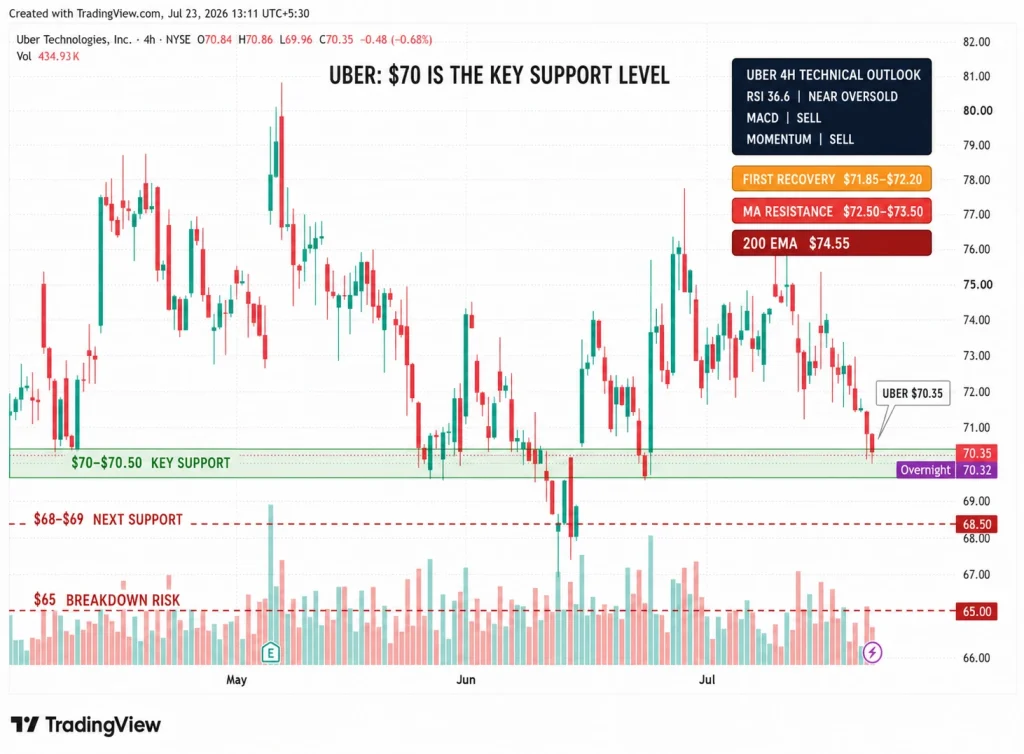
Uber’s four-hour technical setup remains bearish after the latest decline.
The stock is trading below every major moving average listed in the current TradingView setup, confirming that short-term momentum remains under pressure.
Immediate support sits between $70 and $70.50, where the overnight price is trading close to the Hull Moving Average at $70.53.
A sustained break below $70 could expose the $68-$69 region. A deeper pullback may bring the psychological $65 level into focus.
On the upside, the first resistance sits near the 10-period EMA at $71.85 and the 10-period SMA at $72.20.
A much heavier resistance cluster runs from approximately $72.50 to $73.50. This area contains the 20, 30, 50 and 100-period moving averages, the VWMA and the Ichimoku baseline.
The 200-period EMA at $74.55 represents the next major barrier.
Momentum remains weak. RSI stands at 36.64, while Momentum and MACD both show sell signals. Stochastic, Stochastic RSI and Williams %R are close to oversold territory, suggesting the decline may be stretched, but there is no confirmed reversal yet.
A move above $72 would provide the first sign of stabilization. Bulls would then need to reclaim the broader $73-$74.50 zone to shift the four-hour trend back toward neutral.
Can AI Savings Offset Uber Delivery Hero Risk?
Uber is attempting to become leaner and larger at the same time.
AI-driven automation may lower customer-service costs and improve operating leverage. The Delivery Hero acquisition could create an unmatched international delivery network and open additional opportunities in subscriptions, advertising and cross-platform engagement.
The challenge is execution.
Uber must integrate a complex global business, secure regulatory approval, maintain service quality and continue preparing for autonomous transportation.
The August 5 earnings report will need to demonstrate that the company’s existing mobility and delivery operations remain strong enough to finance those ambitions.
Until then, $70 remains the immediate technical line bulls need to defend.
A recovery above $74.50 would materially improve the chart, while a sustained break below $70 could extend the current decline toward $68 and potentially $65.
- Check out our free forex signals
- Follow the top economic events on FX Leaders economic calendar
- Trade better, discover more Forex Trading Strategies
- Open a FREE Trading Account
- Read our latest reviews on: Avatrade, Exness, HFM and XM

Related Articles

Sidebar rates

Related Posts
 Save
Save