NVDA Stock Outlook: Nvidia Rebound Offers Relief as AI Bubble Faces Tougher Questions
Nvidia shares have rebounded more than 3% toward $215 after recently approaching the critical $200 level, but stretched valuations, rising competition, supply pressures, and geopolitical risks continue to create a more cautious outlook for the AI chip leader.
Quick overview
- Nvidia shares have rebounded over 3% to around $215 after approaching the critical $200 level, but concerns about valuation and competition persist.
- The company faces challenges from rising supply pressures and geopolitical risks, particularly regarding export controls to China.
- Investors are questioning the sustainability of AI infrastructure spending, which is crucial for Nvidia's long-term growth outlook.
- While Nvidia remains a leader in AI computing, the stock's recent volatility reflects growing caution among investors.
Nvidia shares have rebounded more than 3% toward $215 after recently approaching the critical $200 level, but stretched valuations, rising competition, supply pressures, and geopolitical risks continue to create a more cautious outlook for the AI chip leader.
Nvidia Stock Rebounds Above $215 as AI Growth Risks Remain
Nvidia stock is showing renewed strength after a recent pullback toward the psychologically important $200 level, with shares climbing more than 3% to around $215 as broader market conditions stabilize.
The rebound offers some relief for investors who had grown increasingly concerned about the sustainability of Nvidia’s extraordinary rally. Lower inflation pressures and a more stable macroeconomic backdrop have helped improve risk appetite, allowing capital to flow back toward major technology stocks.
However, the recovery does not eliminate the growing risks surrounding Nvidia.
The semiconductor giant remains the dominant force in AI computing, but investors are becoming more cautious about its valuation, the sustainability of massive AI infrastructure spending, growing competition, geopolitical restrictions, and increasing pressure on the company’s supply chain.
The latest rebound therefore needs to be viewed carefully. Nvidia may still have substantial long-term growth potential, but the market appears less willing to assign unlimited value to that potential.
Valuation Concerns Return After Nvidia’s Massive Rally
One of the biggest challenges facing Nvidia is the sheer scale of expectations embedded in its share price.
The company’s previous gains were driven by explosive demand for AI accelerators, enormous data center investments, and expectations that cloud providers would continue spending aggressively on AI infrastructure.
That narrative remains intact to a large extent, but investors are now asking whether the current pace of growth can continue indefinitely.
Recent hawkish signals from the Federal Reserve have added another layer of uncertainty. Higher Treasury yields can increase discount rates applied to future earnings, putting pressure on companies whose valuations depend heavily on aggressive long-term growth assumptions.
This creates a more difficult environment for high-multiple technology stocks.
Nvidia’s rebound toward $215 suggests buyers remain interested, but the recent move toward $200 shows that the stock is no longer immune to broader valuation concerns.
Nvidia Faces Supply Pressures From Its Own AI Boom
The extraordinary demand for AI hardware may also be creating unexpected challenges for Nvidia.
The company has reportedly raised prices on several Jetson computer-on-module products amid component shortages. Some price increases have been substantial, with certain products reportedly experiencing increases of more than 100%.
The reported adjustments include higher prices for Jetson modules and developer kits, following the discontinuation of selected models.
While these products represent only a small portion of Nvidia’s overall business, the developments highlight a broader issue: the explosive demand generated by the AI boom is putting significant pressure on the semiconductor supply chain.
If shortages continue, Nvidia could face higher component costs, production constraints, or delays affecting certain product lines.
The company has benefited enormously from strong AI demand, but maintaining that growth requires a complex supply chain capable of supporting rapidly increasing global demand.
China and Export Controls Create Another Risk
Geopolitical tensions remain a significant uncertainty for Nvidia.
White House official Michael Kratsios has accused Chinese AI company Moonshot AI of illicitly obtaining restricted Nvidia GB300 chips through Thailand for AI model training and distillation of U.S. technology.
The allegations highlight the growing difficulty of enforcing U.S. restrictions on advanced semiconductor exports.
For Nvidia, tighter enforcement could have complicated consequences.
China remains a major technology market, and increasingly restrictive export controls could limit Nvidia’s ability to sell its most advanced products in the region.
At the same time, allegations of export-control circumvention could lead to additional scrutiny of Nvidia’s distribution channels and international supply chain.
The situation introduces another layer of regulatory uncertainty for investors already concerned about Nvidia’s exposure to geopolitical tensions.
Technical Picture Reflects Volatility
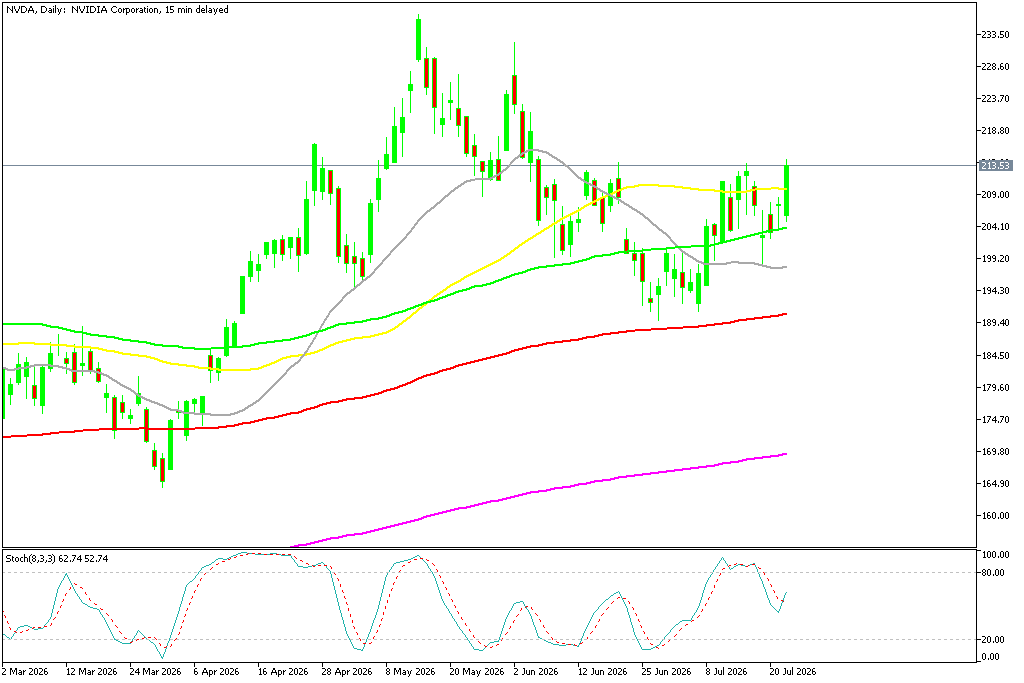
Nvidia’s technical setup mirrors the shifting sentiment. The stock slipped to its 20-day simple moving average (gray) in early May, but reversed back up, so it provided reliable support and NVDA reached a high of $236 before earnings. But then the stock reversed down and sellers headed to the 100 SMA again just above $200 which was broken and opened the door for $230s.
NVDA Chart Daily – Failing at the 50 SMA
Hyperscalers Challenge Nvidia’s Data Center Dominance
Nvidia also faces a long-term competitive threat from its biggest customers.
Major cloud companies are investing heavily in custom-designed chips and application-specific integrated circuits designed to reduce their dependence on external semiconductor suppliers.
Nvidia remains the leading provider of AI GPUs, but the development of proprietary silicon could gradually reduce demand for Nvidia hardware in certain workloads.
The risk is particularly important because the world’s largest technology companies are also among Nvidia’s biggest customers.
If these companies successfully develop more powerful internal chips, Nvidia could eventually face pressure on its market share and pricing power.
This does not necessarily represent an immediate threat, but it could become increasingly important over the next several years.
AI Spending Cycle Faces Tougher Questions
The sustainability of the broader AI investment cycle is perhaps Nvidia’s biggest long-term concern.
Cloud providers and technology companies continue committing enormous sums to data centers and AI infrastructure.
However, investors are increasingly asking whether such spending can continue at its current pace.
The market ultimately needs evidence that AI infrastructure investments will generate sufficient revenue and profits for the companies purchasing Nvidia’s chips.
If cloud providers begin slowing capital expenditures because returns fail to meet expectations, Nvidia’s growth outlook could face significant pressure.
The company’s valuation therefore remains closely tied to the assumption that AI spending will remain elevated for years.
New Technology Must Now Deliver More Than Hype
Nvidia’s latest technology announcements are also facing higher expectations.
The company’s next-generation Vera Rubin platform is designed to deliver significant improvements in AI computing performance and large-scale infrastructure capabilities.
Chief Executive Officer Jensen Huang has positioned the technology as an important step forward for AI and scientific computing.
However, investors appear increasingly focused on financial results rather than technological breakthroughs alone.
New products must now demonstrate that they can generate meaningful incremental revenue and profitability. Simply maintaining technological leadership may no longer be enough to drive another major valuation expansion.
Nvidia Stock Outlook Remains Cautiously Constructive
Nvidia remains one of the strongest companies in the global semiconductor industry, with leading technology, strong financial performance, and substantial exposure to the continued expansion of AI computing.
The latest rebound toward $215 shows that investors have not abandoned the Nvidia story.
However, the recent test of $200 serves as a reminder that the stock is becoming increasingly sensitive to valuation concerns, macroeconomic shifts, geopolitical restrictions, supply pressures, and questions over the sustainability of AI infrastructure spending.
The immediate recovery is encouraging for Nvidia bulls, but the longer-term outlook is becoming more complicated.
If AI spending remains strong and Nvidia continues to defend its technological leadership, the stock could regain momentum. However, any meaningful slowdown in capital expenditure, intensification of competition, or escalation of China-related restrictions could quickly revive downside pressure.
For now, Nvidia’s rebound provides a degree of reassurance, but investors may need to remain cautious as the world’s leading AI chipmaker enters a phase where increasingly high expectations could make further gains harder to achieve.
- Check out our free forex signals
- Follow the top economic events on FX Leaders economic calendar
- Trade better, discover more Forex Trading Strategies
- Open a FREE Trading Account
- Read our latest reviews on: Avatrade, Exness, HFM and XM

Related Articles
Sidebar rates

Related Posts
 Save
Save